Cocaine dealer took Pokémon cards as payment as thieves target £300,000 haul
They were once the currency of the school playground, desperately coveted by kids who wanted to ‘catch ’em all’ – now Pokémon cards are being traded in Britain’s criminal underworld.
The sought-after collectables are being swapped for drugs, stolen to settle debts and targeted by thieves chasing increasingly valuable hauls.


This week, cocaine dealer Jack Young-Larter was jailed after accepting the collectables for drugs and encouraging customers to steal them to clear what they owed.
When police raided the 26-year-old’s home they found cocaine, cannabis, around £2,000 in cash and a box of rare cards.
Messages on his phone showed customers could pay by cash, bank transfer or Pokémon.
His extraordinary case comes as soaring prices have turned the childhood collectables into valuable, easily traded assets.
Across Europe, detectives have found high-value cards cropping up in organised crime investigations, while politicians in Japan are considering tighter controls amid fears the booming market is being exploited by criminals.
And in Britain, thieves are increasingly going straight to the source.
The Sun has identified at least 15 break-ins at businesses selling Pokémon and trading cards since Christmas Day, with more than £300,000 of cards and other stock reported stolen.


It is a crime which barely registered a year ago, but experts say the spate of thefts should raise questions about where the cards are ending up.
Dr Jonathan Gilbert, a financial crime expert at the University of the West of England, said the rise in raids should “most definitely” raise alarm bells for police investigating organised crime.
“You’ve got a high-value product, you sell it off,” he said.
“You can easily sell it. You don’t have to sell it through regulated art galleries or regulated entities.”
Dr Gilbert said criminals have long used valuable goods such as watches and artwork to hold and move money outside the banking system.
“The Pokémon card sounds a little bit abstract, but it’s not,” he said.
“It’s high value. It’s highly versatile. It can be easily concealed. It can travel around the world.
“There’s a global market for it as well and there’s no regulation.”
Then there is the amount they can be worth.
Analysis by UK collection tracker Cardfolio found more than four in five of 2,300 vintage English cards it examined had gone up in value in less than four months. The typical rise was around 15 per cent.
A top-grade Skyridge Charizard has almost doubled from around £36,000 to more than £70,000.
Some cards are worth millions.
YouTuber Logan Paul bought the only known perfect-grade Pikachu Illustrator in a $5.275million deal in 2021.
He later wore it around his neck in a diamond necklace at WrestleMania before selling it earlier this year for a record $16.492million, around £12million.
Oz Kara, founder of Cardfolio, said: “Cards that can’t be printed again, from the vintage era through to the most sought-after cards of a few years ago, are genuinely scarce in top condition.
“That’s where prices have run away, and individual cards now change hands for tens of thousands of pounds.
“That is also why they attract thieves. A card is small and portable, and an ungraded card has no serial number. A shoebox can hold the value of a car.”
Tracing a stolen card can also be difficult.
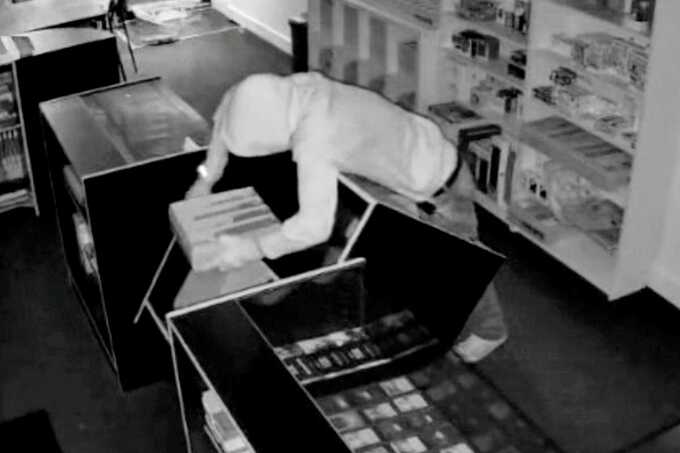
Ben Powell discovered that after three masked men smashed their way into his Full Fire TCG store in Gloucester in February and escaped with around 600 cards worth an estimated £25,000.


CCTV showed the raiders emptying cabinets of valuable graded cards while leaving other expensive stock behind.
“They knew exactly what they were looking for,” Ben said. “They kind of left a lot of stuff too. They didn’t want to take that.”
The cards they targeted had been professionally graded and placed inside plastic cases, known as slabs, carrying unique certification numbers.
Those numbers can be reported stolen and checked by another dealer.
But Ben explained: “You can crack a slab open and as soon as that card comes out of that slab, again, it becomes untraceable.”
The card itself carries no unique number.
Ben believes thieves could then have it graded again, giving it a new certification number before selling it on.
“It is exactly what I think happened to my cards,” he said.
Ben was also frustrated by what happened next.
A month after the raid, having heard little about the investigation, he made a complaint.
“Outside of the generic email that came back, absolutely nothing. Not even a phone call,” he said.
“Not even a ‘we’re still looking into it’. Not even a ‘we’re really sorry, we haven’t been able to do anything’.
“I haven’t had any ounce of anyone doing anything. And I know I’m not alone.”
He also questions whether forces are joining the dots between raids.
He said: “Instead of networking or working together and going, ‘Hang on a minute, we had three guys break into a shop in Manchester, and now we’ve had three guys break into a shop in Gloucester. This could be linked.’
“It almost seems like it doesn’t merit or warrant that.”
And it is not just shops being targeted.
Ben said a trader had their car broken into while packing up after a card show over the weekend.
“It’s not even just like its shops,” he said. “The crime with it is everywhere.”
Cards are also disappearing in the post.
Ben Thyer, owner of Bath TCG, has had dozens of packages go missing or arrive with the card removed since July.
He said: “We always get the odd parcel going missing, but because it was sporadic, we put that down to unfortunate incidents, but now it is a real problem.”
Dr Gilbert said the move into collectables follows a familiar pattern as criminals look beyond cash and bank accounts.
“There’s a broad trend now to exploiting more non-traditional and less regulated value stores, whether or not it’s paintings or watches,” he said.
“As law enforcement or the legal and regulatory frameworks tighten, the criminals need to be more adaptive.”
Police elsewhere in Europe are already finding Pokémon cards in major organised crime investigations.
Earlier this year, specialist detectives in Marbella smashed a criminal network accused of laundering millions in drug money through Pokémon cards.
During raids on the gang, officers discovered an album of valuable cards they believed formed part of the laundering operation.
The gang allegedly presented the collectables as a safe investment, taking advantage of a market where the rarest cards can sell for millions.
Police in Sweden are also seeing Pokémon cards crop up in criminal investigations.
Tamara Fuentes, of Sweden’s West Police Region, said: “We have found larger quantities of Pokémon cards in several investigations recently and we have also had several thefts of valuable cards in the region.”
Officers have also encountered large quantities of cards at border crossings.
Fuentes said much of the trade takes place privately through buying and selling sites, often without receipts.
“They are easy to carry around,” she added.
In Japan, politicians are already considering tighter controls around the trading card market amid concerns it could be exploited by criminals.
Dr Gilbert said Britain may eventually have to consider whether valuable collectables should be covered by tighter anti-money laundering rules too.
He said: “If this sort of developed in a way, then the UK and other jurisdictions will have to view this asset as a high-value asset and a collectible so that it falls within the money laundering regulations and legal frameworks.”
Some experts though believe that the UK is already falling behind.
Professor Branislav Hock said: “The pattern in the UK has been to bring new markets into scope only after enforcement cases force the issue. The cases now emerging suggest the gap is already being exploited.”
The National Crime Agency have been approached for comment.

Politics Editor
Read more similar news:
Comments:
comments powered by Disqus