Reform UK paid £645,000 to mysterious polling firm with no public footprint
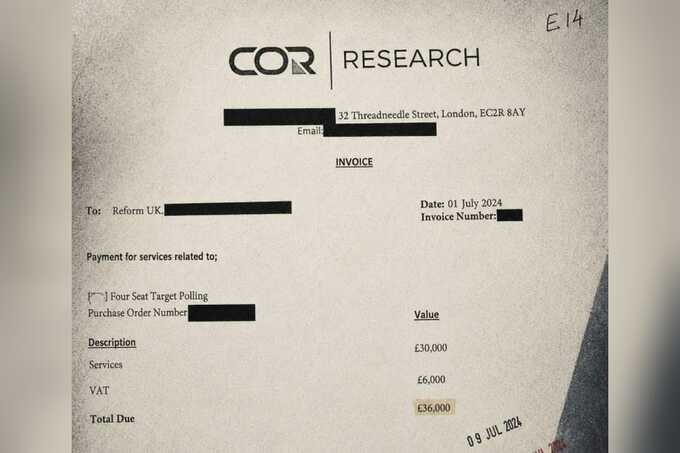
Reform and its predecessor party spent over £645,000 on polling and canvassing work from an anonymous sole trader going by the name ‘COR Research’.
COR Research, which worked for the Brexit Party in 2019 and for Reform UK in 2024, has no Companies House entry, no social media presence, and ten key invoices are missing on the Electoral Commission website – something Reform UK has been criticised for by the elections watchdog.
The Commission’s own spending database records the supplier as an individual. The sole trader’s only public presence is a single-page website carrying a logo, the line “The best vision is insight”, and a contact form.
It gives no address, no named individual, and no description of what the business does. The domain was registered on 28 January 2019, three months before the first invoice. The payments were between May 2019 and July 2024.
Most of the spending – £529,160 of the £645,560 – was paid by the Brexit Party across the 2019 European and general elections, while £116,400 was paid in 2024, after the same party was renamed Reform UK.
Invoices filed with the Electoral Commission in 2024 list only a serviced office address near the Bank of England. Earlier invoices redact the address altogether.
The earliest invoices charge no VAT and state in print that none is payable. Analysis by this outlet of the Commission’s published spending records places the VAT registration window for the mysterious supplier roughly between 15 July and 25 August 2019. Every COR Research invoice in that period is blank on the Commission’s website.
The record for a £15,360 payment of 25 August 2019 — the invoice that would settle the question — is an empty document.
No Trace in the Industry
Two polling industry figures this outlet spoke to had no information about the firm. COR Research is not registered with the British Polling Council, the Market Research Society or ESOMAR. The last invoice in July 2024 – just before the General Election – was for “Final Four Seat Target Polling.” Polling on that scale would normally require a substantial fieldwork team, according to polling experts this outlet spoke to.
Lord (Mark) Pack, a Lib Dem peer who runs The Week in Polls Substack, told this outlet: “Reform are doing themselves no favours with the lack of transparency over the campaign spending. Transparency rules are a fundamental part of how we protect our democracy from malign influences such as foreign states and billionaires such as Elon Musk. They could, and should, do better.”
On the Commission’s published figures, COR Research’s total billing crossed £85,000 – the threshold at which VAT registration becomes compulsory – in late August 2019, at almost exactly the point the recorded amounts begin to be consistent with VAT being charged. On that analysis, registration appears to have been made when it fell due rather than late.
However, despite that £36,000 invoice charging £6,000 of VAT, it states at the bottom: “By virtue of paragraph 15 of Schedule 1 and paragraph 9 of Schedule 3 to the Value Added Tax Act 1994, no VAT is payable. Business name registration is voluntary in the United Kingdom. No business name has been registered.” Accountants this outlet spoke to say it makes little sense, though it may be boilerplate text which was never removed after registration.
Dr Sam Power, a leading expert in political financing, electoral regulation and corruption at the University of Bristol, told Byline Times the situation “does seem odd.”
“Political parties using businesses with rather opaque names which sound like they’ve come straight out of an Apprentice task (for services we know little about) is nothing new, but usually with a little bit of digging one can find out more.”
Not only was this not the case with COR Research, “the sheer amount that is spent on [the organisation]” struck him.
Dr Power and colleagues conducted an audit of invoices from the 2019 election in 2022 and ranked COR as commanding the second highest total spend from Reform. Reform spent close to £1 in every £10 they spent in 2019 on the mysterious firm.
“Usually, a company commanding this amount of money from a party is either a) a multinational everyone has heard of [like] Google or Facebook, or b) a consultancy/campaign firm run by former party campaigners [like] Hanbury strategy.
“In some senses the whole point of doing this kind of work is to put yourself in the shop window so that you can secure further business for other clients and at other elections. So, if nothing else, there being no wider information about the company is rather bizarre business practice,” Dr Power added.
The academic believes that researchers and journalists “ought to pay just as close attention to what the interests of [parties’] suppliers are, and the way in which they might shape political outcomes, as we do people like Christopher Harborne,” the source of Nigel Farage’s undeclared £5m ‘gift’ in 2024.
Watchdog’s Findings
In response to a Freedom of Information request, seen by this outlet, the Electoral Commission said Reform’s spending return “was investigated for a failure to deliver a complete campaign expenditure return for the 2019 UK Parliamentary General Election regarding missing invoices.”
“Offences were found, but it was not proportionate or in the public interest to propose sanctions.”
The Electoral Commission’s published list of investigations records, under April 2022 to March 2023, shows Reform was investigated for failure to deliver a complete campaign expenditure return for the 2019 UK Parliamentary General Election over missing invoices, together with a separate issue of late payment of claims. The watchdog said the number and value of the missing invoices and late payments were “minor.”
However, the ten missing invoices, nearly all covering July–September 2019, are still not published. The unpublished COR payments amount to £80,920. Another record, marked as spending of £5,760 for COR Research on the Electoral Commission database, shows an invoice for an apparently unrelated branding firm.
The EC stated that ‘there is no VAT number displayed on any COR Research invoices’, though a COR invoice published on the Commission’s own website — for £34,800 of internal polling and message testing, dated 24 September 2019 — carries a ‘VAT Number’ field with a redaction box beside it. If the Brexit Party and Reform were not VAT-registered, there was no obligation for a VAT number to be listed on the invoices.
In response to the findings of this story, a spokesperson for the Electoral Commission said: “Parties are required by law to provide an invoice or receipt for each reported payment over £200. Where invoices are missing from a return, we engage with the party to obtain the outstanding information and to ensure the reporting requirements are met.
“This engagement can take place both before and after the statutory deadline. The published record includes a placeholder where no invoice was available, and the register reflects the documentation provided to us.”
The watchdog’s spokesperson added that where requirements are not met and parties do not provide invoices, the Electoral Commission considers the matter in line with its Enforcement Policy.
“We only take enforcement action, including using investigatory powers and sanctions, where we are satisfied that it is necessary and proportionate to do so.”
The elections body would not release further information on the “detailed considerations that form part of any investigations.”
A Pattern
Lloyd Hatton MP (South Dorset), member of the APPG on Anti-Corruption and Responsible Tax, told Byline Times: “A ghost pollster, missing invoices, and £645,000 of unanswered questions. This is exactly the kind of dirty money loophole that gives politics a bad name. If Reform can’t tell us who they’re paying or why the paperwork keeps disappearing, that’s not an accident — it’s a warning sign. As such, the landmark elections bill [Representation of the People Bill], currently before Parliament, could not be more timely.”
The Labour Government appears to have committed to standardising accounting and spending returns for parties following the Rycroft review into foreign interference. Dr Sam Power believes it will “make it much easier [to] catch this kind of non-compliance in real time.”
“It is also beyond welcome that the spending categories that parties report under are likely going to be updated to reflect modern campaign practices, as it stands they are spectacularly uninformative…The number of blank or uninformative invoices is hugely problematic.”
Dr Power and colleagues estimated that at the 2019 general election about 14% of total party spending (about £6.5m) couldn’t be reliably categorised. “That is a huge transparency black hole that small changes can prevent. Enforcement is only a small part of the story though,” he said.
Empowering the Electoral Commission to update and reshape their political finance online database is also key for anti-corruption efforts. Developments in AI mean that information about election spending can feasibly “be released much sooner after an election is completed as opposed to, as was the case in 2024, over a year after the event,” Dr Power adds.
The revelation follows on from Byline Times’ recent investigation into firms with links to party insiders via their directors. As previously uncovered, Reform spent £440,000 on marketing and canvassing work with a series of firms run by donors, party activists, and a former party chairman.
Among them was Touchpoint Strategy, which had never filed any accounts, and was incorporated three months before Reform paid it over £72,000 for market research work. One of the firm’s directors stood as a local Reform candidate, and the company had received a compulsory strike-off notice in February 2026, though this was later suspended.
Byline Times has also documented seven firms which collectively donated £485,000 to Reform while on the brink of being dissolved, struck off, or in otherwise poor financial standing.
Reform UK did not respond to a request for comment.

Deputy Editor
Read more similar news:
Comments:
comments powered by Disqus