Russian opposition activist sentenced to seven years in Poland after FSB espionage case

The police came for Igor Rogov because someone had mailed him a bomb-making kit. The eclectic mix of items – a chrome vacuum flask, a pair of marker pens, a power bank and a bottle of antifreeze fluid – might have seemed innocuous to an untrained eye, but Poland was on high alert in July 2024.
Two months previously, a shopping mall in Warsaw had burned down in an arson attack; an Ikea in neighbouring Lithuania was also set on fire. Authorities believed it was a sabotage campaign masterminded by Russia’s intelligence services, intended to sow panic and undermine support for Ukraine. They feared it was only a matter of time before the Kremlin escalated further.
A security officer at the parcel company’s warehouse was suspicious enough about the package to call in the authorities, who arrived with sniffer dogs and special equipment. X-rays of the marker pens showed they had 1980s Soviet-produced detonators concealed inside, while the flask had a false bottom containing a sachet of metallic powder. The power bank appeared to have been tampered with in some way, and a probe of the bottled liquid showed it contained a highly volatile nitroglycerine solution. With the right expertise, the items could be turned into a powerful bomb.
Police ascertained that Rogov, the parcel’s addressee, was a 27-year-old Russian political activist, who in the past had campaigned for the opposition leader Alexei Navalny and other anti-Kremlin groups. He had fled Russia two years previously, fearing arrest for his activities, and been granted asylum in Poland. He won a scholarship to attend university in Sosnowiec, an industrial city in the south-west of the country. His wife, Irina Rogova, followed him to Poland and also enrolled at the university; the couple lived in a student dormitory. It was there that authorities arrested him.
Rogov’s phone, when searched, contained photographs of urban scenes in the vicinity of Sosnowiec overlaid with red arrows, apparently indicating places to hide or retrieve items. One photo was of a gas pipeline on the outskirts of town, an appealing potential target for a Russian bomb attack. The chance discovery of the package, it seemed, had led authorities to a participant, perhaps even a coordinator, of Russia’s sabotage campaign against Poland, living under deep cover as a brave opponent to the Kremlin.
More than a year later, in October 2025, Polish authorities revealed they were also accusing Rogov of longstanding collaboration with the FSB, Russia’s feared security service. This suggested that his whole career as an anti-Kremlin activist might have been a cover story for his FSB work. When the case came to court, however, the judge closed proceedings to the public and press on national security grounds, fuelling further speculation and rumours about what exactly Rogov had done – especially among Russia’s exiled political opposition, where infighting, suspicions and accusations are commonplace.
Although Rogov’s trial was closed, I discovered thousands of pages of documents about him and his wife in the court papers of a related case. (Some of the files were previously reported on by the Polish news site Wirtualna Polska). Those files, as well as interviews in several countries with intelligence sources and with those who knew Rogov, helped piece together a tale of exile and espionage that involved blackmail, deception and a marital crisis with dramatic consequences. (In accordance with Polish law, people mentioned in court files are identified in this story by first name only, except where they have given their consent to be interviewed and named in full. Rogov and his wife are named as they have already been widely identified as protagonists in the case.)
Many who knew Rogov were shocked by his arrest. They described their friend as likable, easy-going and somewhat hapless, and struggled to imagine him as a cunning superspy, or a bomb courier with a secret life blowing up European cities on behalf of Vladimir Putin. “This is a guy who once accidentally sent half-naked photos to the group chat,” said Milia Kashapova, who was Rogov’s campaign manager when he stood in city council elections back in Russia and worked with him at close quarters for several months. “It’s hard for me to believe that all that time he was playing a double game, that he didn’t once come unstuck. If he was really collaborating all along, well, then I’d have to say that Igor Rogov is a genius.”
At the beginning, the only thing Polish investigators had on Rogov was the fact that someone had mailed him the suspicious package. In his first jail interrogations, Rogov maintained it was all a big misunderstanding. He denied any knowledge of the package’s contents and insisted he would never have knowingly done anything to harm his new homeland. “I’m very grateful to Poland for taking me in and I’m ready to help you in any way I can,” he told investigators.
Rogov gave his version of how his name had come to be on the package. His friend Emil, also a Russian opposition activist, had told him that a contact was bringing a parcel from Ukraine and needed someone in Poland to leave it with. Emil said the package contained “presents from Ukraine” and Rogov said he would be fine to pick it up. Some days later he received a call from a woman who introduced herself as Kristina. “I’ve got a package for you from Diesel,” she told him, adding that she had just arrived in Kraków from Ukraine. Rogov had no idea who Diesel was, but assumed this was the package Emil had asked him about. He told Kristina he was away visiting friends, but gave her his address in Sosnowiec and explained how she could mail it to him using a courier service.
Polish authorities soon identified Kristina as a Ukrainian model from Odesa and put out an international arrest warrant for her. She was detained in late August at Amsterdam airport, just before boarding a plane to the US. Once delivered to Polish custody, she explained her side of the parcel story. “Diesel” was her old acquaintance – the nickname was because he worked with secondhand cars. He had found out she was planning to drive to Poland and asked if she might take a package with her. “He said he needed to distribute this stuff to poor people and was helping women and families,” Kristina told investigators. “I did think it was a weird set of things, but Diesel is a pretty weird guy.”
Kristina told investigators that Diesel had put the flask, power bank and other items in her Mercedes before she embarked on the long drive to Kraków. There, she had a rendezvous with a Czech businessman who had offered to pay her €3,000 if she would spend a week with him at a luxury hotel. She ate oysters and drank champagne with the Czech, though at night they retired to separate bedrooms, the case files suggest.
After she bade farewell to her new Czech friend, Kristina remembered the package. She was meant to hand it off in person, but when she called the number Diesel had given her, the man on the other end – Rogov – told her to send it via parcel courier instead. She retrieved the empty shoebox from a pair of €500 Golden Goose sneakers the Czech had bought her and filled the box with Diesel’s items. Then she wrapped it in paper and took the package to a bank of automated parcel lockers as instructed by Rogov.
Having addressed the package, she shoved it into a locker that was a shade too small, causing the packaging to tear. That damage meant the courier company opened the parcel when it reached their sorting facility, discovered the suspicious contents and raised the alarm. This set in train the arrests of Rogov and Kristina. Had she picked a larger locker, the package might have gone undetected and the bomb been assembled and detonated. But by whom? Rogov, or someone else? And on whose orders?
In the days after she sent the package, but before she was arrested, Kristina said she received a call from Diesel’s number. “I’m going to speak. You listen and stay quiet,” said a male voice she did not recognise. He told her the person she had mailed the package to had been detained, and that if she were also detained, she should invent a story about how she had come by the package. “All the correspondence between you and Diesel has been erased; don’t mention Diesel to anyone,” said the man.
The mysterious Diesel was emerging as the key to the parcel plot. Could he be a Russian agent working in Ukraine? Polish authorities had already arrested several Ukrainians recruited by Moscow to carry out arson in Poland, and it was possible that Diesel was part of a Russian sabotage ring with Rogov, using easy access to explosives in Ukraine to source the raw materials before they were assembled and detonated in Poland. Polish authorities issued an international arrest warrant for Diesel and one for Emil, who had told Rogov about the package.
Whoever Diesel was working for, one thing became clear as the questioning continued: Kristina knew nothing about the parcel’s purpose or final destination. In one of her interrogations, as investigators scrolled through her phone demanding ever more details of her encounters with various men in her contacts list, she lost her cool and asked them how this could possibly be relevant to the matter at hand. “All you’ve managed to achieve through your investigations is to prove that I’m a breaker of men’s hearts,” she told them.
Kristina was released in summer 2025, after a brief trial in which the prosecutor accepted that she had carried the items without realising they were dangerous and agreed to soften the charges. She was sentenced to time already served – 304 days – and fined. She did not respond to my requests for further comment.
As for Rogov, it was starting to look as if he, too, could be a tangential player in the bomb plot. He insisted he knew nothing of Diesel, and that the package had his name on it only because he had agreed to help out Emil. The biggest red flag suggesting he might be lying was the set of photographs of various urban scenes in Sosnowiec, marked with arrows, found on his phone. But he had a convincing explanation for that, too. He had sometimes ordered recreational drugs via a Telegram bot, he admitted, and would receive a photo of the pickup location with an arrow marking the drop spot. The only reason some of the locations were close to pipelines or other infrastructure was because these were desolate, empty places where hiding or retrieving a package would draw less attention, he said.
The investigation, which had initially seemed like it would uncover a major Kremlin terror plot against Europe, was not going to plan. There was no proven link to Russia, and the only two arrests were of a clueless Ukrainian model and a young Russian who was apparently guilty only of the occasional purchase of recreational drugs.
But something else was about to come to light about Rogov. Polish investigators were to learn that he had been credibly accused of working for the FSB for years, spying on his friends and colleagues in the Russian opposition. The source of the accusations made them hard to dismiss: it was Rogov’s wife, Irina.
Igor met Irina when they were teenagers. They were both studying veterinary medicine in Saransk, a drab city about 500km (310 miles) south-east of Moscow, where they lived their whole lives before emigrating. Rogov had a cheeky smile and easygoing demeanour that made him friends easily. He got into activism as a student, though to start with he was mostly drawn to local environmental issues. He was then one of thousands of young Russians who helped out with Navalny’s ill-fated attempt to stand against Putin in the 2018 presidential election, and he later became part of Open Russia, the opposition movement set up by the exiled oligarch Mikhail Khodorkovsky.
Rogov won respect in opposition circles after an incident in Minsk, in neighbouring Belarus, in August 2020, when Alexander Lukashenko, a close ally of Putin, declared victory after a rigged presidential election. Protesters took to the streets and Lukashenko launched a violent crackdown. Rogov was in Minsk as part of an informal monitoring mission organised by Open Russia. On the second evening of protests, Rogov and a fellow activist, Artem Vazhenkov, got caught up in an ambush outside a shopping mall. Black-clad riot police grabbed anyone they could lay their hands on and tossed them into armoured trucks; Rogov and Vazhenkov ended up at Minsk’s notorious Okrestina jail with hundreds of others. They were kept in a courtyard, hands tied and face-down on the ground, then moved to a packed cell holding about 40 men. “There was no attempt to get any information, like in Russian prisons. They just beat you for the hell of it,” Vazhenkov told me. The riot police broke Rogov’s ribs and fingers and left his body covered in bruises. The repeated kicks to his head in custody gave him migraines that recurred for years.

After three days of beatings, Rogov was released and deported to Russia. At the Open Russia office back in Moscow, he alternated between laughing and crying as he recounted the ordeal, still moving gingerly from the bruises. “We sent him to a holiday guesthouse for a couple of weeks to recover,” said Andrei Pivovarov, Open Russia’s executive director at the time.
A few weeks later, Igor and Irina, then 23 and 24 years old, got married in Saransk. Vazhenkov, who attended, said it was a “typical Russian wedding”, with vodka, toasts and lots of dancing. Rogov also became more active in Open Russia; the organisation felt partly responsible for the Minsk debacle and supported him to become the official head of their Saransk branch. But a few months later, Open Russia officially dissolved itself, because its designation as “undesirable” by Russian authorities meant activists could be arrested just for being linked to it. So when Rogov ran for a seat on Saransk’s city council in the summer of 2021, he stood as an independent candidate. Getting registered to stand, even in such a low-level vote, required organised and sustained campaigning. Milia Kashapova, a 26-year-old activist formerly associated with Open Russia, moved to Saransk for a few months to be his campaign manager.
The campaign was low-budget – Kashapova lived in the apartment of Rogov’s grandmother – but inventive. They spent long days canvassing on the streets and made Instagram reels featuring Igor and Irina’s cats. In the evenings they sat in bars, often with Irina, and discussed strategy. The police showed up at most public events to intimidate supporters, but this was standard practice in Russian regional politics, and Rogov ploughed on. He and his team went door-to-door, promising those who agreed to hear them out that, if elected, he would bring a breath of fresh air into the corrupt city council. In a campaign post on Telegram, he posted a picture of him and Irina with one of the cats, accompanied by the slogan: “Love and fidelity are the foundations of my family.”
When polling day came, Rogov won 16% of the vote in his district, finishing third behind two broadly pro-Kremlin candidates. He thanked his supporters and announced that he planned to launch several court cases to protest against procedural violations. “Think this is the end? It’s just the beginning,” he wrote on his Telegram channel. But in the following weeks, with a political crackdown on opposition groups under way, the Rogovs decided to leave Russia. They went to Georgia, then to Poland, after winning scholarships on a programme for Russian opposition activists. They arrived in Sosnowiec on 28 February 2022, four days after the full-scale invasion of Ukraine. Over the next few months, Russia would take a dramatic turn for the worse, as wartime censorship laws kicked in. Henceforth there would be only two choices for most political opponents: jail or exile.
The Rogovs’ new home was a boxy room in a student dormitory, where their neighbour was Danila Buzanov, another exiled Russian activist. Buzanov had spent several years working as a Navalny coordinator in Balakovo, a gritty industrial town known for its nuclear power plant. He had done multiple stints in jail and fled Russia in late 2021, packing a bag and slipping out of the country overnight after police showed up at his mother’s house with another arrest warrant for him.
Buzanov was also starting a new life from scratch in Sosnowiec, and he bonded with Igor and Irina over stories from Russia. “Igor was just a solid, straightforward guy, always joking, always pleasant to talk to, just like the kind of friends I had back at home, the ones I knew since school,” Buzanov told me. The trio’s closeness was amplified by the living arrangements: they shared a bathroom and a kettle, and the doors to their bedrooms were usually left open so the cats – which Irina had managed to exfiltrate from Russia – could roam freely.
Rogov always seemed to have money to go out and socialise. “Absolutely any meeting, with anyone, he was always there, always ready to have a beer and talk,” said Buzanov. Irina worked long hours doing manicures at a beauty salon to supplement her miserly university stipend – but Igor had no job. When Buzanov asked him where the money came from, he said he had sold his car before leaving Russia and was living off the proceeds. Rogov was also ever-present at the political demonstrations organised in nearby Katowice, where the small community of Russian exiles would gather to protest against the war in Ukraine or commemorate the death of Navalny in a Russian jail. Irina rarely joined. “She was completely apolitical; she’d rather go clubbing than go to a rally,” said Buzanov.
Over time, the psychological pressures of a life in exile began to take their toll on the Rogovs’ marriage. Irina found Igor distant and moody, and he was increasingly using recreational drugs. One of the dormitory’s administrative staff later described him in a police interview as a “nice polite boy” who was “rather hapless and seemed as though he wasn’t very good at dealing with things”. The couple’s arguments got progressively worse, and at some point Irina moved out to a room on a different floor, taking the cats with her. Igor grew a moustache and started working out more. He began spending time with another Russian exile studying at the university, named Polina. In April 2023, Irina walked in and caught him and Polina having sex on their old bed. She shouted at them and stormed out. A few minutes later, Buzanov’s phone buzzed with a Telegram message from Irina: “Did you know that Igor has been informing on you and others to the FSB?”
Irina sent a similar message to a group chat of her husband’s old political contacts from Russia, and within minutes, Igor’s phone was lighting up with queries that could be loosely summarised as: “WTF?” After a frenzied discussion between the couple, Igor persuaded Irina to give him her phone and he unsent her message. Later, she and Igor both messaged the group to say it had been a bad joke, apologising for any confusion. But Rogov swiftly confessed to his neighbour, Buzanov: “He was close to tears, and he didn’t try to justify himself, he just began apologising. ‘I’m so sorry, I was forced to do it,’ that sort of thing,” Buzanov told me. Too shocked to ask many follow-up questions, Buzanov put a password on his laptop and warned other friends to be careful around Rogov.
The marriage crisis put Irina in a difficult position, as her Polish residence permit was tied to Igor’s asylum status. She was furious that the whole dormitory knew about his affair, and told him he had humiliated her and ruined her life. She even discussed with friends whether it would be safe for her to move back to Russia, given that she had never directly been involved in opposition politics, and had once gone back to Saransk for a short trip to visit relatives without encountering any problems. But she was still in Sosnowiec in July 2024, when Igor was arrested.
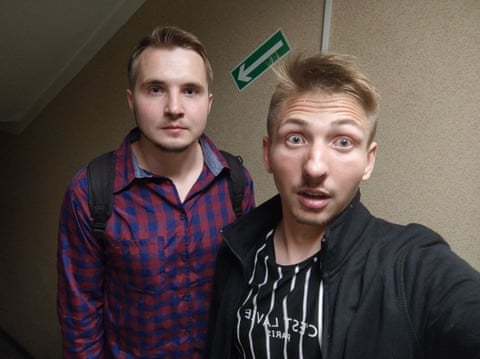
When the news broke, the friends from the group chat assumed it was confirmation that Irina had been telling the truth about Rogov’s FSB collaboration, and that Polish authorities had found out. In reality, for the first few months of his detention, investigators were focused only on the explosive parcel, and had no idea about anything else.
From the files I was given access to, it is not clear how Polish authorities first became aware of Rogov’s alleged FSB links – whether Igor confessed, Irina told them or information was volunteered by someone in the group chat. But on 13 November 2024, roughly four months after Rogov was arrested, investigators added a second charge to his file: along with the charges linked to the explosive, he was also now under investigation for espionage. On the same day, Polish authorities arrested Irina, grabbing her as she crossed the street in Sosnowiec and accusing her of being her husband’s accomplice. Through a series of interrogations of both, the story of Rogov’s collaboration came into focus.
Rogov said he had been recruited during his university years, before he even started out in opposition politics, by a local Saransk FSB officer he knew as Yevgeny. To start with, he was proud of the collaboration, believing the FSB to be a patriotic organisation and grateful for the small amount of extra income it provided. After some time, Yevgeny gave Rogov a burner phone, and told him to keep it hidden at home; it would be their way of communicating. Irina was suspicious of these conversations, and demanded to know who Igor was speaking to so regularly on the secret phone. At first, he told her it was “a person who helps me with studies, deals with various bureaucratic issues and helps me financially”. Later, he confessed that he had been recruited by the FSB. He never told her the details of his conversations with Yevgeny, he claimed, and she never pushed. “It was enough for her to know it wasn’t another woman,” he said.
It is not clear from the files if the initial impulse to get involved in opposition politics came from Rogov or from Yevgeny, but once Rogov started his political activism, the FSB man pushed his recruit to make as many contacts as possible. “I was supposed to keep doing the things I wanted to: climb up the ladder in opposition circles, meet new people, help people, and then at the end tell the FSB about everything,” Rogov recounted. Whenever he came back from a trip to an opposition conference in Moscow or abroad, he told Irina he needed to spend some time working up a report to pass to Yevgeny.
The ideal scenario, Yevgeny told Rogov, would be if on one of these trips abroad, he was approached and pitched by a western intelligence agency. “The point was, I was supposed to become a double agent,” said Rogov. That plan never worked out, but it suggests Yevgeny had big plans for his agent. In every Russian region, one European intelligence official told me, there were numerous FSB operatives focused on infiltrating opposition groups, and these officers would look for ways to elevate their cases beyond local interest. “The low-level officer who did the recruitment will be trying to prove himself by pushing the case as far as possible,” said the source.
This may also explain Rogov’s trip to Minsk in August 2020. A report detailing the mood on the Belarusian streets would have been attractive currency for Yevgeny, an FSB man in the provinces, with his superiors in Moscow. Irina had begged Igor not to go, as they were due to be married a few weeks later, but after several conversations with Yevgeny on his burner phone, Rogov had told her he had no choice.
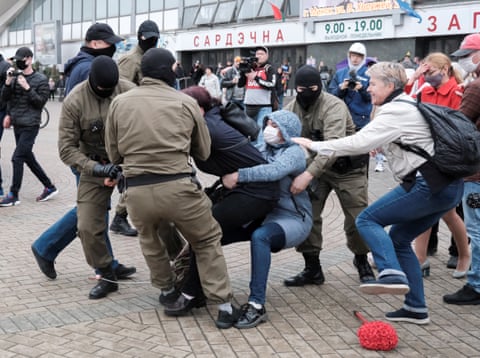
A few days after Rogov left for Minsk, he went dark. There were widespread reports of mass arrests, and Irina was in such a panic that she retrieved the burner phone and called the single number saved in it. When a man picked up, she said: “I’m Igor’s fiance and I know he talks to someone on this phone. I know that Igor went to Belarus because of you, and I need to find out what happened to him.” The man on the other end said little, then hung up. Soon after, Belarusian authorities released Rogov. It is not clear whether the FSB intervened with Minsk to facilitate his liberty, but his fellow activist Vazhenkov, who was detained at the same time, was not freed for another two days.
When Rogov returned, shaken and bruised from the beatings in Minsk, he was angry with Irina for contacting Yevgeny. He told her she should not poke her nose into his business and that she should never use the secret phone again. Then he hid it somewhere she could not find it.
In the months after Minsk, Rogov could sense that Yevgeny was delighted as he rose to prominence in the local opposition scene, he recalled. But he also claimed to have become genuinely engaged in the opposition struggle, and regretted he had ever agreed to collaborate. “If I had a choice I wouldn’t have done it … but to function in politics and maintain relationships I had to pass information on, because [Yevgeny] could have made everything impossible with one click of his fingers,” he said. On one occasion, when Rogov was at a hospital appointment for his migraines, he was presented with a military draft notice. When he discussed it with Yevgeny, the FSB man suggested he could make it go away. “Yevgeny knew everything about me and he blackmailed me … I had no choice, I felt under constant psychological pressure,” Rogov claimed. It was not clear from the files whether Yevgeny supported or had input into Rogov’s 2021 city council run, nor was it clear whether Rogov continued to receive regular payments from the FSB.
In Rogov’s telling, when he arrived in Poland in February 2022, he thought he had finally escaped Yevgeny’s clutches. He broke off contact, he claimed, and was focused on building a new life in Poland. But three months later, he got a message from an unknown number on Telegram and guessed immediately it was Yevgeny. “In a very veiled way he asked me to bring him some car parts, and I knew that he was demanding I pass on information,” Rogov told investigators. He ignored the message, but Yevgeny kept sending new ones. “Each of his messages caused huge stress for me, because I had family in Russia and I was really afraid of that,” he said. Rogov claimed that his father, still in Saransk, had been approached and told he could be mobilised into the army to fight in Ukraine, even though he was over 50 and should not have been eligible. Rogov assumed it was Yevgeny cranking up the pressure.
Eventually, Rogov said, he collected some fairly mundane information about Buzanov and a few other exiled opposition activists he knew, wrote it up into a Word document, and put it on a USB stick that he gave to Irina, who was taking a trip to Russia in summer 2022 to visit her parents. “I was convinced that the information could not really harm people, that this data could be partially found on the internet,” he claimed to his interrogators. Rogov said he had hoped the information transfer would placate Yevgeny, and also that he believed it could have been useful insurance for Irina: if she was given any trouble by Russian border guards for her links to opposition figures, she could say she was carrying important information for the FSB. (Irina claimed he did not tell her what was on the stick or who it was for until after she arrived in Russia.)
In the end, Irina entered Russia with no trouble. Back in Saransk, she visited the couple’s old apartment, which was now empty, and on her husband’s instructions, retrieved his old burner phone from the back of a kitchen cupboard, where it had remained undisturbed since their emigration. She charged it and called the one number saved in its contacts, as Igor had ordered her to, but there was no reply. She left Russia without handing over the USB stick. When she returned to Poland, she asked her husband if he was still in touch with Yevgeny. “He said no, and that he doesn’t want to maintain contact with him but he doesn’t know how to get out of it,” she said.
Some months later, around the time the marriage started disintegrating, Rogov got a message from another of Yevgeny’s alias accounts. By now, the couple’s asylum papers had come through and Rogov said he had been ready to start a new life, without Russian politics and without the FSB. “I wrote back saying I don’t work in politics any more and I won’t be passing any more information,” he said.
Later in 2023, Vazhenkov – the activist who had also been arrested in Minsk – visited Rogov in Sosnowiec and found his old friend to be a changed man. “We hardly discussed politics … he said he’s no longer political, he’s focused on studying hard. And he was really upset about the breakup with Irina,” Vazhenkov told me. Irina seemed to be adjusting better, having apparently moved on from the dark period immediately after the separation: “She had a lot of plans and she had learned good Polish.”
But neither Igor nor Irina would get to live the new lives they had envisioned. Before long, both were in jail. Last month, three years after Rogov claimed he had broken off contact with Yevgeny and two years after his arrest, a court in Sosnowiec sentenced him to seven years for espionage. Irina was sentenced to three years for aiding him by taking the USB stick to Russia.
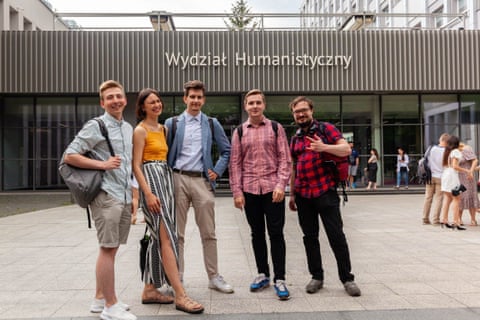
The trial was held behind closed doors, and even information about how the defendants pleaded is classified. But lawyers for Igor and Irina told me they were planning appeals. Both lawyers said they would have preferred an open trial, suggesting that if the public knew the facts of the case, they might be less inclined to view the couple as Kremlin superspies. “It’s a shame my client’s case couldn’t be looked at in a more transparent and nuanced way,” said Irina’s lawyer, Katarzyna Matejczyk. However, at a time when Moscow is waging war in Ukraine and organising sabotage attacks in Europe, Polish authorities have little time for shades of grey when it comes to Russian spying. “In the current geopolitical situation, there is no chance of any verdict other than a conviction,” she said.
There was one remaining loose end – the explosive package that had set the whole story in motion. Rogov was found guilty on charges relating to the package, but there were few details in the short public verdict. Jacek Dobrzyński, a spokesperson for the Polish minister who coordinates the country’s security services, told me the parcel’s trail had led back to Moscow. “There is no doubt that this was a Russian plot orchestrated by the Russian secret services,” he said.
However, something did not quite add up. The court files I was able to see yielded no evidence of a Russian link and in fact pointed to a different possibility. During the investigation, one source told Polish authorities they believed “Diesel”, the Odesa car salesman who had given the package to the model Kristina to bring to Poland, actually had links to Ukrainian military intelligence.
This suggested the package might not have been a Russian bomb after all, but a Ukrainian one, transiting Poland and eventually destined for Russia. Since 2022, Kyiv has been running its own campaign of sabotage inside Russia, targeting military officials or pro-war cheerleaders. The latest such attack came this month, when an improvised bomb exploded in a Moscow restaurant during the birthday celebrations of a Russian army general. Three people were killed. My Ukrainian intelligence sources claimed no knowledge of the package sent to Rogov, but one said Kyiv’s sabotage campaign was a delicate issue with allies and usually organised behind their backs: “Almost every European country agrees that it’s legitimate for us to do this, but almost none of them want to cooperate on it.”
The person who could best solve the puzzle of the package, I thought, was the man who sent it, the mysterious Diesel – real name Yuriy Kovalenko. Finding him was easier than expected: he replied to my Facebook messages and agreed to meet at the offices of his lawyer in Odesa, on condition that she also be present. When we met, he was wearing a shell-suit jacket, blue jeans and New Balance trainers, and a kippah – he had rediscovered his Jewish identity in recent years, he said. He told me his nickname was due to his longstanding love of cars, but that these days most people just called him Yuriy.
Kovalenko told me he made a living by importing, fixing up and selling secondhand cars. He categorically denied any links to the Russian intelligence services. He also denied links to the Ukrainian services, but made it clear through his answers that he believed the explosive package had been Ukrainian, not Russian. The final destination was meant to be Kaliningrad, the Russian exclave that borders Poland, he said. However, he insisted he had only found this out later, and that he, too, had been merely a link in a chain of unsuspecting couriers. He claimed he had been given the collection of items by a friend who “possibly had some kind of link” with Ukrainian intelligence services. That friend, he said, asked him to send some items to Poland, so he asked an old acquaintance in the Russian opposition, Emil, if he knew anyone reliable there. Emil gave him Rogov’s name.
Kovalenko was evasive on the specifics: he refused to give further details about the person who supposedly gave him the package and he would not say how he knew the explosives were bound for Kaliningrad. Nor could he explain how they were meant to get there. In addition to his lawyer, he was accompanied to the interview by a man who sat silently next to him and did not introduce himself, claiming to be there “by chance” when asked.
In the shadow world of intelligence games and sabotage plots, it can be hard to discern where the true loyalties of each individual player lie. To add a final complication to the tale, Emil is suspected by many former colleagues in the Russian opposition of being an FSB informer just like Rogov. The full story of the bomb and its various couriers might be lost to history, but the very fact that Ukraine has not arrested Kovalenko, given Poland warned Kyiv of his role in the bomb plot and requested his extradition, points in the direction of the explosives being Ukrainian, not Russian.
And if that is indeed the case, it would be a further strange twist in the story of Igor Rogov, making him at once a Russian FSB informant and a would-be Ukrainian bomb courier.
In the two years since Rogov’s arrest, his old roommate Buzanov has been conflicted over what to think about his former friend. At the start, he felt sorry for Rogov and wrote him letters in prison. Then he was angry that Rogov’s treachery had led to Irina also being jailed, simply for carrying the USB stick into Russia. He also fears the story could prompt unfounded doubts, among Polish authorities or his friends, about his own loyalties. “Our biographies are so similar, and that’s uncomfortable,” he said, as we chatted in a cafe in a city not far from Sosnowiec. Many of Rogov’s friends rejected my interview requests, saying they did not want to be linked publicly to a convicted spy, but Buzanov was happy to talk for hours, keen to show he had nothing to hide.
This is one of the most damaging consequences of Rogov’s collaboration: it has intensified suspicions about Kremlin infiltration among the thousands of Russian opposition and civil society activists who have fled the country in recent years. These suspicions further corrode the effectiveness of the exiled opposition, already weak and divided, as they struggle to remain relevant from their new homes in Warsaw, Berlin or Vilnius.
Rogov was certainly not the only one among their ranks to have been recruited. “I am convinced there were hundreds of us,” a former FSB informant in Navalny’s organisation told the Guardian in 2022. Increasing the sense of paranoia among the opposition is likely part of the FSB strategy in making these recruits in the first place. Kashapova, Rogov’s former campaign manager, told me she used to brush off concerns about infiltration but had become “suspicious of everything and everyone” since Rogov’s arrest.
If the FSB’s goals are clear, Rogov’s motivations remain more elusive. From the testimony I saw, it is hard to say for sure just how reluctant his cooperation was, where his real loyalties lay or whether the information he passed on caused anyone real harm. His friends, without access even to that testimony, have drawn a range of conclusions: some refuse to believe the charges, others accept he may have been an informant but presume he was subjected to unbearable pressure by the FSB, while a third group are furious at him and believe there can be no excuses for collaboration. None can quite square the idea of Rogov as a long-term FSB plant with the young man they thought they knew.
Buzanov, who testified as a witness at the trial, imagines Rogov’s collaboration was likely down to his trademark poor decision-making, which had always got him into scrapes. He is convinced that Rogov was genuinely against Putin, but suspects he was so weak-willed that he was co-opted into working for the FSB, thinking he could make some money without doing anyone much harm. In the same vein, he assumes, Rogov agreed to receive the suspicious package without asking too many questions. “I don’t think he’s some superspy, sent on a special mission to Poland,” he said. “I think he’s just a fool.”

Head of Investigations
Read more similar news:
Comments:
comments powered by Disqus