Ben Delo’s £36m Reform donation puts BitMEX money-laundering allegations back under scrutiny

When Ben Delo handed Reform UK £36m last week to become the biggest donor in British political history, a flurry of articles quickly followed seeking to explain exactly who this so-called “crypto billionaire” was.
Most told some version of the same story: Delo is an Oxford graduate who co-founded the cryptocurrency exchange BitMEX, became Britain’s youngest self-made billionaire at 34, gave millions to philanthropy and, along the way, fell foul of an obscure US financial law.
By and large, the articles did not dwell on that last part. Delo himself has described his offence under the Bank Secrecy Act as a “spurious blip”.
But US court records we have examined, building on reporting by Democracy for Sale, raise far more troubling questions about the business that made Delo his fortune. The prosecution’s wider case extended far beyond the single offence Delo admitted. Those allegations were disputed by Delo and BitMEX and were never tested at trial.
Documents filed by US prosecutors said Delo’s decisions turned BitMEX into a “magnet for money laundering and criminal activity”. They said the company processed trillions of dollars of transactions for its customers. For much of this time, they were required to provide nothing more than an email address. “No real name or other advanced verification is required,” trumpeted the website.

A document filed by US prosecutors ahead of Delo’s sentencing
The FBI said BitMEX, in which Delo owned almost a third of the shares during the period covered by the case, deliberately kept these requirements loose in order to drive up revenue. Delo personally intervened to help customers dodge restrictions on US trading, prosecutors claimed.
BitMEX generated more than $1.3bn in revenue during the five years covered by its criminal case, with prosecutors describing Delo as a “critical organiser and leader” of the “criminal decision” not to install the required safeguards.
In 2020, the US Department of Justice charged Delo and three other BitMEX executives with violating the Bank Secrecy Act by failing to maintain proper anti-money-laundering controls. Meanwhile, the US derivatives regulator, CFTC, brought a civil action against the founders and five companies behind BitMEX.
In response to the DoJ’s charges, Delo pleaded guilty to one offence as part of a pre-trial plea agreement in which the US government agreed not to prosecute him over other alleged offences it had investigated. At the sentencing, prosecutors set out this wider case against Delo, much of which was refuted by his lawyers who argued that his role was not compliance-related, but neither case was tested at trial.
Delo’s lawyers told us: “There is no truth in the serious allegation that our client was guilty of the types of improper, unlawful or criminal conduct that the DoJ crowed about but did not even try to prove.
“The prosecutors’ unproven references to money laundering, sanctions evasion and fraud were irrelevant to the charges brought against Mr Delo and were put forward purely for prejudice and no attempt was even made to evidence or otherwise substantiate them in court.”
Reform UK and BitMEX did not respond to our requests for comment. Nor did co-founder Arthur Hayes, whose own defence relied on similar arguments to Delo’s.
Delo, the “D” in BitMEX parent company HDR Global Trading, co-founded the company in Hong Kong in 2014 and, as chief operating officer, built and oversaw the exchange’s trading software. US regulators later said all three founders worked together on critical decisions.
After receiving a pardon from Donald Trump in 2025, Delo said “a legal wrong has been righted”, claiming he and his co-founders had been “sacrificed for political reasons”, referring to the Biden administration.
While Delo’s “crypto billionaire” label comes from the value of his stake in BitMEX during its height, the size of his wealth today is much less clear.
The current rules governing political donations are clearly not fit for purpose, -Tim Picton, Spotlight on Corruption
But certainly the company described by prosecutors as a “platform for money-laundering” made Reform’s largest donor extremely rich. Prosecutors said he and his two co-founders each withdrew between $100m and $150m in dividends between 2014 and 2020.
Tim Picton, senior advocacy adviser at Spotlight on Corruption, told us: “Political parties should be required to check a donor’s source of funds before accepting any large sum of money.
“In the age of mega donors who have derived their wealth from loosely regulated sectors such as crypto, this is urgently needed alongside a cap on donations.”
Before BitMEX even launched, its founders were discussing how much they really needed to know about its customers. The answer, initially at least, was as little as possible.
“Basically just valid email address until we feel significant pressure to do otherwise,” said co-founder Arthur Hayes in an internal message to Delo in November 2014. And for years, that was all users needed – with BitMEX’s own website advertising this fact to prospective customers.
Prosecutors argued that without knowing who was behind an account, BitMEX was ill-equipped to check whether the bitcoin flowing through it belonged to an ordinary trader, a hacker, a darkweb marketplace or someone in a sanctioned country. Nor could it report suspicious customers to the authorities.
The upshot, prosecutors said, was that BitMEX became “in effect, a money laundering platform”.
Regulators in the US demand tighter customer ID controls than this – so BitMEX banned US customers. But it also launched what it described as a “hidden service” on Tor, a web system that obscures the user’s location.

Delo admitted that BitMEX recorded logins from users known to be in the US and “did not immediately act to restrict [their] trading”.
In October 2018, Delo said BitMEX had frozen roughly 2,000 accounts associated with restricted jurisdictions, but not those in the US. When one valuable customer was caught logging in from a US territory, Delo instructed a colleague to “tell them to log in from Canada like they normally do”.
Delo’s lawyers said such examples gave a misleading picture of his wider conduct, producing evidence of hundreds of occasions on which he personally restricted US-linked users. Judge John Koeltl acknowledged that Delo had been “actively involved” in enforcing controls on US customers. He said BitMEX had introduced procedures over time to exclude US customers and “did screen out a considerable amount of business from United States customers”. But he said that “given the admittedly wilful nature of the violation, the crime remains a serious one”.
They said the exchange used distinctive bitcoin addresses, making funds easier to trace, and said BitMEX had an “excellent track record” of cooperating with US law enforcement.
Comprehensive identity checks for all customers were not introduced until 2020, by which point the “significant pressure” Hayes had anticipated had arrived. Prosecutors argued BitMEX had started strengthening controls only after US regulatory scrutiny in 2018; BitMEX disputed this, saying it decided to do so independently in 2019.
The US Attorney’s Office later described BitMEX’s restrictions on US customers as “toothless or easily overridden” in pursuit of its ultimate goal: US money.
At BitMEX’s corporate sentencing in January 2025, Judge Koeltl found that US users accounted for about $2bn in deposits and $155m of the exchange’s revenue.
For years, BitMEX knew remarkably little about many of its customers. It turned out that some of them had good reasons to want it that way.
FinCEN, the US Treasury’s financial crime regulator, identified at least $209m in BitMEX transactions, including from unregistered money services and so-called darknet markets, where drugs and counterfeit goods are bought and sold. BitMEX settled this case without admitting or denying the findings.
Among the criminal customers linked to the BitMEX, prosecutors cited Elliot Gunton, a hacker from Norwich who had been convicted as a teenager for accessing the personal information of thousands of people as part of the notorious 2015 TalkTalk cyberattack. Prosecutors said Gunton had an account linked to BitMEX.
There is no suggestion BitMEX was involved in Gunton’s hacking or that Delo knew who he was.
FinCen found that in October 2018, the company identified more than 40,000 accounts registered in the US; US territories; or US- or UN-sanctioned countries such as Cuba, Iran, Syria, North Korea or Sudan; as well as people logging in from Quebec. Delo’s lawyers told us that because he was not a US citizen and the companies were not US companies they were not “bound by US sanctions law when acting outside the US”.
Delo also had dealings with Sam Bankman-Fried, years before the entrepreneur was convicted of fraud.
Court papers describe how in December 2018, BitMEX blocked an account belonging to Bankman-Fried’s trading firm Alameda Research over US activity. By then, prosecutors said, it had traded from the US for more than six months without providing onboarding documents and deposited more than $100m into its BitMEX account.
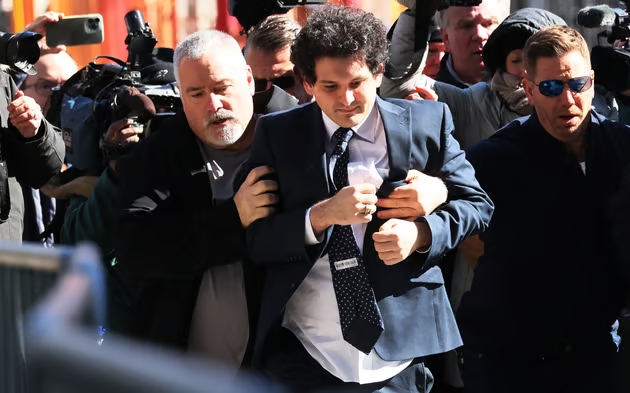
When Bankman-Fried contacted Delo, he was put in touch with an employee who recorded that Alameda was “very appreciative we took care of their US log-in ban this week so quickly”. The employee then encouraged Bankman-Fried to move the account to a non-US entity, settling on the British Virgin Islands, despite prosecutors saying there was “no indication” Alameda stopped logging in from the US.
BitMEX maintained that Alameda supplied BVI incorporation documents and later provided evidence that its authorised traders lived outside the US. At sentencing, the Judge accepted a government calculation that counted Alameda’s deposits as coming from US customers, rejecting BitMEX’s broader challenge to the way US customers had been identified.
Prosecutors said the episode showed BitMEX knew US crypto traders could easily circumvent its restrictions.
When BitMEX itself pleaded guilty to the same breach of the Bank Secrecy Act in 2024, US attorney Damian Williams said the absence of meaningful anti-money laundering controls had opened the exchange up as a “vehicle for large-scale money laundering and sanctions evasion schemes”.
BitMEX’s issues with regulation were not confined to its dealings with its customers. As a crypto company, it had a banking problem.
So in 2015, the prosecution alleged, it acquired a Hong Kong company called Shine Effort before quickly transferring it to Delo for $1. Although Delo owned the company on paper, they said, he was holding it on behalf of the true owner, BitMEX.
Assisted by Hayes, Delo opened an HSBC account in Shine Effort’s name. Prosecutors alleged that he and Hayes presented Shine as an independent IT company.

Documents filed by the US attorney against BitMEX
Sentencing papers filed by prosecutors even allege that he, Hayes and another executive doctored internal BitMEX documents to present to the bank. More than $100m subsequently passed through the account.
The US Attorney’s Office later described the arrangement in starker terms. It said BitMEX, as part of its “willful evasion” of US anti-money-laundering laws, had lied to a bank so it could “pump millions of dollars through the US financial system”.
BitMEX, through its lawyers, told the court that it denied these allegations and the claims were never tested at trial. Under Delo’s plea agreement, prosecutors agreed not to bring bank- and wire-fraud charges relating to alleged misrepresentations to HSBC. Judge Koeltl said he would not consider the Hong Kong bank conduct at BitMEX’s sentencing as he believed it “too tangential” to the case; he did not rule on whether it happened.
In February 2022, Delo pleaded guilty to violating the Bank Secrecy Act by wilfully failing to establish the required anti-money-laundering programme at BitMEX.
Delo admitted knowing Americans were trading on BitMEX, knowing this required the exchange to identify its customers and knowing its existing controls were inadequate. When asked by the judge whether he knew at the time that what he was doing was “wrong and illegal”, Delo replied: “Yes, your honour.”
He admitted that he had not acted “quickly enough or effectively enough” to stop US customers illegally using the exchange.
“It was a terrible decision, the consequences of which I have to carry the rest of my life,” he told the court.
His lawyers, however, argued that his principal role at BitMEX was technical and that he was not involved in setting compliance policies. They said he had taken “numerous steps” to deal with problematic customers, including personally restricting hundreds of accounts.
Judge Koeltl accepted that others had “more responsibility over the company’s marketing and compliance functions than Mr Delo”, BitMEX had introduced controls over time and “did screen out a considerable amount of business from United States customers”. But, he added, “given the admittedly willful nature of the violation, the crime remains a serious one”.
Delo told the court that his guilty plea represented a “fair resolution” of the case. He was not convicted of money laundering, fraud or breaching sanctions, and was sentenced to 30 months’ probation and fined $10m.
His financial connection to BitMEX, however, did not end when he stepped down in 2020 after being charged. A 2024 court filing by BitMEX in 2024 said that he and his two co-founders still collectively owned 91% of its parent company, HDR Global Trading.
The following year, a federal judge fined HDR $100m after it pleaded guilty to the same Bank Secrecy Act offence. The money was due on 28 March 2025. On 27 March, Donald Trump pardoned the company and its founders, writing off the fine.
BitMEX settled with the CFTC and FinCEN in 2021 on a “neither admit nor deny” basis, while Delo and the other founders separately settled the CFTC case against them in 2022, each agreeing to pay $10m.
Delo neither admitted nor denied the CFTC’s allegations, except those admitted to in his guilty plea, and his $10m CFTC payment was counted as his $10m criminal fine.
What Delo has called a “blip” was also a period in which his business generated more than $1bn in revenue and paid him, according to prosecutors, more than $100m in dividends.
His fortune is now being used to boost the bank balance – and the election hopes – of Reform.
Delo’s record donation comes as parliament considers some of the biggest changes to political funding rules in years, including a £100,000 annual cap on donations from overseas voters and a ban on cryptoasset donations.
Steve Goodrich, head of research and investigations at Transparency International UK, said political parties relying on funding from a handful of individuals presents a “major corruption risk”.
“No politician or party should leave themselves so dependent on so few sources of funds, especially when one of them has been convicted for serious anti-money laundering failings,” he said, adding that a wider cap would reduce the risks surrounding the source of these donations and “what might be expected in return”.
Picton from Spotlight on Corruption said: “The current rules governing political donations are clearly not fit for purpose. The government must ensure that its new know your donor regime is tightened up to more closely mirror the customer due diligence checks as laid out by anti-money laundering regulations.”

Editor-in-Chief
Read more similar news:
Comments:
comments powered by Disqus