Crypto scammers exploit EU rule changes to target millions of investors

Fraudsters are seizing on the disruption created by the EU’s new crypto rules and seeking to steal money from customers by impersonating both crypto companies and their regulators, officials have warned.
Several of the EU’s top financial watchdogs told the FT they are seeing an increase in scams targeting customers of crypto exchanges since a deadline passed on July 1 for such companies to gain a licence under the new regime. This was reported by Financial times
Companies that failed to be authorised are now considered illegal and must tell their customers to withdraw or transfer their assets elsewhere, potentially opening the door to exploitation by criminals.
“This moment is an opportunity for scammers more than usual,” said Stéphane Pontoizeau, executive director of the market intermediaries and market infrastructure supervision directorate at the Autorité des Marchés Financiers, the French financial watchdog.
Hundreds of crypto companies operating in the EU under national authorisations have been forced to wind down, sell or transfer their activities in the region after they failed to secure bloc-wide approvals to continue under the EU’s Markets in Crypto-Assets Regulation.
Only 323 crypto companies have secured licences, according to a list that the European Securities and Markets Authority, the EU’s main market watchdog, updated at the end of July. Data provider VASPnet estimated last month that more than 1,700 unlicensed companies would have to cease their operations.
Big names including exchanges Coinbase, Kraken and OKX have received licences under the EU regime. Binance, the world’s biggest crypto trading venue, is the most high-profile group that has failed to become EU regulated.
Esma said it was “aware of fraudulent practices involving the misuse of Esma’s logo and identity, including through the use of falsified documents, to promote scams”.
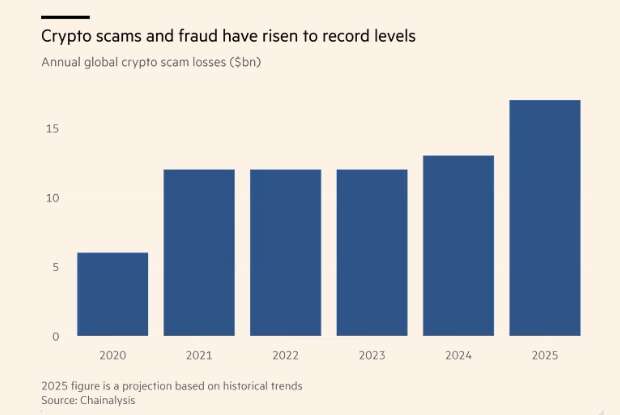
Worldwide, losses to crypto scams and fraud such as fake investment schemes rose to $17bn last year, up from $6bn five years earlier, according to crypto tracing company Chainalysis. One of the fastest growing types of crypto scams has been impersonation fraud, it said.
Pontoizeau at the AMF said the French regulator had seen “a few cases of scams” involving fraudsters pretending to be the regulator or a crypto exchange and trying to trick customers of unlicensed companies into transferring their assets into a fake account.
“People pretend to be from AMF staff and tell customers to transfer their assets to a fake website,” he said. “Scammers are trying to use every opportunity and we have warned customers on that.”
The Dutch watchdog, the Autoriteit Financiële Markten, said: “Fraudulent actors may indeed see an opportunity to scam investors/consumers who are or will be in the process of looking for an alternative licensed provider [after the new regime came into force last month].”
Tom Keatinge, founding director of the Centre for Finance and Security at the UK-based Royal United Services Institute, said: “This is a prime opportunity for fraudsters, who often prey on regulatory uncertainty.
“People facing all the doubt and disruption of their EU crypto wallet provider shutting down will be more exposed to traps set by criminals who may set up fake websites and try to get them to move their money,” he added.
Some EU countries have seen a “deluge of last-minute applications” for licences, according to one lawyer, who added that it remained to be seen “how much power” national regulators would have to go after scams and unlicensed companies.
The AMF has sought to reduce the risk of fraud by refraining from imposing an aggressive deadline on when it expects unlicensed crypto companies to wind down their French operations.
“We wanted to avoid a false emergency feeling among clients because this is the exact situation when clients fall into the trap of scams,” said Pontoizeau. “Take your time to make a wise choice of the crypto-asset service provider that you want to use.”
Pontoizeau said the AMF would inform law enforcement authorities when finding criminals impersonating the regulator or licensed crypto companies.
The Dutch regulator said crypto traders “should be cautious” when a third party asks for funds to be transferred, and that they should “check publicly available information (website and app) and in case of doubt avoid such transfers”.

World Affairs Correspondent
Read more similar news:
Comments:
comments powered by Disqus