European goods reach Russia through India despite sanctions
Russian defense and security firms are using supply chains in India to import thousands of security-linked goods originally made in Europe, new data tracking the scale of the trade shows.
As reported by Politico, New Delhi’s recent trade deals with the U.K. and the EU risk further exposing exports of sensitive and dual-use goods to Russian-linked industrial supply chains on the subcontinent, researchers warn.
Europe and the U.K.’s new trade agreements with India offer significant economic opportunities. But they also require that governments and businesses take “a clear-eyed view of the competitive landscape alongside these opportunities,” said David Vigneault, chief intelligence officer at Strider Technologies and former head of the Canadian Security Intelligence Service.
Strider researchers tracked 50,000 controlled or sensitive goods from third countries that were routed to Russia through India after President Vladimir Putin ordered the full-scale invasion of Ukraine in February 2022.
The firm analyzed customs data using globally standardized product codes to identify European-made products that were subsequently exported from India to Russia, revealing the scale of the trade for the first time. The products included electronics, machinery, precision instruments, transport equipment, metals and advanced electrical components.
European origin of sensitive and dual-use goods exported from India to Russia
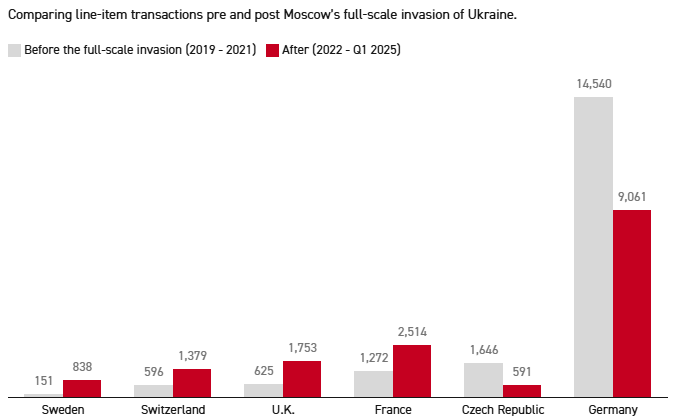
Between the invasion and the start of 2025, the data shows a sharp increase in the export, from India to Russia, of sensitive or dual-use goods originating in the U.K. (+180 percent), Switzerland (+131 percent), Sweden (+455 percent) and France (+98 percent) compared to the three years before Moscow’s assault.
Export volumes of German-origin goods remain significant, even though the trade is declining.
Last year, French-origin carbon fibers reached a Russian firm designated as part of the country’s military-industrial complex, the researchers found. Carbon fiber is used in aerospace, drones, missiles and other defense products; the importer supplies multiple sanctioned firms.
Components originating in the EU or the U.K. also risk being assembled in India into finished products for onward shipment to Russia. State-owned defense conglomerate Rostec’s joint ventures with Indian partners under New Delhi’s “Make in India” manufacturing push underscore the hazard.
A growing number of line-item transactions for sensitive goods exported from India to Russia also originated in the U.S., Japan, Canada and Australia.
Historic ties
The findings reinforce a growing body of evidence that India has become an important conduit for sensitive Western technology entering Russia despite sanctions.
“This is something we’ve seen repeatedly since 2022, and we’re likely going to continue to see,” said Nicholas Fenton, associate director for the Europe, Russia and Eurasia Program of the Center for Strategic and International Studies. In a recent report by the center, Fenton and his co-authors identified India as a possible supplier of critical electronics to Russia based on a review of customs data.
The Russia-India relationship dates back to India’s Cold War ties with the Soviet Union. India remains one of Russia’s largest arms customers, while Moscow increasingly relies on Indian manufacturing supply chains to help sustain its war effort, Fenton explained.
“When we look at captured Russian weapon systems, drones, what have you, and the Ukrainians go and open them up, there are all these Western components inside,” Fenton said.
European exports risk further fueling Russia’s war effort. As European companies expand manufacturing and sourcing in India, analysts warn the challenge could become even harder to police.
Firms are now able to trade under the terms of the U.K.-India trade deal, which took effect on July 15, with ratification of the new EU-India trade deal expected early next year. With firms increasingly viewing India as a manufacturing hub, defense partnerships between India on the one hand, and the U.K. and the EU on the other, are also deepening security and dual-use supply chains on the subcontinent.
Since the Ukraine invasion, Moscow has also worked to expand its defense and dual-use supply chains in India. In December 2022 the Confederation of Indian Industry hosted Russian oil and gas, aerospace, mining, financial services, telecoms and cement firms that could have dual-use military and civilian applications on at least three trade missions to New Delhi and Mumbai.
Crackdown coming?
The same industrial ecosystems that are attracting Western investment are also giving Russia access to sensitive technologies.

“Our research shows that Russia is leveraging many of these same manufacturing, research and technology ecosystems to preserve access to critical capabilities and evade sanctions,” Vigneault said.
New Delhi’s “Make in India” policy is making it easier to route Western-origin components through Indian intermediaries, the Strider report finds. “As India deepens its role as a global manufacturing hub, the opacity of complex, multi-jurisdictional supply chains will increase the enforcement burden on European companies,” it states.
Analysts caution that tightening enforcement will be far from straightforward, given the complexity of global supply chains and the proliferation of dual-use technologies.
“Cracking down on this is very tricky. Supply chains are extremely complex, more and more goods have dual-use utility, and companies continue to find new ways to evade detection and enforcement,” said Katja Bego, a senior research fellow at Chatham House’s Europe program.
Bego said Europe has little appetite to take a harder line with India as it seeks to diversify trade and supply chains away from China. Effective enforcement, she said, would require much closer intelligence-sharing and cooperation between governments and companies. “This takes significant resources, which are currently not available at scale.”
British and European firms “need to be especially rigorous” in scrutinizing their suppliers and customers, Fenton said.
“Obviously, this is hard. It takes coordination,” he said. “That’s why coordination between allies and partners here is really critical.”

Editor-in-Chief
Read more similar news:
Comments:
comments powered by Disqus