Far-right protests leave women’s refuges fearful and survivors afraid to seek help
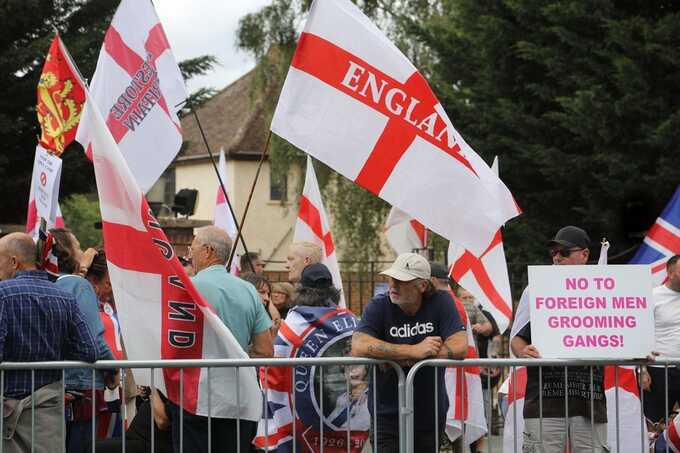
Sikh Women’s Aid was expecting more than 150 guests at a remembrance event for victims of domestic and honour-based violence. But a far-right anti-immigration protest had been planned nearby the same day and, as the start time drew closer, the room wasn’t filling up.
“The community were just too fearful,” recalls Sukhvinder Kaur, chair of the Midlands-based charity. “Even to our own staff, we were saying: don’t travel alone, cover your face, stay safe.”
In the end, just 37 people attended.
That was in July 2024, the start of a summer when riots broke out across the UK, sparked by false rumours that the killer of three young girls in Southport was a Muslim asylum seeker.
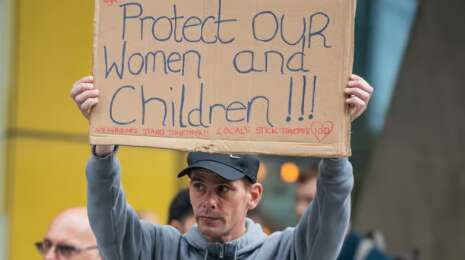
In the ensuing months, far-right protesters rallied around what has since become a pervasive trope: that British women and girls need to be protected from violent migrant men. That rhetoric was repeated by the crowd that gathered in Dover earlier this month, this time clad in black and wearing masks.
At Sikh Women’s Aid, a charity set up to protect women from violence, the effect of this activity has been immensely damaging. Workers have been equipped with panic alarms and so-called tactical pens, which double as a self-defence tool. They are encouraged to wear face masks in public and turn their ID badges inwards.
Risk assessments and detailed safety planning have become the norm for routine activities like supporting survivors in court. Public-facing events are held on police property or come with an expensive security bill. Vital services have been changed from in-person to remote.
As Kaur puts it: “Violence against women and girls is being weaponised to turn people against each other.”
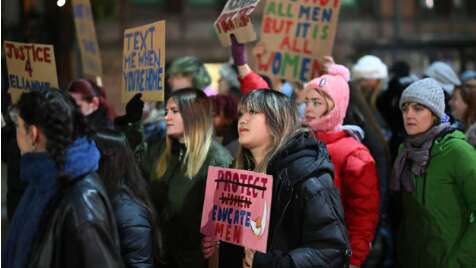
She is one of a number of representatives from across the UK’s women’s sector who told us how, far from tackling violence against women, far-right activity has actively disrupted frontline women’s services – and ultimately left victims more vulnerable.
Labour MP Diane Abbott, said our findings showed that “the far right’s claims to be protecting women and girls are a grotesque distortion of reality”.
State of fear
The 2024 riots were an example of what Kaur says has been “hit after hit” since the formation of Sikh Women’s Aid in 2021: from the racist backlash to Britain’s so-called “grooming gangs” scandal, to the religiously aggravated rape of a Sikh woman in Walsall in 2025, and the murder of student Henry Nowak by a Sikh perpetrator in Southampton a few months later, sparking another round of far-right protests.
“A constant state of fear, and adjusted living and working, is just part of our everyday life now.”
For her charity, this has meant moving services online or over the phone out of safety fears. A number of other organisations told us they had temporarily closed services when their local areas were affected by far-right protests.
A survey this year by Women’s Aid of domestic abuse services in England found two had closed and cancelled face-to-face appointments during the 2024 riots, despite the events having pushed up demand, particularly from Black and minoritised survivors.
Campaigning and advocacy work has also been affected. “We were set up to address inter-community violence and we routinely call out perpetrators in our own community, but now our narrative is getting lost,” she explained.
“When a white man rapes a woman, nobody holds all white men responsible. But we have to carry the weight of every bad apple – it just takes one person and suddenly it’s, ‘Send all migrants home.’ That’s a huge challenge for our work.”
Almost 500 miles north, in Inverness, Rape and Sexual Abuse Service Highland found itself facing similar challenges in December 2025 when a planned Reclaim the Night march fell within days of a far-right protest to oppose the use of a nearby barracks for asylum accommodation.
“We had concerns that our march had the potential to be co-opted by those groups or inadvertently further fuel public fears and safety concerns,” says CEO Romy Rehfeld. “And we were also aware that Reclaim the Night was borne out of sexual violence perpetrated by strangers, at night, on the streets.
“Given that the vast majority of sexual offences are perpetrated by someone known to the survivor, at home, we worried there was a risk of undermining our own efforts to debunk misconceptions and myths given the political climate at that time.”
Victims left vulnerable
In Tamworth, Staffordshire, violence broke out at a Holiday Inn in August 2024, when protesters gathered to oppose the use of the hotel for asylum seekers – many of whom, it later transpired, were women fleeing domestic abuse. Two women, Memory and Maria, told Women For Refugee Women that the summer’s hotel protests had been retraumatising and left them feeling unsafe in public.
Services we spoke to described a range of impacts on victims and survivors of violence, particularly those from BME and migrant backgrounds.
Ngozi Fulani, CEO of London-based Sistah Space, which supports women from African and Caribbean backgrounds, noted that service users with insecure status have become increasingly reluctant to seek help.
Statistically, the most dangerous place for a woman is the home – not outside a refugee hotel or whatever the far right likes to claim, - Sophia Beach, Women Against the Far Right
“They don’t want to bring attention to themselves – they don’t want their houses burned down,” she says. “They suffer their abuse quietly, and perpetrators know that as well. So what the far-right are doing, actually, is helping perpetrators.”
Kaur puts it just as bluntly: “We see women in our community essentially saying, ‘Better the devil you know than the one you don’t.’” She says media coverage of “false” asylum and benefit claims has dissuaded many service users from engaging with these systems, leaving them trapped. “Often [the woman] ends up staying with the abuser, because the risk away from him is too great.”
A safety guide published in English and Punjabi on Sikh Women’s Aid’s website has been downloaded almost 8,000 times, Kaur says, far outstripping any previous website traffic.
This heightened fear among survivors is justified, she says. Sikh Women’s Aid supported the survivor in a high-profile 2025 case, when John Ashby was convicted of the racially aggravated rape of a Sikh woman he thought was Muslim.
“She was looking at online comments saying things like, ‘She shouldn’t have been in this country anyway’ and, ‘It’s better she was raped by a white man,’” Kaur says. “These are the types of things we’re now trying to shield our survivors from.”
Fighting back
In July 2023, the End Violence Against Women Coalition, made up of almost 200 women’s organisations and activists across the UK, collaborated with Hope Not Hate to publish a guide to challenging the far right’s weaponisation of violence against women. In the years since, opposition has only grown.
Just last month, Glasgow and Clyde Rape Crisis made headlines when it turned down a donation from a group known as the Scottish Citizens’ Army. In a statement, the organisation said they had concerns about “link[ing] sexual violence to someone’s immigration status.”
Last year, the campaign group Women Against the Far Right (WAFR) was set up in response to another summer of asylum accommodation protests.
“We’re very clear that sexism and misogyny is something that’s ingrained in our society and not just committed by refugees and asylum seekers, so we exist to counter that racist narrative,” says steering committee member Sophia Beach. “Statistically, the most dangerous place for a woman is the home – not outside a refugee hotel or in an Uber or whatever the far right likes to claim.”
In fact, says Beach, much of the misogyny she has experienced recently has been at the hands of protesters “claiming to be on the side of women”.
“Every single time we’ve called a counter-demonstration, men on the far-right side have been more than happy to hurl abuse at women protesters, saying we’re stupid, that we’re traitors to our own country,” she says.
A WAFR member carrying a Palestine flag at one recent counter-protest, Beach says, was met by protesters who shouted at her “about how likely it was she would be assaulted or raped in Gaza”.
Beach also points to police data obtained by the Guardian showing that one in five people arrested during the 2024 riots have since been reported for domestic abuse.
“Targeting victims of rape or domestic abuse is the opposite of protection and adds a new layer of trauma,” Labour’s Diane Abbott told us.
“Thankfully more and more women are speaking out about this and organising against it. We must encourage and support them as much as possible.”

Deputy Editor
Read more similar news:
Comments:
comments powered by Disqus