Eton gives every new boy an iPad despite parents’ warnings over screen addiction
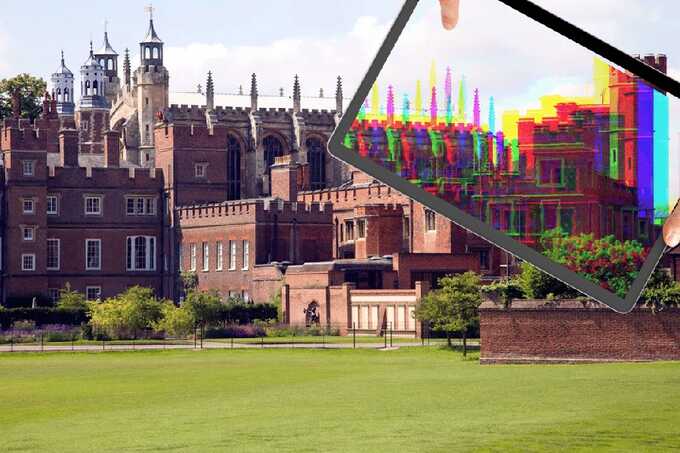
Eton College is better known for princes and prime ministers than iPads but every new boy at the school is now handed one – and much of their work depends on it.
For Isaac’s* 13-year-old son that became a problem after he developed a screen addiction and a psychologist advised him to stay away from online devices. When he asked to hand back the iPad and return to pen and paper, Eton refused.
He was not alone. More than 100 Eton parents backed a letter in 2024 warning of “clear evidence of harm to a significant number of boys in the school’s care due to screen addiction”, we can reveal. The letter, which has not previously been made public, said families who wanted their sons to stop using the school-issued devices had no way to opt out.
Eton told us: “Our approach has been developed over many years following extensive consultation with pupils, parents and staff and is informed both by independent expert advice and by the sharing of best practice with others in the education sector.”
Eton’s influence reaches well beyond its own classrooms. The public school has long set an example for others at home and abroad, and its research centre says it aims to play a “sector-leading role” in sharing best practice across education. Even as its own parents were pushing for restrictions on iPads, it was helping Holyport College, a nearby state school it sponsors, to introduce them.
Jane Rowland, director of the campaign group SafeScreens, said: “If Eton, one of the most well-resourced schools in the country, cannot stop pupils using one-to-one devices in ways that are distracting or to access non-educational and often inappropriate content, what confidence can parents at most other schools have?”
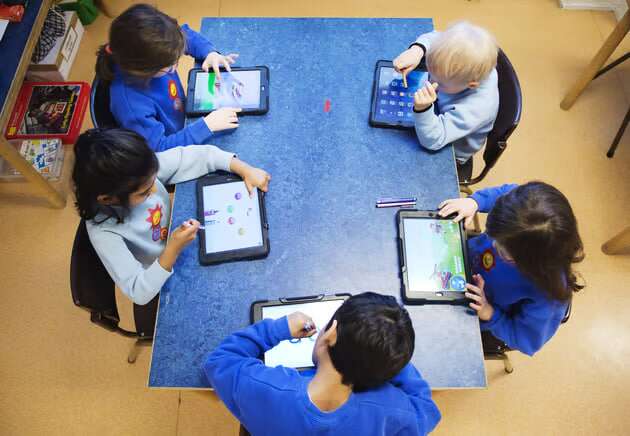
State schools have gone the same way, a shift that began before the pandemic and has accelerated since. Around 960,000 UK pupils – including about 270,000 at primary school – use an individual screen in nearly every lesson, according to polling commissioned by SafeScreens. A further 2.6 million use them daily.
Parents at state schools told us they had also struggled to opt out, and that refusing a school-issued device meant refusing the education on offer. One mother we spoke to has taken her children out of school altogether.
The Department for Education (DfE) has yet to demonstrate that these devices actually benefit pupils. Lord Nash, a Conservative peer and former schools minister, said there had been “an explosion in the use of one-to-one devices in schools with very little evidence to support it”.
“Our children are being used as guinea pigs,” he said, “and that will continue until only products which have been proven to be safe are allowed in schools.”
‘Gross failure’
Isaac’s son Anton* started at Eton in September 2023. His father knew he would be given an iPad for lessons but had chosen the school partly because of its strict device policy, believing it would keep Anton’s screen use under control while he lived there during term time.
Within weeks, Isaac told us, Anton was using his new iPad to play games for hours at a time. Some evenings he had “forgotten to eat or drink” all day. Anton said iPads were “used for everything” at school and that at his worst he was spending 12 hours a day on screens.
By the holidays, says his father, Anton had lost a lot of weight. A school counsellor recommended that he go cold turkey from screens. When adults tried to take his iPad away, Isaac recalls bouts of aggression and withdrawal. Other times, Isaac said, Anton begged them to help him stop.
A psychologist recommended “complete restraint” from online devices after concluding Anton had “an addiction to computer games”. When Anton tried to hand in his iPad, the school told him that was “not possible with our academic policy”.
Around the same time, other families were raising similar concerns. A dossier of unpublished parent testimony shared with the Bureau described boys’ distraction from schoolwork and struggles to concentrate since the iPads were introduced. One parent described “school iPad-enabled gaming addiction” as “a gross safeguarding failure”.
In December 2024, over 100 parents backed a letter to the school, which we have seen, saying Eton’s technology and screen policy was “failing” their kids.
Eton said: “We have clear and well-established processes for responding to concerns raised by pupils, parents or staff, ensuring that issues are addressed promptly and appropriately, as happened in the cases referenced. Any suggestion that concerns relating to screen use or online activity have been disregarded is not correct.”
Even as Eton parents were pressing it to restrict iPads, it was helping another school introduce them. Holyport College, a state school near Maidenhead for which Eton is educational sponsor, approved a one-to-one iPad rollout for Years 7 to 10 in 2024. Eton also loaned devices to Year 11 pupils and provided digital coaching and support for what it called “digitally enhanced pedagogy”.
Eton did not directly answer whether it had supported Holyport’s rollout while its own parents were raising concerns.
Customers for life
Schools are a valuable market for tech companies. They are involved in education through programmes like Apple’s Distinguished Schools scheme, for which schools must use Apple products in the classroom to qualify. In return, the company offers access to events, experts and a network of other schools. Google and Microsoft run their own versions.
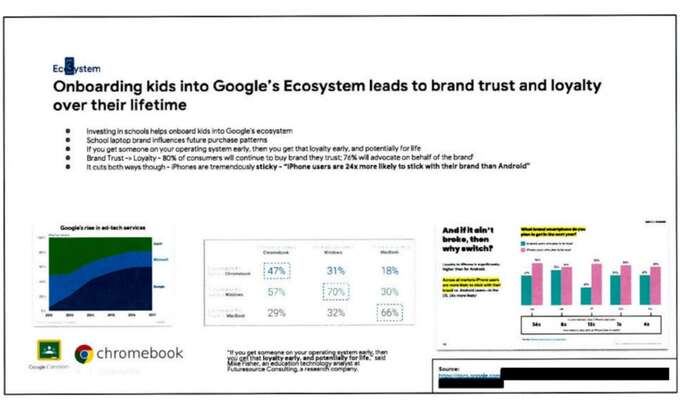
The companies pitch these schemes as investments in education. But an internal Google presentation from 2020, made public as part of US litigation, spelled out the commercial motive: “Investing in schools helps onboard kids into Google’s ecosystem.” Early adoption of Google could create brand loyalty “potentially for life”, it said.
One source with direct knowledge of schemes run by Apple, Google and Microsoft told us that while the schools can get a lot from these schemes, “you have to see it for what it is, which is essentially a large marketing ploy into education. I’m not saying that they don’t care about education, but education is not their main raison d’être.
“It’s a business play.”
A Google spokesperson told us its education tools combined learning science with strict privacy protections. It did not directly answer questions about the presentation or the commercial benefits it gains from schools.
The schools, meanwhile, say they want technology to benefit their students. Eton’s head of digital education wrote in 2019 that early use of tablets had produced “deeper learning” and “greater engagement”, and could encourage independence, collaboration and creativity.
That year, in Eton’s Journal for Innovation and Research in Education, Kevin Burden, professor of educational technology of the University of Hull, said digital devices, when used innovatively, had been seen to help students become “more engaged and stimulated” (although any rollout initiative would need a “rigorous and transparent evaluation”).
Burden previously ran a university centre recognised by Apple as a Regional Training Centre and was later invited to speak at Apple education events about the benefits of “mobile learning”. In 2012, he led an evaluation of an iPad pilot in eight Scottish schools which recommended one-to-one devices and broad pupil access.
Burden did not respond to a request for comment.
When Eton started its own pilot in 2019, the Scottish Borders Council also approved its iPad programme for pupils and teachers across the region.
‘We’re Apple teachers’
Anita* is a single mother of two primary-school children in the Scottish Borders, where pupils across are issued devices by the council as part of its digital-learning programme.
“Sometimes my daughter would come back and she basically would have been on screen the whole day,” she said. Anita noticed that her daughter struggled to write continuously and became frustrated quickly – issues that eased once she began doing more work on paper at home.
Her son complained that his eyes hurt after school. “I came back all cranky,” he said. “I used to get fed up just doing the same things all the time with all the screens every day.”
When the school sent her an agreement for her son to take an iPad home, Anita refused to sign it and requested for her children to not use devices at school. The school said it was “unable to withdraw consent” because digital technology was central to the delivery of the curriculum.
Anita eventually applied to home educate both children, who she took out of school this month. “I don’t feel I’ve got the choice when I’m being told it’s either internet or home ed,” she said.
A Scottish Borders primary teacher and parent said the council had built the devices into its local curriculum. “I think they would make your life difficult if you were to opt out as a school,” she said. “And as a parent, you can’t opt out, seemingly, unless you want to home-school.”
Scottish Borders Council confirmed that online resources were “not subject to parental opt-out” but said it was not council policy for parents to home-educate if they disagreed with how lessons were delivered.
The government should be much less cavalier about device adoption, - Baroness Kidron
Another mother, whose 11-year-old daughter has complex additional support needs, visited the support unit at the secondary school her daughter was preparing to join. “Every room I looked into was about 10 kids on iPads,” she said.
Even in the sensory room, a child was on an iPad. She said the teacher who ran the unit had an Apple logo on his door, as did his colleagues. “We’re Apple teachers,” he told her.
‘Where is the evidence?’
Scottish Borders Council told us every school inspection since its device rollout had found effective use of digital technology. But it did not point to any evaluation of the programme’s effect on attainment or wellbeing.
Professor Alison Clark-Wilson of University College London, worked in education technology for 30 years, said researchers had never been able to show that “when we put all these devices into schools, we improve the education system”.
Anton’s family withdrew him from Eton and sent him to a school where classroom technology is kept to a minimum. He left with top marks in his GCSEs. “I never saw a screen,” he told the Bureau.
This summer Eton tightened its device policies. Internet access is more restricted, teachers can lock devices into selected apps and younger boys hand their iPads in each night. But every new boy still gets one.
The Department for Education told us schools were “best placed” to decide whether individual pupils would benefit from one-to-one devices and should consider parents’ views, but did not say whether parents should be able to refuse one.
Lord Nash asked the department in July what evidence it held on the impact of devices on learning. “It pointed to programmes which are still being set up,” he told us. “And it confirmed that its survey of schools ‘does not include specific information about use of devices during lessons or for homework’ – which cannot be right.”
The department told the Bureau it had invested £24m to build evidence of what works, but said that it does not routinely collect data on how much time children spend using school devices.
Baroness Kidron a crossbench peer and longtime digital rights activist, warned against importing the tech industry’s “minimum viable product” model into schools, where products can be launched in basic form and expanded before their effects are fully understood.
“The government should be more cautious,” she said. “School is compulsory for most children and the DfE is in loco parentis – they need to be much less cavalier about adoption, and much more cognisant of child development concerns.”
Apple did not respond to our request for comment.

Deputy Editor
Read more similar news:
Comments:
comments powered by Disqus