England’s illegal children’s homes industry exposed after £250m paid for unregistered placements

The booming illegal children’s homes industry in England has been revealed for the first time, setting out the sheer scale of this shadow industry and the amount of public money being poured into it.
Payment records we have obtained from local councils reveal that hundreds of businesses are running children’s homes that are not registered with Ofsted. In total, they have been paid a quarter of a billion pounds in taxpayers’ money.
Unregistered homes are subject to no routine inspections and offer no guarantees of quality or safety. Operating them is a criminal offence. But a chronic lack of legal provision means councils are increasingly turning to them as a means of housing the country’s most vulnerable children.
Our investigation reveals that over the last two years, more than 480 private companies have operated illegal children’s homes, receiving £250m for 1,800 placements.
Given that nearly half of local authorities in England failed to respond to our freedom of information requests, the true figures are likely to be far higher.
We have also traced £40m of that money to companies linked to care failings, including those involved in the care of a teenage girl harmed in a succession of illegal homes in Peterborough.
Our findings lay bare the reality of an industry that operates without regulation. Some companies are run by people with no previous experience in care work: directors are security bosses, or come from the music business or the military. One company in our dataset is owned by an overseas private equity firm.
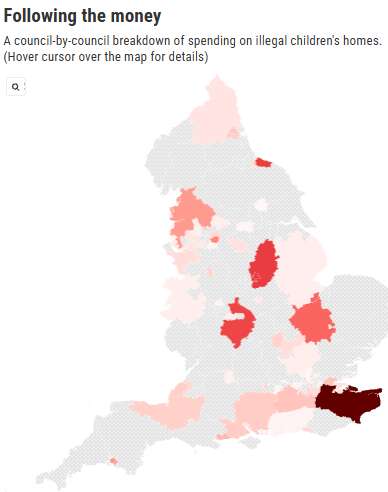
Many of these companies have no public profile, their names familiar only to council commissioners. Yet they are handed huge sums of public money to supervise some of England’s most at-risk children: at least eight councils paid companies over £1m for a single placement.
Rachel de Souza, the children’s commissioner for England, said our findings showed wider failings in the care sector.
“Local authorities are paying extortionate sums of money for placements that were intended as an emergency measure but have since become an accepted part of the system,” she said.
“This investigation raises serious questions about the millions spent by local authorities on placements when they cannot guarantee that vulnerable children are receiving the safeguarding and quality of care they need.”
How to prosper
The company to have received the most money relating to illegal children’s homes is an agency that provides staff for them.
London-based nursing agency Prospero Health and Social Care has 11 offices in the UK as well as operations in Australia and New Zealand. The company’s accounts show owners Robert and Lesley Grays received more than £4m in dividends in the last two financial years. In the same period local authorities paid Prospero at least £7.6m for staffing illegal homes, our investigation found.
Despite the legal questions around such arrangements, the company openly advertised roles in “unregistered settings” on its website. In a statement, it said this wording described the “range of council-arranged environments in which staff might be asked to work” and was not intended to give the impression that the company was responsible for illegal accommodation.
This speaks to an important grey area. It is illegal to “carry on or manage” a children’s home without Ofsted registration – but in these circumstances, who does that refer to? The local authority that arranges the placement (and often rents the property) or the agency that provides the workforce?
Ofsted says both may be liable but so far has shown little appetite for prosecuting councils. With the first illegal children’s home prosecution only taking place this month, the distinction has yet to be fully tested in practice.
Prospero does not accept it has broken the law. “Prospero is a provider of staffing services,” a spokesperson said, adding: “We do not own or provide accommodation, operate children’s homes, commission placements or decide where a child is placed. Responsibility for placement decisions, assessment, care planning, care, supervision and control remains with the local authority responsible for the child.”
The company said the £7.6m represented revenue for staffing and support services, “not payment for placements and it is not profit”.
Our data points to widespread concerns about the care provided by Prospero’s workforce. Seven of the 14 English councils to have paid Prospero for illegal placements told us they had received safeguarding complaints about its care workers.
In total, councils reported at least 44 allegations that Prospero staff had harmed or posed a risk to children between January 2024 to April 2026. Sixteen have been upheld, four were deemed to be unfounded, and the outcomes of the others are either unknown or pending.
Prospero said it reviews all upheld concerns under its safeguarding, recruitment and misconduct procedures, and refers matters to safeguarding authorities where required. It said an upheld concern is not, in of itself, a finding that a young person was harmed. It could not comment on individual cases, but said all workers supporting children are subject to enhanced criminal records checks and complete mandatory safeguarding training.
To date, no local authority has suspended or ended its relationship with Prospero as a result of any safeguarding matter, according to the company.
New crackdown
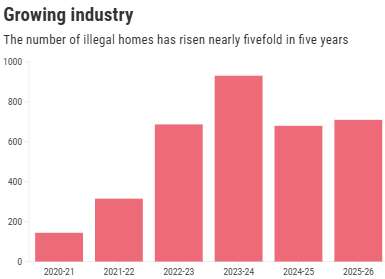
Though the shadow care market has expanded rapidly, with the number of unlawful homes identified growing fivefold since 2020, until recently there had been no prosecutions against companies running illegal homes.
But earlier this month Ofsted secured its first ever conviction, with Catalyst Care Limited fined £92,000 for operating three unregistered homes in Kent. Catalyst has received over £1.7m from local authorities for operating illegal homes.
The company’s directors – which include Davidson Lynch-Shyllon, a songwriter and music producer who has played at Glastonbury – are now banned from holding a financial interest in children’s homes.
Kent Council, which placed 10 children with Catalyst, said unregistered placements were a last resort. It added there was a high level of oversight for these type of settings.
Ofsted’s tougher stance has been driven by growing public outrage. Earlier this year, we exposed one of the worst safeguarding failures so far uncovered in the unregulated market: the sexual abuse of a 15-year-old girl by two ex-soldiers turned carers in a home in Durham.
The then education secretary, Bridget Phillipson, described it as “a case of unspeakable evil” and pledged to end the use of illegal homes.
Announcing a crackdown on unregistered homes in July 2026, Ofsted warned that criminality is an increasing problem in the sector. In August we revealed the links to organised crime from a Merseyside-based children’s homes operator SafeSpace4U.
Our new data reveals that SafeSpace4U has been used by at least seven councils, which puts it in the top 2% of illegal operators in the country. It is currently being criminally investigated by Ofsted.
Care failings
At least 16 companies in our dataset are linked to care failings. These include companies involved in the care of a high-risk teenage girl who was put in 13 unregistered placements by Peterborough City Council.
A safeguarding case review last year found that the girl, who had been deemed to be at risk of criminal and sexual exploitation, had been placed in Airbnbs and hotel rooms as well as “barren and inhospitable” properties. She sometimes lived in empty rooms.
The placements couldn’t meet her needs, the review noted, and her behaviour continued to escalate: she self-harmed and hurt staff. One police officer who was interviewed said: “If she lived with her parents and I came into this house – I’d be removing her for serious neglect.”
The girl told the review she hated her time in care and it made her issues worse.
One of the companies involved in her care, Bristol-based Thornbury Nursing Services, is ultimately owned by Onex, a Canadian private equity firm that has said it will pay out $275m to its shareholders in 2026 so far.
The review into the girl’s care does not name Thornbury, or any other company involved.
Thornbury Nursing Services said it complies with all relevant laws. It said it supplies health care staff when there are limited options but does not operate children’s homes, adding: “responsibility for accommodation and placement decisions sits with the relevant local authorities."
Another agency, CAMHS Professionals, was paid over half a million pounds for staffing the girl’s unregistered placements. The firm said it supplied a large team of qualified nurses at short notice to a home commissioned by Peterborough Council: “CAMHS Professionals did not provide the home for this young person.”
Peterborough Council said it secured the properties and commissioned the companies to provide care and support for the girl. It added unregistered placements were only used when there were no regulated alternatives and were subject to monitoring visits to ensure the child’s welfare.
Holiday loophole
Some of the bigger companies use a loophole in care regulations that allows children in care to spend 28 days “on holiday” in unregistered facilities. But they sometimes stay beyond this legal limit. We found at least 10 companies offering 28-day breaks. Six are among the most prolific unregistered operators in the country.
Ofsted is increasingly concerned that councils are using these “holiday homes” as a normal placement when they have nowhere else to send children.
The victim of the abuse we uncovered in Durham was on one of these placements, and it went on longer than 28 days. Our data shows that the company looking after her, MAP Adventures, has been used by three councils. It has now gone into liquidation.
One of these 28-day providers, Creative Outdoors Group (COG), which is based on a farm in Derbyshire, exceeded the legal limit with nearly half of its 28 placements. A former carer told us a boy lived in a tent on the site for four months in 2022.
The company’s owner, Robert Hutchinson, said young people in COG’s care did not camp more than several days at a time. He added that the boy chose to camp for several nights during the week, spending other nights in the house where he lived: “This person chose to receive his respite care in COG so that he could camp for some of the time he was at COG.”
Hutchinson added that COG provided emergency 28-day respite care, with young people’s permanent address elsewhere. He said the company had supported more than 150 young people since 2016 but did not provide residential care. He explained that young people occasionally stayed with COG for a longer than 28 days if they were doing well. He said Ofsted would not register the company as it provided respite care and psychological therapy.
But Ofsted told us that there are no exemptions for respite care or for providing therapy, and many providers of this type of support are registered with them.
For too long, illegal children’s homes have been allowed to operate in the shadows, - Rachel de Souza, children’s commissioner for England
Another company, Merseyside-based Servizi Care Services, has published testimonials showing it has accommodated at least one child under a “deprivation of liberty” order – a court order restricting a person’s freedom. Ofsted told us any children subject to these orders should be in registered accommodation. The company did not reply to emails and a man answering Servizi’s phone said he “was not interested in speaking”.
The bills for some illegal placements can run to eye-watering sums. For example, Thurrock Council paid DMC Consulting Services, £2.7m to place two children in unregistered accommodation. The council said it carries out rigorous quality checks of unregistered homes.
The owner of DMC, Tawanda Mudavanhu, has 28 other current and past company appointments, including for wholesale, property management, consultancy, renting cars, and electricity trade companies. Mudavanhu told us: “I do not wish to comment on Thurrock Council’s business”.
Illegal care has flourished in the shadows. But now a light is being shone on the businesses profiting from a system wide failure.
As De Souza puts it: “For too long, illegal children’s homes have been allowed to operate in the shadows, where children are treated as a business opportunity, and huge amounts of public money are spent on placements that are not properly registered or inspected.”

Deputy Editor
Read more similar news:
Comments:
comments powered by Disqus