Charles Hernu’s dark past: from Vichy propagandist to Mitterrand’s defence chief
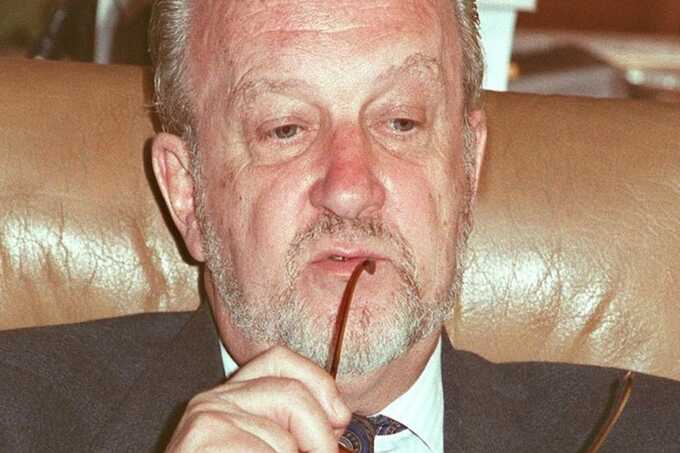
Charles Hernu (1923-1990), a loyal political ally of the late French president François Mitterrand, is for most known only for his role in the deadly bombing attack on the Greenpeace flagship Rainbow Warrior, when he was defence minister between 1981 and 1985. But Hernu’s life is darkened by other scandals. In this episode from a Mediapart summer series on the lives of disgraced French parliamentarians, Jean-Christophe Piot tells the story of how, in the shadows of Hernu’s post-WWII political ascension, lies an inglorious past as a propagandist for France’s collaborationist Vichy regime in Nazi-occupied France, crowned posthumously by the accusation that, early in his political career, he became a spy for the Soviet bloc.
On June 18th 1957, Charles Hernu took part in a commemoration of the celebrated Appel du général de Gaulle in June 1940, a call to arms by General Charles de Gaulle, broadcast from London by the BBC, when the soon-to-be leader of the Free French Forces, exiled in London, called upon his compatriots in occupied France to continue the fight against the German occupation.
The commemoration was held at the mont Valérien, a hill and fortress site in the west Paris suburbs, where a memorial was built in 1945 for members of the French Resistance movement, killed in fighting or executed. Hernu was then aged 33, a loyal ally of former leftwing prime minister Pierre Mendès France and, elected to parliament for the centre-left Parti Radical one year earlier, was already a rising personality among the Left.
In the spring of 1944, Hernu joined the “propagande ouvrière” of Vichy’s information ministry, aimed at rallying the support of workers for the Vichy regime and its ideals.
Attending the homage was routine for politicians, including the promising young Member of Parliament (MP). But suddenly, the ceremony was interrupted by shouting, followed by insults – “Collabo!”, the term designating a wartime collaborator – and the sound of a hard slap to Hernu’s face. It was delivered by former Resistance fighter Georges Jouvent, an ex-paratrooper with the Free French Forces, who had a good 30 combat missions to his CV.
It was an ignominious moment for Hernu, who had never been shy to make known that he had spent several weeks serving with the French Forces of the Interior (FFI), who were made up of numerous Resistance groups, fighting in parallel to the Free France military. But 13 years before that slap on the face, Hernu had indeed begun his career training and working as a propagandist for the services of the collaborationist wartime Vichy regime of occupied France.
Serving Marshall Pétain
The son of a gendarme, Charles Hernu was born in Quimper, in the north-west region of Brittany, in 1923. In 1943, a then 20-year-old Hernu was enrolled into what was called the Chantiers de la jeunesse de Vichy, which was obligatory for many young French men at the time. It was a paramilitary corps established by the Vichy regime as a replacement to national service, and one of its purposes was to inculcate French youth with the ideals of the regime.
In the spring of 1944, Hernu joined the “propagande ouvrière” of Vichy’s information ministry, aimed at rallying the support of workers for the Vichy regime and its ideals, in the city of Lyon (which Hernu would, much later, make his political fiefdom). In April that same year, he enrolled at the École des cadres du Mayet-de-Montagne, a Vichy-run school for training the regime’s future propagandists. He graduated several weeks later and was appointed as the head of “social information” for the Isère département (administrative area equivalent to a county), which stretches south-east from Lyon. His mission was to encourage collaboration and to sooth the hostility of industrial workers against the service du travail obligatoire, the compulsory nationwide deportation of hundreds of thousands of French workers to Germany to fill the manpower shortfalls of the Third Reich.
It was hardly a judicious choice of career in 1944. Following the liberation of France, Hernu was arrested and imprisoned for three months in Grenoble, the capital city of the Isère département, for collaborationist activity. But to that was added a complaint filed against him by Arthur Wolberg, a Jewish furrier based in Grenoble. In June 1944, Hernu had obtained from the local prefecture a requisition order for Wolberg’s shop, which had been sequestered during the Occupation under anti-Jewish laws. Wolberg accused Hernu of robbing him of goods worth 3200,000 francs (equivalent to 6.7 million euros today). Questioned in prison over the complaint, Hernu denied robbery, but admitted that he had obtained the requisition of the store.
His brief detention was followed, on his release, by a similarly brief inclusion into the FFI. But after the liberation he had difficulty in erasing the trace of his pro-Vichy past. He was, of course, not the only one who would try to do so.
From Pierre Mendès France to François Mitterrand
In 1951, Hernu popped up on the political scene, joining the Parti Radical and reviving a sort of think tank precursor called the Club des jacobins., which brought together supporters of Pierre Mendès France, the tutelary figure of the French post-war Left. First elected to parliament in January 1956 in a constituency made up of east-Paris suburbs (he would next stand in Lyon), Hernu made a name for himself clamouring for the resignation of the then-justice minister, François Mitterrand.
However, after the return to power of Charles de Gaulle in 1958, Hernu became close to Mitterrand, joining, in 1965, the Convention des institutions républicaines (CIR), a centre-left party founded by Mitterrand one year earlier, before then joining the French Section of the Workers’ International (the SFIO, which later became the Parti Socialiste).
Hernu, who had never previously exercised the least role in government, was parachuted into the job of defence minister.
Hernu became Mitterrand’s PR chief during the latter’s unsuccessful 1965 presidential election campaign, and in 1971, at the third national congress of the Parti Socialiste (the congrès d’Épinay, which unified differing socialist groups), he was a front row witness of Mitterrand’s election as the party’s leader. Elected in 1977 as mayor of Villeurbanne, a suburb of Lyon with a population then of around 115,000, he also became its MP the following year.
The major accomplishment of his career, however, came after the election of Mitterrand as president in 1981 and, with the victory of the Left in legislative elections that immediately followed, the formation of a socialist-led government. Hernu, who had never previously exercised the least role in government, was parachuted into the job of defence minister.
Hernu’s appointment was Mitterrand’s attempt to reassure the French military; long opposed to the principle of nuclear dissuasion, the Parti Socialiste had latterly changed its position, in no small part due to Hernu, who championed a strong militarily in possession of an arsenal of nuclear weapons. Whereas the “common programme” of the parties of the Left, detailed in 1972, included the abandonment of France’s nuclear deterrent, in 1981 Mitterrand decided to maintain it.
In May 1983, Hernu was pushing for the adoption in parliament of draft legislation outlining the long-term programme for France’s nuclear arsenal. Two years later, it was with that vision that he gave the go-ahead to an operation that was to be one of the most spectacular failures of the French secret services.
Deadly bombing in Aukland
In the spring of 1985, while France continued its testing of nuclear warheads on the remote atoll of Mururoa, situated in French Polynesia, in the southern Pacific Ocean, the environmentalist NGO Greenpeace was planning a major protest campaign against the tests (which had first begun in 1966). The French government was particularly concerned about the NGO’s plans. Hernu asked the French foreign intelligence services, then called the Direction générale de la sécurité extérieure (DGSE), to prepare a choice of counter operations. On May 15th, the head of the DGSE, Pierre Lacoste, met with Mitterrand who secretly validated the principle of an operation in New Zealand for the blowing up and sinking of the Greenpeace flagship, the Rainbow Warrior, when it docked in the port city of Aukland at the start of the NGO’s protest.
The director of France’s counter-espionage services, Jacques Fournet, later recalled that when he handed Mitterrand the file on Hernu, the president told him: “Consider, Mr director, that this concerns a state secret.”
On July 7th 1985, Hernu in turn validated the operation. Three days later, the ship’s hull was punctured by two bombs, but the DGSE agents had made a terrible mistake. Fernando Pereira, a photographer of Portuguese origin who was accompanying the Greenpeace mission, had returned to the boat to collect his equipment and subsequently died after drowning in the waterlogged hull, ripped open by the second of two bombs planted by the French agents.
Within 48 hours the New Zealand police had arrested two of the DGSE agents. The French authorities pretended to be unaware of the DGSE operation, but the pressure on them grew, and the revelations of Mediapart co-founder Edwy Plenel, who was at the time a journalist with the daily Le Monde, finally lifted the lid of secrecy covering the sabotage. On September 20th 1985, Hernu resigned, protecting Mitterrand by publicly accepting total responsibility for the disaster. Mitterrand would not forget his minister’s loyalty, and after Hernu died of a heart attack at a public meeting on January 7th 1990, the French president attended his funeral.
An agent for the Soviet bloc?
After his death, Hernu once again became the subject of controversy.
François Mitterrand was still president in the autumn of 1992 when the French domestic intelligence services, the Direction de la surveillance du territoire (DST), informed him of a document they had received from Mihai Caraman. The latter had become the head of the Romanian secret services after the fall of dictator Nicolae Ceaușescu in December 1989. Caraman, recently based in Paris, was an experienced old hand in the espionage world, and from the late 1950s had led a group of agents, dubbed “the Caraman network”, which spied on NATO.
The document that Caraman had handed to the DST contained information covering the period 1953-63. It detailed how a person loyal to Pierre Mendès France, and whose pseudonym was “André”, had been recruited by the Bulgarian secret services. In 1956, André was passed on for handling by Russian intelligence before being finally managed, as of 1962, by the Romanian Securitate, this time using the pseudonym of “Dinu”.
The DST identified Charles Hernu as the person hidden behind the pseudonyms. The information alleged that Hernu’s campaign for election to parliament in 1958 was funded by the Soviet bloc, which Hernu’s family have firmly denied.
While the result of Hernu’s alleged collaboration with the Soviet bloc appeared modest, seemingly at most a few notes of little strategic interest, it was an embarrassing accusation for Mitterrand and his government, all the more so given Hernu had served as defence minister. The director of France’s counter-espionage services, Jacques Fournet, later recalled that when he handed Mitterrand the file on Hernu, the president told him: “Consider, Mr director, that this concerns a state secret.”
But on October 31st 1996, the “secret” was splashed over the cover of French weekly news magazine L’Express, under a notably unambiguous headline: “Charles Hernu was a spy for the East”. For having confirmed to L’Express the existence of the file on Hernu, Jacques Fournet was convicted in 2002 of “violation of professional secrecy” and fined 2,500 euros, while the charges against L’Express investigative journalists Jérôme Dupuis and Jean-Marie Pontaut, who wrote the story, were dropped.
Those who uphold Hernu’s innocence argue that his name never appeared in KGB files, that no Romanian agent who crossed to the West said they had heard of “Dinu”, while it is claimed that in CIA archives it is mentioned that at the end of the 1960s, Hernu worked for US intelligence.
Could Hernu have been playing off the ones and the others? His son Patrice insists the accusations were a disinformation operation, hatched in Bucharest or Moscow to discredit his father and, by ricochet, Mitterrand.
Three decades later, the questions remain unanswered. Like so often in cases of espionage, the truth becomes lost in smoke and shadows. What does remain, however, in established historical record is that Hernu had served as a propagandist for France’s wartime collaborationist regime of Vichy, and that he was involved in the planned attack on the Rainbow Warrior, an example of state terrorism, and gave it the green light. That is sufficient in itself for ranking the former minister among the specialists in dirty tricks.

Editor-in-Chief
Read more similar news:
Comments:
comments powered by Disqus