Southern train derailment blamed on “track geometry irregularity” as investigation begins
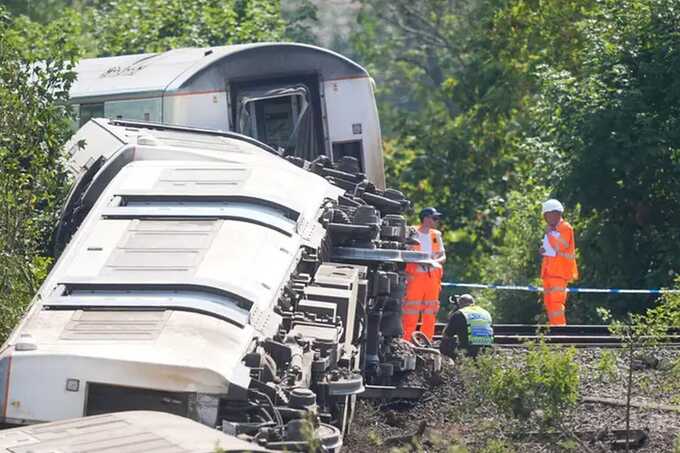
CCTV images from services on the line show the fault, which was described as a “track geometry irregularity”, an interim report by the Rail Accident Investigation Branch (RAIB) said.
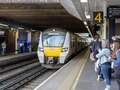
About 150 people were onboard the eight-carriage Southern train from London Victoria to Eastbourne.
Three carriages ended up on their side, trapping passengers.
A total of 30 people were injured, including 20 who required hospital treatment, the RAIB said.
British Transport Police previously said two people sustained serious injuries which were not deemed to be life-threatening.
The report also found the train was travelling at 65mph at the time of the accident, which is within the 70mph speed limit for the area.
Data shows that the driver applied the brakes at the point where the train derailed, with the train beginning to decelerate at this point.

The RAIB said its investigation will consider the weather conditions on August 13, which were hot and sunny, as well as the status of the track, embankment, condition of the train and the effectiveness of any measures taken to address potential issues caused by hot weather.
It said the accident took place "during a sustained period of hot and dry weather", when it was "hot and sunny, with little wind" and around 27C (ambient air temperature).
The RAIB report also went into detail about how the ongoing investigation will be carried out, including analysing the data on the derailed train’s "black box".

Data from the front of the train has already been recovered, while more data from other recorders on the train "will be obtained during recovery operations", the report said.
CCTV recordings from the train have already been recovered, as has signalling data and radio communications.
Examinations of the train, track and embankment through laser scanning and aerial photographs will also be carried out.
The report comes after regular passengers complained that the train had derailed on a notoriously sketchy part of the track.
Passenger Jared Collins, 55, who regularly takes this route home told The Telegraph last week: “There’s always a dip in the line, and everyone jolts backwards and forwards, and I’d think something’s going to happen here.
“It’s a previous problem that’s definitely happened over the last 18 months.”
The paper’s senoir travel writer, Greg Dickinson, who also regularly takes this train, said that "the ongoing heatwave has seen the track behave more like a rollercoaster."
Demanding answers, he wrote:" I don’t care about the compensation. What I would like, instead, are answers as to how this accident on a known ’dodgy bit of track’ was allowed to occur."
Speaking last Thursday evening, South East Coast Ambulance Service deputy chief paramedic officer, Michael Bradfield, said there had been a “mix of injuries of varied severity” among those people taken to hospital.
He described the derailment as “complex and challenging to deal with” and required “a carefully co-ordinated multi-agency response”.
A Department for Transport spokesperson said: “Safety remains the absolute priority across our rail network, and we will ensure the industry acts on any findings in the Rail Accident Investigation Branch’s full report when published.
“The UK’s railways remain among the safest in the world, with the number of delays caused by track faults has falling by 45% since the late 2000s. We’re investing £29 billion to renew and maintain the network and a further £2.6bn to improve climate resilience.”
Rail bosses Lucy McAuliffe, Network Rail’s route director for Sussex, and John Whitehurst, chief executive of Greater Thameslink Railway, said they "remain fully committed to supporting the current investigation".
In a joint statement, they said they are "very sorry that this happened on our railway", adding: "We will carefully consider any recommendations arising from the investigation and work across the industry to implement them, with the shared goal of making an already safe railway even safer for our customers, colleagues and the communities we serve."

Editor-in-Chief
Read more similar news:
Comments:
comments powered by Disqus