Guinea-Bissau bans fishmeal production after sardinella stocks collapse
As the day draws to a close in Bubaque, a remote island in Guinea-Bissau, fishermen are arriving with their day’s catch, pulling canoes onto a muddy bank teeming with crabs.
It’s a common scene here in the Bijagós Archipelago, and elsewhere along the West African coast. And one species is especially prized as a source of high-quality protein — the sardinella.

But the small and silvery fish has been decimated in Guinea-Bissau’s coastal waters, according to an internal fisheries assessment produced for the government and obtained by OCCRP.
The assessment was carried out in 2025 by the Atlantic branch of the Russian Federal Research Institute of Fisheries and Oceanography (VNIRO), which worked with scientists from INIPO, Guinea-Bissau’s oceanographic institute.
While the assessment does not delve into the cause of the decline, a government official attributed it to the recent rise of the local fishmeal industry, which grinds up large volumes of the sardinella and other fish to make a nutrient-dense powder that is fed to farm animals around the world.
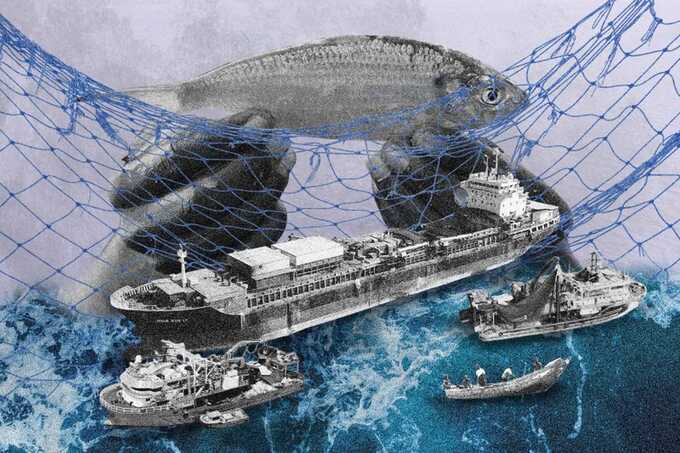
At the time the survey was conducted, fishmeal production in the country was handled solely by two offshore cargo ships equipped with factories on board. Owned by Chinese companies, the two floating facilities — Tian Yi He 6 and Hua Xin 17 — arrived in Guinea-Bissau in 2019 and 2024.


Export data compiled by reporters, and reviewed by a marine biologist, aligns with the conclusion that fishmeal production on the vessels was linked to the collapse of the sardinella.
This January, acting on VNIRO’s findings, Guinea-Bissau issued a blanket ban on fishmeal production.
The sector was clearly to blame for the decline of the sardinella, said Amadú Djaló, director of industrial fishing at the country’s Ministry of Fisheries and Maritime Economy.

The ban is aimed at protecting “fish intended for human consumption, especially for the disadvantaged population,” he added.
After the measure went into effect, the Chinese factory ships and a fleet of Turkish fishing vessels that had supplied them with fish moved south to Sierra Leone — a country whose fish stocks have also been under pressure in recent years — in May and June, marine traffic data shows.

OCCRP reached out with requests for comment to the owners and operators of the vessels, but none responded to the allegations that their operations brought about decimation of the sardinella stock. One of the shareholders of the company owning Hua Xin 17, who also owns companies that operate that ship and the other factory vessel, said he used to be involved but recently cut ties with his business partners, and refused to provide further comment.
The findings of the assessment by VNIRO do not come as a surprise for the fishermen busy offloading their catch on the muddy shores of Bubaque island, which has a population of 4,000.
In the fading daylight on a recent afternoon, they were transferring fish from the ice-filled floors of their motorized canoes into buckets to be taken to market. The catch was made up almost entirely of bonga, a herring-like fish about 25 centimeters long when fully grown.

Overall, the average catch is a lot smaller than it used to be, according to Tejan Joof who oversees a seven-man crew. In particular, he said, the “yaiboi” — the local name for sardinella — has become “too rare.”
Joof said fishermen used to set out to sea and return within a day or two with a full catch.
“Now we need to spend four or five days at sea,” he said. “Sometimes, even with all these days, you don’t even catch what you want before our supplies run out.”
Coastal Crisis
The loss of the sardinella in Guinea-Bissau is not just a localized crisis — it ripples up and down the West African coast. That’s because the nutrient-rich waters around the Bijagós Archipelago, and estuaries elsewhere in the country, are key spawning grounds for a number of migratory species.

The “dramatic decline” of the fish stocks in Guinea-Bissau “should alarm the entire West African region,” according to Aliou Ba, who leads Greenpeace Africa’s oceans campaigns.
“Over-exploitation in one country directly impacts fish stocks, food security, and livelihoods throughout the region,” said Ba.
During their stay in Guinea-Bissau, the two factory vessels were anchored several dozen kilometers off the Bijagós Archipelago, an area made up of 88 islands that was declared a Biosphere Reserve by the UN Educational, Scientific and Cultural Organization in 1996.
Sardinella, and other small pelagic fish, are a vital part of this ecosystem, which is home to dolphins, manatees, sharks, and rays. The mangrove forests and expansive estuaries are also teeming with bird life, including flocks of pink-backed pelicans. And the islands host one of the world’s largest nesting sites for sea turtles.
About 41,924 people, mainly of the Bijagó ethnic group, inhabit the archipelago, and fish provide both jobs and food for the community. Some 120,000 people are employed in the fisheries sector nationally.

But the livelihoods of those fishermen could now be under threat, according to the results of the February 2025 assessment by VNIRO, which was established under the Soviet Union and contributes to global fisheries databases managed by the United Nations Food and Agriculture Organization.
The study specifically focuses on small pelagics, which are migratory fish species that move through the ocean in large schools feeding on plankton. In Guinea-Bissau, such fish account for around a third of the population’s animal protein intake.
Though migratory patterns could play a role, since 2013, when the last such assessment was conducted, the total biomass of the six fish species surveyed in Guinea-Bissau waters declined by nearly half from an estimated 339,680 to 164,700 tons, VNIRO found.
Most of this decline was accounted for by the loss of two species of sardinella: the maderensis and the aurita. The total biomass of maderensis fell nearly 90 percent from 125,027 to 16,433 between 2013 and 2025.
The aurita migrates more widely, but it would be expected to be present at the time of year the survey took place. And yet the assessment detected no biomass at all for the aurita, which had been estimated at 145,082 tons in 2013.
While those alarming results prompted the government to ban fishmeal production in Guinea-Bissau, the recent movement of the Chinese fishmeal factory ships to Sierra Leone raises questions about further pressure on fish stocks down the coast.
In 2023, OCCRP spoke to more than a dozen Sierra Leonean fishermen and all reported diminishing yields in recent years, which they attributed to industrial fishing vessels depleting fish populations.
As of mid-August, both the Tian Yi He 6 and the Hua Xin 17 were loitering at two different locations about 60 kilometers offshore, marine traffic data shows. Four out of six Turkish fishing ships that supplied the fishmeal facotries when they were based off the coast of Guinea-Bissau have also been present in Sierra Leone’s waters, according to marine traffic data.

While three of these industrial fishing boats have kept their vessel tracking systems off when leaving the port area, marine traffic data for the fourth vessel shows it regularly meets Tian Yi He 6 on the high seas.
In a short phone interview, Sheku Sei, acting director of fisheries at Sierra Leone’s Ministry of Fisheries and Marine Resources, said that “all our vessels are authorized” when asked about the status of the Chinese ships and their fishmeal production.
During their previous stay in Guinea-Bissau, one of the Turkish vessels and one of the Chinese factory ships, Tian Yi He 6, were intercepted and fined together on three separate occasions in 2019 and 2020 for offenses that included unauthorized fishing-related operations in a prohibited zone, according to a report by Guinea-Bissau’s fisheries inspection authority body, INFISCAP.
Owners and Operators
To understand the ownership structure behind the vessels, OCCRP obtained corporate, ship ownership, and court records from Guinea-Bissau, Hong Kong, and mainland China. The records reveal overlapping ownership and management of the factory ships, as well as fishing boats supplying them, cargo vessels bringing the product to port, and companies exporting fishmeal.
They also show that a company and personnel connected to the vessels have run into trouble elsewhere.

For example, a man named Lin Zhigao is the manager of Bissau Wang Sheng Fisheries Development Co SARL, an exporting company based in the capital, Bissau, responsible for a vast majority of Guinea-Bissau’s fishmeal exports.
In an advertisement on the Yellow Pages website for Vietnam, the company said it maintained an “offshore factory” producing fishmeal and oil. (Bissau Wang Sheng did not respond to OCCRP’s request for comment, including about its connections to the factory ships.)

Lin is also the chairman and minority shareholder of a Chinese company that owns the Tian Yi He 6, named Weihai Tianyihe Marine Biotechnology Company Limited.
Three years before the 147-meter ship traveled to Guinea-Bissau, authorities in the Chinese coastal city of Weihai suspended that company’s fishmeal operations. The actions were due to the company causing “excessive pollution,” as well as “not implementing mitigation measures and producing illegally,” according to a 2016 letter by the local government agency responsible for environmental protection.
In August 2020, the company’s assets were frozen by a Chinese court over unpaid debts totaling almost $4.6 million. In July 2023, Weihai Tianyihe Marine Biotechnology was put into bankruptcy liquidation. The following year, the order was extended to its subsidiaries, which had accumulated an additional $16.6 million in debt and unpaid taxes.
It is unclear how the Tian Yi He 6 continues to operate despite the order to liquidate the assets of its owner, Weihai Tianyihe Marine Biotechnology. The liquidator appointed by the court did not respond to requests for comment.
The 2020 court document lists Lin Zhigao as chair of Weihai Tianyihe Marine Biotechnology and owner of 13 percent of the shares. In May 2020, Chinese courts froze his assets over an unpaid $2 million debt, and issued a civil detention order for him.
A worker at Lin Zhigao’s office in downtown Bissau told reporters in July that Lin Zhigao was in Sierra Leone. OCCRP managed to reach him via WhatsApp, and he said the Chinese court and Weihai Tianyihe Marine Biotechnology had “reached a settlement agreement.” He did not respond to further questions.
Meanwhile, the fishmeal factory ship that arrived in Guinea-Bissau in 2024, the Hua Xin 17, was part-owned by a man named Zheng Liyong. According to the most recent available records from January 2026, he holds 15 percent of the Hong Kong company that owns the vessel, Bishaohuaxin Co Ltd.
Zheng Liyong also owns two companies that operate the factory ships and the six Turkish fishing vessels that supplied them with fish, according to corporate records from Guinea-Bissau.
Contacted by OCCRP, Zheng Liyong said he no longer owned part of Bishaohuaxin, having had “some disagreements” with the other shareholders who are “all in China.”
“Yes, I used to be 15 (percent), but I’ve left the company now,” he said.
Bishaohuaxin did not respond to a request for comment.
’Deeply Worrying Trend’
The first of the six Turkish fishing vessels that supplied the floating fishmeal factories reached Guinea-Bissau’s waters in November 2019, just 11 days after the arrival of fishmeal ship Tian Yi He 6.
The remaining five Turkish fishing boats joined in 2023 and 2024.
The fleet had previously operated in Mauritania, further north along the West African coast, where 44 land-based fishmeal factories had been built by 2021.
Mauritania has since imposed strict measures on the fishmeal industry due to overfishing concerns, with production more than halved since its peak in 2020, and most of the factories shut down.
The impact that the floating factories will have in Sierra Leone remains to be seen. But OCCRP compiled export data that helps illustrate the effect on fish stocks in Guinea-Bissau.
Prior to Tian Yi He 6’s arrival in 2019, there was no fishmeal production in Guinea-Bissau. Then, in 2020, starting with a shipment of 200 tons of fishmeal valued at $70,000 sent to Vietnam in April 2020 by Bissau Wang Sheng Fisheries Development Co SARL, the country’s exports surged.

By early 2026, this company had exported fishmeal and fish oil valued at least $141 million, according to the available trade data compiled by reporters. (During this time period, the floating factory vessels remained the only producers of fishmeal aside from an onshore factory that opened in April 2025 and exported its own products.)
Of the reported amount, more than $133 million worth of fishmeal and fish oil — which according to OCCRP’s calculations included at least 72,226 tons of fishmeal — went to Turkey and Vietnam.
Taleb Sidi Mahfoud, the director of Mauritania’s Higher Institute of Marine Sciences, said those recorded exports would correspond to at least 350,000 tons of raw fish crushed into fishmeal.

That “would be consistent with the stock collapse documented” by VNIRO, he said.
“The catastrophic decline in sardinella stocks in Guinea-Bissau” is part of “a deeply worrying trend that we are observing across the region,” said Taleb.
His concerns are mirrored in the latest assessment of sardinella stocks by the Fishery Committee for the Eastern Central Atlantic, a body of 33 member nations aiming to promote sustainable fisheries management.
The committee reported in June that both species of sardinella migrating along the West African coast were in “great danger,” describing aurita stocks as “collapsed” and the maderensis as “overexploited.”

For fishermen from the Bijagós Archipelago, like Joof who runs the seven-man motorized canoe, the link between collapsing stocks and the Turkish vessels supplying the fishmeal factories, which he has seen at sea, is obvious.
“They catch a lot of fish, that’s what causes our difficulties,” he said.

Technology & Business Editor
Read more similar news:
Comments:
comments powered by Disqus