Luxury watch theft exposes how organised gangs track high-value targets
Chris* had waited years for the telephone call, which he received in early 2025.
He’d joined the waiting list for a Rolex Daytona and made several smaller purchases from the same major London watch store before he was finally offered the piece he had always wanted.
“It was my dream watch, I was so pleased to finally get called,” he told LBC. “I had literally just got it, I paid almost £50,000 for it.”
Staff placed the Rolex inside a plain, unbranded shopping bag. There was nothing on the outside to suggest it contained a highly valuable watch.
Chris left the shop and drove away. A short time later, he parked on an ordinary side street while he picked something up for his wife.
He was gone for only a few minutes, “I was only nipping into a shop, and when I came back, the side window had been smashed and the bag with the watch in it was gone,” he said.
“That was all they took. Nothing else. Just the bag with the watch in it.”
There were other items inside the car, but the thieves had not searched it or stripped it of anything they could sell. They had broken one window, taken one specific bag and fled.
Chris can’t prove he was followed after leaving the shop. He doesn’t think anyone connected to the store was involved. But the speed and precision of the theft left him convinced somebody knew what he had.
“They didn’t rummage around and take everything they could find,” he said. “They smashed the side window, took the one bag, and left.
“The watch was in a plain bag, so unless someone had seen me leave the shop or followed me, I do not know how they would have known what was inside.
*Chris’s name has been changed by Media to protect his identity

A Rolex Cosmograph Daytona.
But, Chris did not call the police. He did not report the watch stolen. He had no crime reference number, no attempt to trace CCTV and no possibility of recovery.
“Honestly, because I felt like an idiot,” he said.
“I had left an expensive watch unattended in a car. Even saying that out loud makes me wince. It sounds obvious. It sounds like basic common sense. You do not leave something like that in a car, even for a few minutes. I don’t even know the serial number.
“I thought I was just quickly picking something up for my wife, but by the time I came back it was gone.”
His thinking could help to explain why the true scale of luxury watch crime remains difficult to measure.
Victims do not always report what happened. Some feel embarrassed. Others believe the police will be unable to recover the watch, particularly if there is no clear suspect or usable CCTV. Those targeted abroad may return home without contacting the local authorities at all.
Research by The Watch Register, which maintains an international database of lost and stolen luxury watches, found only half of victims had reported their theft to police.
For Chris, the embarrassment was almost as difficult to deal with as the financial loss.
“There was real shame,” he said. “Not just because of the money, but because I felt stupid.
“I had waited years for that watch, finally got it, and then lost it almost immediately because I made one bad decision.
“I thought if I reported it I’d get a crime number, be told there was no CCTV or no suspect, and that would be the end of it. At the time I just did not want to go through the whole thing and feel even more foolish.
“Looking back, maybe I should have reported it. But that is why I didn’t."
Watched, followed and marked as a target
The image of luxury watch crime is often a violent street robbery, a moped pulls up, a victim is threatened and an expensive watch is torn from their wrist.
Those attacks remain a serious part of the problem. But specialists warn that many thefts begin much earlier, when somebody first identifies the watch and decides its owner is worth following.
Guy Welchman, a recoveries specialist at The Watch Register, told LBC that organised gangs use scouts in luxury shopping districts, restaurants, hotels, clubs and holiday resorts.
The initial sighting might happen outside a store, at a hotel bar or beside a swimming pool. The theft may come later, once the owner is alone, distracted or away from security.
“These places like outside Harrods, they have scouts,” Mr Welchman said. “Thieves will have scouts just standing outside the front because they know that the clientele are wearing these expensive things or going in to buy these expensive things.”
The scale of the organisation behind some watch thefts is also being seen by private security teams on the ground. David McKelvey, chief executive of My Local Bobby, told LBC that many of the offenders his patrols encounter are not simply opportunists who happen to spot an expensive watch on somebody’s wrist, but coordinated groups in which different people can have very different jobs.
“Typically, one or more individuals patrol busy locations looking for people wearing high-value watches,” he told LBC.
“Once a suitable target has been identified, information is passed to other members of the group who then follow the victim, monitor their movements and decide the most appropriate opportunity to strike.” He warned the methods range from distraction and surveillance to violent robberies involving motorcycles, bicycles or scooters, with luxury shopping districts, expensive hotels, restaurants, bars and entertainment venues providing what he described as “attractive hunting grounds” for organised criminals.
That was highlighted in June when My Local Bobby officers on a routine patrol in central London became suspicious of a group they were watching and continued to monitor them, eventually concluding that a serious theft was about to take place. The intended victim, Mr McKelvey said, had no idea they were being targeted or even that they were being watched.
His officers intervened before the suspected theft could happen and detained one person. Metropolitan Police officers arrived around ten minutes later and arrested the suspect. “Like many victims of luxury watch theft, they were simply going about their business with no idea they were being watched,” Mr McKelvey said. “It is an excellent example of how private security and the police can work together effectively to prevent crime before somebody becomes a victim.”
Mr McKelvey said his patrols regularly encounter behaviour they believe is consistent with criminals carrying out reconnaissance before an offence, with officers monitoring, challenging and disrupting suspicious individuals and passing intelligence to the Met where appropriate. He said offenders are highly mobile, moving between parts of central London where wealthy residents, tourists and business visitors congregate rather than remaining in one established robbery hotspot.
“Criminals seek opportunity and anonymity. A professional, highly visible uniformed presence removes both,” he said. “It deters offenders, disrupts criminal reconnaissance, reassures businesses, residents and visitors and, as this incident demonstrates, can prevent serious offences before they occur.”
More concerning, Mr McKelvey said his teams have recently encountered a pattern of suspected offending inside bars, restaurants and other hospitality venues in which criminals appear to engage or befriend potential victims before their property is stolen.
He said there have been incidents where his officers suspect a victim may have had a substance covertly put into their drink before becoming disorientated or incapacitated, allowing watches, jewellery, phones and wallets to be taken. He said said suspected cases of this kind are now being encountered by his teams “on an almost weekly basis” in parts of central London. “It reflects the increasingly sophisticated and predatory tactics being adopted by organised criminal gangs,” he said.
My Local Bobby, which was setup in 2016, says its officers have carried out hundreds of interventions involving offences including robbery, theft, burglary, possession of offensive weapons and wanted suspects. Mr McKelvey said the company was never intended to replace the police, but to provide highly visible patrols capable of spotting suspicious behaviour early, intervening where lawful and preserving evidence until officers arrive. “Ultimately, tackling organised watch theft requires a partnership approach,” he said.
“The police, Business Improvement Districts, retailers, hospitality venues, private security providers and the public all have an important role to play. By working together, sharing intelligence and maintaining a visible presence on our streets, we can make central London a far more hostile environment for organised criminals.”
The Metropolitan Police says that work is already having an effect. A spokesperson told LBC that watch theft across Westminster, Kensington and Chelsea and Hammersmith and Fulham, the three boroughs where the offences are most prevalent, fell by more than half during the first six months of 2026 compared with the same period last year, dropping from 213 reported offences to 97.
Across London more widely, theft from the person has fallen by 23 per cent, representing more than 23,000 fewer offences, while personal robbery is down by 11 per cent, or nearly 3,000 offences.
“As a result of targeted patrols and intelligence-led operations, officers are identifying offenders, preventing crime and bringing criminals to justice,” the spokesperson said.
The warning is particularly stark during the summer months, when expensive watches are easier to spot with short sleeves and owners are more likely to be relaxed, drinking or sharing their location online.
Figures supplied by The Watch Register show that 70 per cent of watches reported stolen in the South of France were taken between May and September. In Spain, 60 per cent of reported thefts happened during the same summer period.
“You’re wearing your short sleeves, you’re on holiday, you feel relaxed, you feel like nothing bad can happen,” Mr Welchman told LBC.
“But the sad news is that in the South of France, 70 per cent of the watches that were reported to us were stolen during the summer months. That is quite a good indication of the dangers that come with the summer period.”
Holiday destinations including Ibiza and the South of France have become established hunting grounds for thieves who understand the luxury watch market and know which models can be moved quickly.
Rolex remains the biggest target, accounting for more than half of all watches registered on The Watch Register’s database. Cartier and Omega also appear heavily, while the extraordinary values attached to Richard Mille watches make them particularly attractive.
“We recently had two registrations for holidaymakers in the South of France who had their Richard Milles stolen,” Mr Welchman said.
“The thieves know what they’re looking for. I don’t want to give them the time of day by calling them watch experts, but they know what sells, they know what’s valuable.
“Unfortunately, some people who are wearing these watches in these high-profile locations like Ibiza, the South of France and London still don’t have the awareness that, if you are wearing these £300,000 watches on your wrist, it is a big risk.”
Around one in five watches reported to the database are classed as “thefts from person”, meaning they were taken directly from their owner.
Other victims are burgled or have watches stolen from hotel rooms, vehicles and luggage. In some cases, the thieves also obtain the box, certificate and paperwork, making the watch easier to present as legitimate when it re-enters the market.
About a third of stolen watches registered with The Watch Register are taken with their original box and documents.
More than £1.9 billion in watches
More than 125,000 watches, with a combined value exceeding £1.9 billion, are currently recorded on The Watch Register’s database.
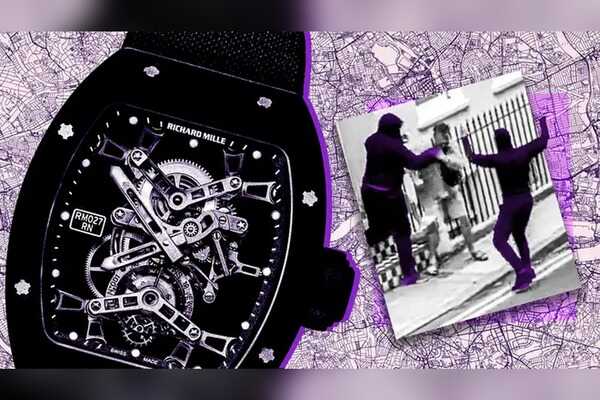
A Richard Mille 027 Carbon Tourbillon “Rafael Nadal” limited edition model valued at £875,000 is the most expensive swiped in London last year, says Katya Hills of The Watch Register.
Two others by the same Swiss watchmaker worth £450,000 and £245,000 were targeted by thieves in 2025.
Dealers, auction houses, pawnbrokers, insurers and other businesses carry out more than 280,000 checks against it each year. More than 6,000 watches have been located since the organisation was established in 2014.
The system relies heavily on serial numbers, but The Watch Register’s research found only one in three owners could immediately locate the serial number for their watch.
Mr Welchman urged owners to photograph their watches, record their serial numbers and store the information separately before travelling.
“Before you travel, or the moment you buy your watch, I would suggest taking note of the serial number, taking a picture of your watch, something simple as that,” he said.
“Make sure you have all the paperwork safely stored. The best thing is to store the paperwork and the box in a secure location separate from your watches.”
Without that information, police, dealers and recovery specialists can find it much harder to identify a watch when it resurfaces.
That may happen quickly, but it can also take decades.
The Watch Register works with police forces and the luxury watch industry around the world to identify stolen pieces when they are offered to dealers, entered into auctions or taken to pawnbrokers.
Mr Welchman said the organisation has recovered watches more than 20 years after they were stolen.
It is currently overseeing the return of a Patek Philippe worth more than £100,000 which was ripped from its owner’s wrist by thieves on mopeds during the summer of 2025.
The watch was later traced and is being returned to its owner.
“If we’re recovering for a private individual, we can pick up the watch, bring it into our office and have the fantastic moment of handing it back to the person who had it stolen from them, often in quite a violent way,” Mr Welchman said.
“That’s always the most satisfying, heartwarming aspect of the job.”
The organisation also monitors online forums, including Reddit, where victims frequently describe thefts, ask for advice or warn other watch owners.
Its message is that even those who did not initially report or register their watch should still come forward. A stolen watch may pass through several countries and owners before a routine database check finally identifies it.

The Richard Mille 027 Carbon Tourbillon “Rafael Nadal” is one of only 50 made and is worth more than £850,000.
‘You start thinking like a target’
There have been claims that watch robberies have fallen in parts of London following increased police attention and publicity around the issue.
Mr Welchman said that does not mean the problem has been solved.
Research by The Watch Register found around half of UK luxury watch owners now feel nervous or reluctant to wear their watches openly.
“I think that’s a pretty good indication of how bad it is at the moment,” he said.
“Certainly, the public perception is that it’s not safe. I wouldn’t say we’re totally fixed. I wouldn’t say we’re totally there yet.”
Social media has created another source of intelligence for thieves.
A photograph or video may reveal the make of a watch, its owner’s location and the restaurant or hotel where they are spending the evening. An Instagram story posted in real time can effectively advertise that a high-value target has arrived.
“What people need to be mindful of is just be careful with what you’re sharing,” Mr Welchman said.
“Particularly if you have a large fan base, so many people can see your Instagram stories, and if the wrong person sees that you’re wearing a watch in a certain location then that does come with some danger.”
Before his Daytona was stolen, Chris had worn valuable watches in London and abroad for years.
His collection included pieces made by Omega, Rolex and Patek Philippe. He was aware of the newspaper reports about robberies, but the threat still felt distant.
“I had read about people getting robbed, but it never happened to anyone I knew, so I didn’t really think anything would happen to me,” he said.
That has now changed.
He thinks about his clothing, his route and where he parks. He watches the people around him when he leaves shops and restaurants. Wearing a watch is no longer an entirely ordinary decision.
“Now I think about it all the time,” he said. “I think about where I am going, whether I am driving, where I am parking, whether I am wearing short sleeves, whether someone might be watching me leave a shop or a restaurant.
“It has taken a lot of the enjoyment out of it. These watches are meant to be worn. That is the whole point.
“But once something like this happens, you stop thinking like someone enjoying a watch and start thinking like a target.”
Chris told LBC he knows the person who smashed his window and took the bag is responsible for the crime. But that hasn’t stopped him replaying the few minutes in which he left the watch inside the car.
“The worst bit is that part of me still blames myself,” he said.
“I know the thief is the criminal. I know that. But I also know I left it there, and that is hard to get over.”

Head of Investigations
Read more similar news:
Comments:
comments powered by Disqus