31 July 2026 , 12:42
837
0
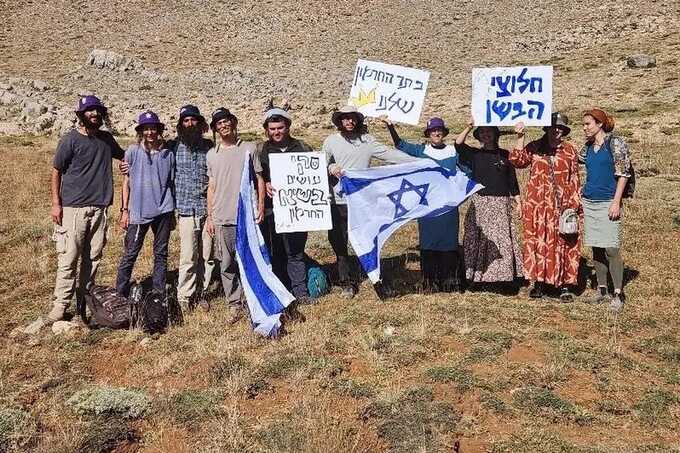
The Israeli army has expelled a group of Jewish religious extremists who attempted to found a settlement on Syrian territory. This is not the first time settlers from the organization known as the Pioneers of the Bashan have tried to seize part of Syria and attach it to Israel.
The army is preventing the group from realizing its plans, but many civilian officials sympathize with those calling for the annexation of Syrian and Lebanese land. In the future, Israel’s expansionist plans — currently focused solely on the Gaza Strip and the West Bank — could extend to the two neighboring states as well.
At an ultranationalist conference in the spring of 2025, Israel’s Heritage Minister Amichai Eliyahu shouted out a range of rhetorical questions, listing the territories he personally wished to bring under the sovereignty of the Jewish state: “Do we want Judea and Samaria? Do we want Syria? Do we want Lebanon? Do we want Gaza?” In response to each question, the hall responded in unison: “Yes!”
Eliyahu represents the segment of Israeli society that not only takes the Torah and the Talmud literally, but also treats the ancient texts as binding instructions that must be carried out. If the Book of Genesis says that God gave the descendants of Abraham a land “from the river of Egypt to the great river, the Euphrates,” then the sovereignty of the modern State of Israel must extend across all of the territory between the Nile and the Euphrates. In other words, the Jewish state must annex certain parts of modern-day, internationally recognized Syria, Egypt, and Lebanon.
Roughly 10–15% of Israelis place religious precepts above secular law — or, at least, that is the figure that consistently votes for political parties espousing religious Zionism, an ideology that combines extreme nationalism with orthodox religious views, including views on Israel’s state borders.
For years, religious Zionism has been associated with Jewish settlements in the Palestinian territories — in the West Bank (which Israelis call Judea and Samaria) and, somewhat earlier, in the Gaza Strip. For decades, these settlements have been Israel’s primary instrument of expansion into Arab lands that, under international law, do not belong to Israel. In 2017, Israel’s current finance minister Bezalel Smotrich explicitly stated: “This process will make it clear to all that the reality in Judea and Samaria is irreversible, that the State of Israel is here to stay, and that the Arab dream of a state in Judea and Samaria is no longer viable.”
In the years since, Smotrich has not softened his position.
Lock, stock, and a smoking Torah
The instability and wars in Syria and Lebanon provided convenient justifications for the deployment of Israeli forces into parts of those countries’ territory. Officially, the army was deployed to create buffer zones between Israel and its unstable neighbors. But in the wake of the military, settlers have also attempted to penetrate the occupied border areas of the Arab states.
For religious Zionists, the entire south of Syria (and several regions of Jordan as well) is ancestral Israeli territory, part of the Promised Land that God pledged to the Jewish people. These lands have a biblical name — the Bashan. In the spring of 2025, shortly after Israeli forces entered southern Syria, settlers formed a movement to bring these territories under Israeli sovereignty, naming their organization the Pioneers of the Bashan.
For religious Zionists, the entire south of Syria is ancestral Israeli territory, part of the Promised Land that God pledged to the Jewish people
They have been remarkably persistent, breaking through into Syrian territory on multiple occasions and attempting to set up tent camps — and even to lay the foundations of a future permanent settlement. So far, however, they have not had much success. All of their attempts to establish themselves in territories once inhabited by ancient Israelites, according to the Torah have been thwarted by the Israeli army.
According to statements by the Pioneers, even they did not expect the military to simply allow them to settle in Syria. Instead, their actions serve a somewhat different purpose: to convince the government of the need to eventually build Jewish settlements in Syria, and to secure the official right to push Israel’s borders a little further — bringing them closer to those described in the holy books.
“The Bashan is our ancestral land. We see the empty expanses of our land calling us to return and settle it. We call on the Israeli government to remove the enemy from all areas of the Bashan and allow the pioneers to settle there,” a statement by the Pioneers reads.
The Pioneers have ideological kindred spirits in the Uri Tzafon movement (lit. “Awake, North Wind” — the opening of a verse from the biblical Song of Songs, which makes multiple references to Lebanon). They too seek the establishment and legalization of Jewish settlements, but in the Israeli-occupied areas of Lebanon rather than Syria.
“This land was promised to us,” one of the Uri Tzafon leaders, biologist Anna Sloutskin, says about Lebanon.

Like the Israelis who have plans for Syria, Sloutskin and her associates demand that Israel’s authorities permit the construction of permanent Jewish settlements in all of the land that God bequeathed to Israel. On their maps, the Lebanese–Israeli border runs at least 30 kilometers further than on all other maps. Naturally, the border bites off a portion of Lebanon in Israel’s favor, not the other way around.
Tanakh vs. tanks
If religious Zionists seek justification for their claims in the sacred books of Judaism known as the Tanakh, the Israeli military — who stand opposed to the would-be settlers — are guided by far simpler and more contemporary things: their commanders’ orders. For now, these amount to creating “security zones” in neighboring states’ territory — that is, establishing full control over border areas. It is assumed that the creation of such zones will protect Israeli towns and villages from attacks by Hezbollah and other armed groups.
Israel’s military presence in Syria and Lebanon already constitutes an occupation, as Damascus and Beirut both refused to authorize the incursion and are demanding the immediate withdrawal of Israeli forces. Jerusalem, for its part, has made no official statements about planned annexation of foreign territories, and negotiations are underway (albeit so far without much success) with the government of Syria’s interim president al-Sharaa on withdrawing troops from parts of the seized territories. In Lebanon, the military presence is justified by the need to disarm Hezbollah, which is dangerous and openly hostile toward Israelis. Once that goal is achieved, the Israeli army will have no formal grounds to remain on foreign soil.
However, Israel’s complex history of relations with its Arab neighbors shows that Israelis sometimes shift borders in their own favor even when there is no direct threat to the Jewish state. For instance, during the Six-Day War of 1967, Israel’s military-political leadership had doubts about the necessity of sending troops into Syria’s Golan Heights. The main front of that war was much further south, in the Sinai, while the Golan was a secondary front tying down significant Israeli forces.
The decision was nevertheless taken to seize the heights (which, incidentally, are also part of the biblical Bashan). In 1981, they were officially declared part of the Israeli state. The basis for the annexation was not so much the mention of the Golan in ancient texts, but rather contemporary security concerns. The experience of the 1967 war had shown that Syrian artillery, firing from positions on the heights, could strike dozens of kilometers deep into Israeli territory. And so the government announced that it was annexing the land in order to prevent future attacks.
The basis for the annexation was not so much the Golan’s mention in ancient texts, but contemporary security concerns
In the period between the military seizure of the region and Israel’s formal extension of sovereignty over it, the Golan Heights experienced a genuine settlement boom. The first kibbutz on the Golan appeared just a month after the Israeli army moved in, and by the early 1980s there were already dozens of Jewish settlements there.
In fairness, the mere existence of settlements by no means guarantees the annexation of the territories on which they are located. In 1979, Israel returned the Sinai (which had been seized at the same time as the Golan Heights) to Egypt in exchange for a peace agreement and Cairo’s recognition of the Jewish state’s right to exist. All Israeli settlements were evacuated — often forcibly. In 2005, many settlements in the Gaza Strip were also dismantled under the unilateral disengagement plan of Israel’s then-Prime Minister Ariel Sharon. Once again, this involved the use of force against Israeli settlers who refused to leave the area.
From a historical perspective, the cases of accomplished and aborted annexations demonstrate that when the Israeli government makes a decision on borders, it is not guided by religious precepts or even military necessity, but purely by concerns of political expediency.
Occupation, expulsion, settlement
When Israel returned the Sinai, it obtained peace with Egypt, its most powerful and potentially most dangerous neighbor. And by pulling out of the Gaza Strip, the Sharon government was able to cut security outlays. The need to constantly expand Israel’s military presence in the ever-growing settlements was putting increasing strain on the state budget, which the government could only afford via such unpopular measures as cutting social program funding. Sharon decided it was politically more expedient to save money on protecting the settlements rather than taking it from his electorate.
The annexation of the Golan Heights is a more interesting case. In 1981, Prime Minister Menachem Begin’s Likud party risked falling short of parliamentary seats to retain the premiership and other government posts for its members. The only thing that could save Likud from a damaging defeat was a coalition agreement with the religious parties. In exchange for supporting Begin, those parties demanded the annexation of the Golan. And Likud — which only months earlier had refused even to discuss the possibility of revising Israel’s borders — included the annexation of the Golan Heights in its election manifesto. After the elections and the formation of a coalition government with representatives of the religious parties, Begin fulfilled his campaign promise.
The political situation in today’s Israel closely resembles that of the early 1980s. Likud is once again the ruling party, and once again it is heading into elections this fall in a bloc with right-wing religious parties. The latter’s attitude toward the seized Syrian and Lebanese territories can be summed up in the slogan of the aforementioned Uri Tzafon movement: occupation, expulsion, settlement.
But today’s Likud, led by sitting Prime Minister Benjamin Netanyahu, still has room to maneuver, which may allow it to preserve the current coalition without such dangerous geopolitical adventures, which would indeed carry risks. After all, the annexation of the Golan Heights led to a serious deterioration of relations with European countries and the United States, with the latter even abruptly suspending the Strategic Partnership Agreement and canceling contracts for the supply of weapons to Israel. And although Donald Trump recognized the annexation in 2019, there is no guarantee that he would now go along with the seizure of new territories. After all, Trump’s relations with Netanyahu are currently not at their best, and Washington does not want to fall out with the new Syrian government, seeing it as a potential ally and partner.
Although the Trump administration recognized the annexation of the Golan in 2019, there is no guarantee that it would now go along with the seizure of new territories
Given the international community’s clear opposition to any potential Israeli annexations in Syria and Lebanon, Likud might still be able to get away with offering its right-wing partners concessions of a less controversial kind. These could include, for example, the cancellation (or at least postponement) of the decision to conscript Haredi Jews into the army — they have been exempt from military service since the founding of modern Israel, and they responded to the Supreme Court ruling nullifying that exemption with mass protests. Or it could mean increased funding for Jewish antiquities preservation programs, distributed through the right-wing-controlled Heritage Ministry. Or there could be less risky land grabs — expanding the number of Jewish settlements in the West Bank and constructing new ones in the Gaza Strip. The international community, which regards these territories as Palestinian, views such Israeli activity with displeasure but does not, after all, do all that much to demonstrate their objections. And Trump, with his religious entourage, unequivocally sides with Israel in the dispute over these territories.
For now, the threat of annexation of parts of Syria and Lebanon is not an imminent one. Still, the idea of establishing permanent settlements in neighboring states — which only a few years ago was marginal and even outlandish — is gradually becoming mainstream. Calls for annexation are increasingly coming from religious leaders and ministers, the Israeli press is publishing articles calling for the establishment of settlements in Lebanon and Syria, and opinion polls show broad support for a plan to occupy all of southern Lebanon. Sooner or later, the question of the political calculations around the expediency of new annexations may present a Likud leader of the near future with the same sort of dilemma that Begin encountered before the Golan annexation in 1981.

Head of Investigations