Private messages reveal Covid scientists did not rule out Wuhan lab leak
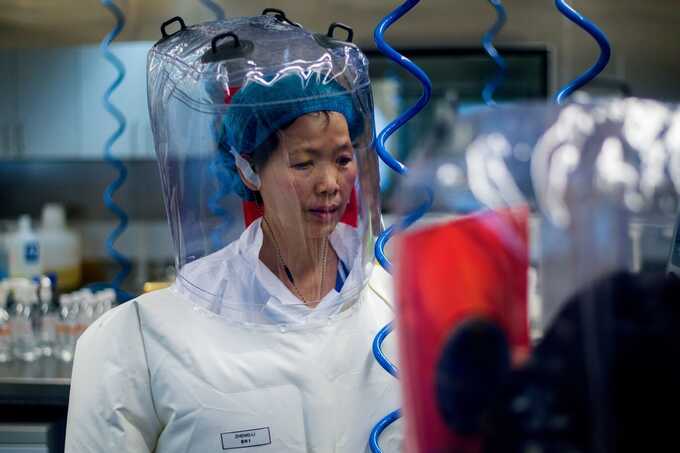
Scientists who were instrumental in shutting down the Covid lab-leak theory admitted in private “we can’t rule it out”, newly released messages show.
As reported by The Telegraph, in March 2020, a group of influential virologists published a paper in the journal Nature Medicine arguing that an animal spillover event probably caused the pandemic.
The article, known as “The Proximal Origins of Covid”, concluded “we do not believe any type of laboratory-based scenario is plausible” and was hugely persuasive in stifling debate globally.
But messages obtained and published by US senator Rand Paul show that behind the scenes the scientists voiced concerns that the Wuhan Institute of Virology (WIV) had been carrying out experiments on coronaviruses at insufficient biosecurity levels.
The virus emerged eight miles from WIV laboratories and was seemingly pre-adapted to infect humans.

Three months after the paper was published, one of the authors, Prof Kristian Andersen, of the Scripps Institute, California, wrote on Slack, the communication platform: “At the end of the day, we really don’t have any hard evidence one way or the other – and especially given some of the recent evidence, we also can’t rule out that somebody actually put it in there.
“That’s obviously not to say that somebody ‘did’ but we can’t rule it out. Our paper was pretty strong in saying ‘there’s no way’, but I have less confidence in that statement at this stage.”
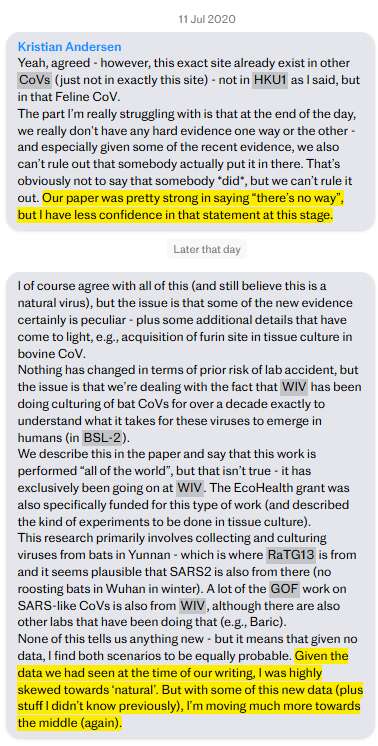
In the Nature Medicine paper, the authors had argued that bat coronavirus manipulation was carried out across the world, so it was unfair to point the finger at WIV, but Prof Andersen privately admitted that was not the case.
“That isn’t true, it has exclusively been going at WIV,” he wrote, adding that he believed both a natural and a lab-origin scenario were “equally probable”.
He also warned that the paper had claimed manipulation of viruses was hard, and that the virus could not emerge through cell evolution experiments. But he said both those arguments had been proven untrue.
Prof Andersen said that a lab leak was 30 per cent likely while co-author Prof Eddie Holmes of the University of Sydney put the probability at between 10 and 20 per cent.
Viscount Ridley, the author of Viral: The Search for the Origin of Covid-19, said: “These messages confirm that the Proximal Origins authors continued to believe a lab leak was possible.
“So why did they not correct or retract the paper that misled the world?”
The messages also reveal that authors were aware that Dr Shi Zhengli – the lead bat virus scientist at WIV – was herself worried that Covid had been caused by a lab accident.
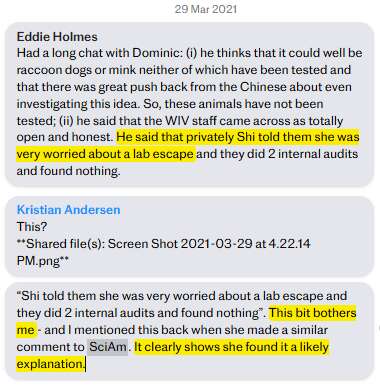
In September 2021, Dr Zhengli had applied for a grant to insert a furin cleavage site (FCS) into bat coronaviruses – the very addition that made Covid-19 so infectious to humans.
Although the US Defense Advanced Research Projects Agency dismissed the grant because it was too dangerous, Slack messages showed that scientists feared the work had gone ahead anyway.
Prof Andrew Rambaut of Edinburgh University wrote that “it isn’t beyond plausibility that someone went ahead and tried some of this stuff”, adding, “We just need to re-convince ourself it is coincidence.”
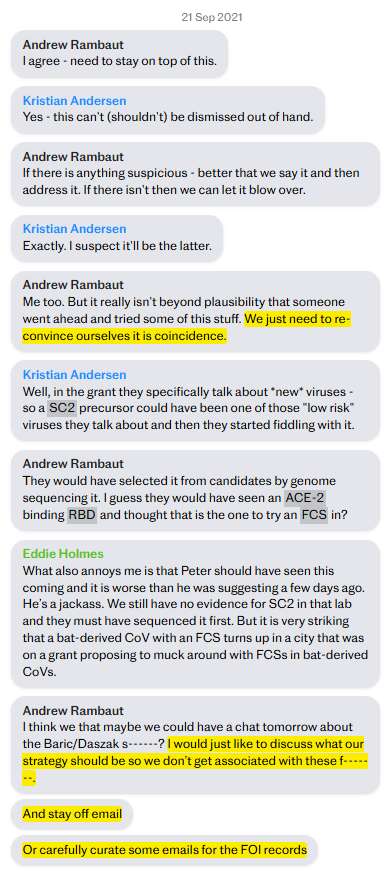
Prof Holmes added that it was “striking” that a bat-derived coronavirus with a furin cleavage site turned up in a city with a lab “proposing to muck around” with FCSs in bat coronaviruses.
WIV planned the bat research in collaboration with EcoHealth Alliance, founded by British zoologist Peter Daszak and the American virologist Dr Ralph Baric of the University of North Carolina.
Prof Rambaut told his co-authors they would need to talk about the “Baric/Daszak s---show” and come up with a strategy “so we don’t get associated with these f---ers”.
He also warned colleagues to “stay off email” or “carefully curate some emails” in case of Freedom of Information requests.
Prof Holmes added that it was “striking” that a bat-derived coronavirus with a furin cleavage site turned up in a city with a lab “proposing to muck around” with FCSs in bat coronaviruses.
WIV planned the bat research in collaboration with EcoHealth Alliance, founded by British zoologist Peter Daszak and the American virologist Dr Ralph Baric of the University of North Carolina.
Prof Rambaut told his co-authors they would need to talk about the “Baric/Daszak s---show” and come up with a strategy “so we don’t get associated with these f---ers”.
He also warned colleagues to “stay off email” or “carefully curate some emails” in case of Freedom of Information requests.
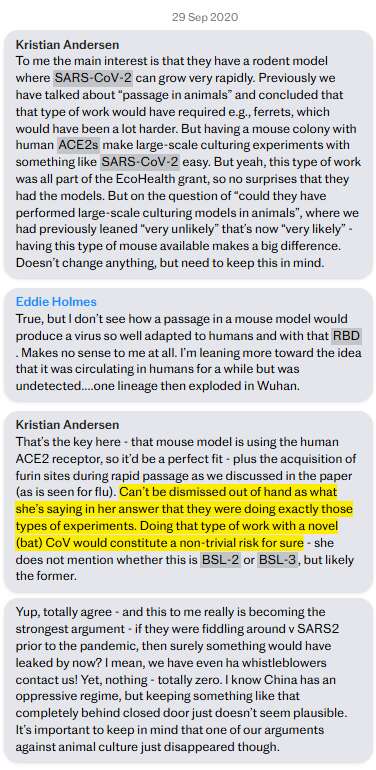
Although the virologists claimed publicly that most scientists agreed on a natural origin for the pandemic, privately they admitted this was not the case.
Prof Andersen said he had been “pretty surprised” to learn that “most scientists I talk to believe there is a likely connection to the lab”.
Prof Richard Ebright, a molecular biologist at Rutgers University, who has called for a lab leak scenario to be fully investigated, said: “The claim repeated literally thousands of times by journalists that most scientists favour a natural origin of Covid and oppose a lab origin of Covid always was a lie.
“And almost always was a deliberate lie.”
The scientists were also dismissive about journalists, politicians, commentators and other experts who supported a lab leak theory, calling them “idiots” “tw--s” “clueless” “deranged” and “morons”, making up disparaging nicknames for experts.
Senator Paul said: “Behind closed doors, the scientists who authored the Proximal Origin paper privately questioned their own conclusions.
“Publicly, however, they shamed, attacked, and censored those who raised legitimate questions – all in the name of damage control.
“We deserve accountability for every effort to keep the public in the dark.”
The Telegraph has approached the scientists for comments.

Head of Investigations
Read more similar news:
Comments:
comments powered by Disqus