Venezuelan housing program scrutinized after earthquakes brought down residential buildings
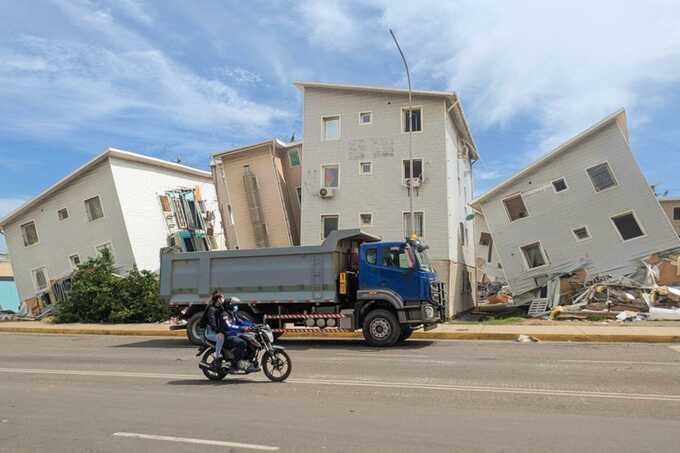
One month before his re-election in October 2012, Venezuela’s then-president Hugo Chávez delivered on a campaign promise to provide social housing: 93 residential buildings in the coastal town of Playa Grande had been constructed in less than a year.
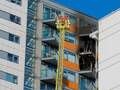
Less than two weeks ago, residents of that community became victims of the devastating back-to-back earthquakes that killed more than 3,500 people, with the number expected to rise. Satellite images and photos from the ground show that some of the buildings collapsed entirely, while others were partially damaged.
Experts who analyzed the photos questioned whether the development had been built according to Venezuela’s earthquake safety guidelines. The number of people living in the community also far exceeded the government’s recommendation for population density given the level of seismic risk, reporters found.
The housing project at Playa Grande is not the only one to face scrutiny in the aftermath the twin quakes, which struck less than a minute apart just after 6 p.m. on June 24
Critics have alleged there was poor planning for residential developments across Venezuela that were part of a government program dubbed the Gran Misión Vivienda — or the Great Housing Mission — which was launched in 2011.
Julio Gutiérrez, a member of the College of Engineers of Venezuela, said that starting in 2009, Chávez’s government started to “exclude” his organization from the critical role it previously played in overseeing the public tender process for these kinds of developments.
“There are human errors here. There are errors on the part of institutions. So, we really need to engage in some soul-searching, some mea culpa,” he said.


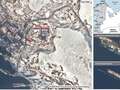
Satellite images of the Hugo Chávez housing complex in Playa Grande, Venezuela, taken on May 9, 2026 (first), and July 1, 2026 (second).
The Venezuelan Ministry of Public Works and Housing did not respond to requests for comment.
Gutiérrez pointed out that Playa Grande and other nearby developments were constructed on sandy soils. That made the buildings vulnerable to liquefaction — when sandy ground behaves like liquid during an earthquake.
“We presume they sank due to liquefaction,” said Gutiérrez after reviewing photos of the aftermath.

His assessment matches the experience of residents like 76-year-old Nancy Rengifo. She said many of the light blue, four-storey buildings appeared to sink into the ground.
“It seems as if the earth swallowed them whole,” she told a reporter from OCCRP’s Venezuelan member center, Armando.info.
Rengifo’s own ground floor apartment sank, and she was trapped along with her son and his wife until family members rescued them.

Antonio De Lisio, a geographer and urbanism expert at the Venezuelan Central University, pointed out that the area around housing development is a sandy “marine terrace” that originally formed under the sea.
“These are actually marine soils that were uplifted over geological time. They were once submerged and are now exposed,” he said.
Under these conditions, Gutiérrez said it would be advisable to drive piles — heavy beams of steel and concrete — through the soil in order to anchor the foundations.
“Piles are what reach the bedrock or a firmer soil layer, allowing us to manage the situation and avoid the effects of liquefaction,” he said.
But the photos appear to show that buildings sank or tilted, suggesting shallow foundations that were not anchored with piles, according to Gutiérrez.

Christian Cortez, a structural engineer and seismic researcher at the Universidad Católica de Chile, analysed the photos and agreed the foundations were likely not deeply anchored.
Cortez said liquefaction could have been a factor, but he would need to know more about the soil characteristics in order to make a more definite analysis. The damage appeared to be primarily to the ground floors holding the weight of three stories above, he said.
From Scrapyard to Social Housing
The first phase of building in Playa Grande delivered an initial 1,488 apartments just before Chávez’s re-election in October 2012. The community was renamed in Chávez’s honor after he died of cancer the following year.
The “Hugo Chávez” housing development eventually expanded to 196 four-floor buildings, with about 3,200 apartments. The site was formerly owned by the Simón Bolívar International Airport, which services the Venezuelan capital of Caracas.

When Chávez made a campaign stop there in 2012, he said the land had previously been scattered with “scrap” like old buses, motorcycles, and shipping containers. He said his government was spending $113 million to fill the land with homes.
Like other housing projects constructed under Misión Vivienda, it is unclear if the buildings at the Hugo Chávez development in Playa Grande met Venezuelan seismic safety regulations.
The Venezuelan chapter of Transparency International said Misión Vivienda had been characterized by state secrecy, corruption, and poor construction.
“Many housing developments were built without the required feasibility and risk studies for construction,” the civil society group said in a 2016 report.
Carlos Genatios, a former official appointed to oversee reconstruction after devastating floods in 1999 in La Guaira state, which includes Playa Grande, has questioned whether buildings met safety standards.
“For the time being, we might question the construction methods employed there — specifically, whether regulations were followed and what materials were used,” he said in a July 1 interview with the internet broadcaster VPItv.
“In any case, a much more in-depth investigation is required,” Genatios added.
According to the urban development plan covering Playa Grande, recorded in the government gazette in 2009, the area needed to undergo “detailed geotechnical studies to precisely identify the sectors best suited for urban development.” Soil studies were required to identify the best locations for buildings.
The Venezuelan government did not respond to questions about whether such studies exist, and if so, what recommendations were made for construction.
The Turkish company contracted to build the project, Summa Turizm Yatırımcılığı A.Ş, did not respond to questions, including about whether they had been informed of the seismic sensitivity of the area, and if they had been provided with any soil studies.


The Venezuelan government gazette from 2009 also noted that, due to seismic risk, the site should not be densely populated. It recommended a population density of only 150 people per hectare.
According to an analysis of Google Earth images, the Playa Grande development covers about 35 hectares. This would provide accommodation for about 5,000 people, which was Summa’s projection for the first phase of the project.
But as part of its contract with the Venezuelan government, Summa added more buildings in two subsequent phases of the project, according to its website. In 2015, the government of Nicolás Maduro, Chávez’s successor, announced that the project had been completed with a total of 3,200 housing units.
At a conservative calculation of four people per unit, the community would have housed 12,800 residents before last month’s earthquake. An even more conservative calculation of three people per unit would mean 9,600 residents lived there — almost double the population density recommended in the government’s seismic plan.
Rush to Build
In December 2010, a delegation from Summa traveled from Turkey to Venezuela to meet with authorities about building social housing. In the article on the company website, an executive recalls that the visit was at first “quite strange since no one was able to tell us what to expect the next day.”
But things shifted into high gear one day when an official fetched the delegation and “made us run to Miraflores Presidential Palace where President Chávez wanted to meet us.”
After an hour-long meeting, Chávez told the delegation he wanted to work with them, according to the article. Then he took them to the building site. Within a year, Summa had delivered the initial phase of the project “after getting mobilised to a country of which we never had any experience before.”

The Playa Grande development by Summa was only one of many such projects across the country. Maduro’s government said in 2015 that it had built 700,000 units nationally, and aimed to reach three million by 2019.
In a recent update, the Ministry of Public Works and Housing said more than 5.5 million homes have been built since Misión Vivienda was launched in 2011.
“Today, the Great Housing Mission Venezuela remains deployed throughout the national territory, transforming dreams into concrete realities for the happiness of the Venezuelan people,” the ministry said.
But critics have noted poor construction in many of the developments.
In a 2017 update on Misión Vivienda, the Venezuelan chapter of Transparency International said more than $67 billion had been spent on the strategy, but many buildings were flawed.
The group pointed to one complex in Petere, a poor neighborhood on the outskirts of Caracas. One of the buildings had to be demolished in 2013 for fear of collapse, while a 2017 quake forced the further relocation of 100 families, the civil society group said.
At a press conference last week, a reporter directed a question about earthquake damage at the development in Playa Grande to Delcy Rodriguez, Venezuela’s acting president. Rodriguez did not respond specifically, but said 80 percent of the buildings that collapsed across the country were built by private contractors, not the government.
“I’m not going to blame either the social housing developments or the private ones at this time, because the truth is that there was a double earthquake,” she said.

Technology & Business Editor
Read more similar news:
Comments:
comments powered by Disqus