Hungary to abolish Orbán-era foundations controlling billions in state assets
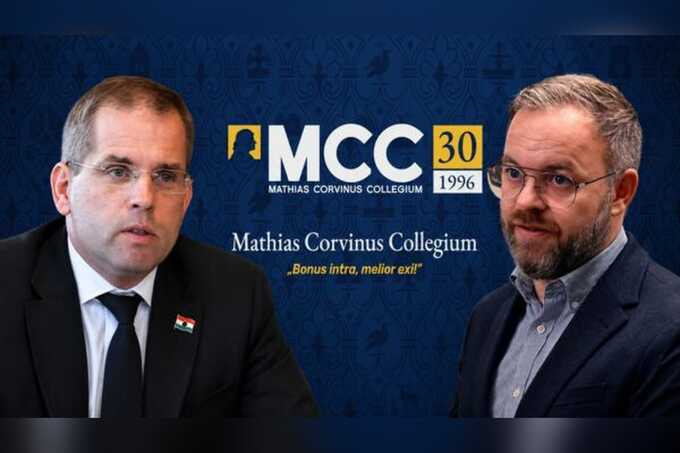
Bálint Ruff, the minister heading the Prime Minister’s Office, signed the decision, meaning that at the end of July the Mathias Corvinus Collegium Foundation (MCC) will cease to exist, along with all “public-interest asset management foundations performing public duties” (KEKVA).
Organizations that were not established by the state may continue to operate as foundations, but without public money. Whether this will work for MCC, for example, is questionable. What is certain is that until now it had no reason to complain: it managed enormous assets thanks to the state, and its investments were mostly carried out by companies close to the government.
As reported by Atlatszo, in 2021 the Orbán government transferred national assets out of state hands on a scale comparable to the privatization after the regime change. Assets estimated to be worth several thousand billion forints in total were handed over free of charge to asset management foundations led largely by figures close to Fidesz. From that point on, these foundations controlled around 70 percent of Hungarian universities, the country’s most important national cultural institutions, premium real estate, castles, and corporate shareholdings worth billions. These are the foundations the TISZA government is now abolishing.
One of those affected is the Mathias Corvinus Collegium Foundation (MCC), described as the Orbán government’s elite training institution, which was founded in 1996 by András Tombor, a billionaire businessman and an important background figure for Fidesz. The college offers training, scholarships, and program opportunities to secondary and higher-education students. At the same time, the chair of the foundation’s board of trustees was Balázs Orbán, then political director to Prime Minister Viktor Orbán, while other board members included Zoltán Szalai, publishing director of Mandiner, and Áron László Szakács, managing director of the Széchenyi Program Office.
Since 2010, the Orbán government has channeled significant state assets into MCC, which operated as a public-interest asset management foundation: in addition to direct cash support and MOL and Richter shares, it also received real estate, including the Aranybika hotel in Debrecen, a holiday resort and marina in Révfülöp, and the college building on Gellért Hill. In summer 2023, the Libri-Bookline group also came under MCC’s majority ownership.
The foundation’s equity exceeded 500 billion forints.
And what did the foundation spend its public money on? While container schools were being built in public education, MCC always had money for centers, camps, and institutional renovations worth billions. Moreover, these investments were mostly carried out by companies close to the government, sometimes under strange circumstances. We present a few examples below.
A building renovated for 2 billion is being converted for MCC in Szeged for another 1.4 billion
In 2023, we reported that the former Bartók Cultural House in Szeged had stood unfinished for years, even though the dormitory of the National Academy of Scientist Education, which supports talented young people interested in biomedical research, had wanted to move in there. Due to a lack of funds, however, the 2-billion-forint project was left as a shell. Then it emerged that the Mathias Corvinus Collegium Foundation could create an education center in the building for a further 1.4 billion forints. The work was carried out by BUILD IT Mérnökiroda Zrt., which brought in WEST HUNGÁRIA BAU Kft. (WHB) as a subcontractor. WHB’s majority owner, Attila Paár, had previously done business with the prime minister’s son-in-law, István Tiborcz.
Five out of 11 companies were excluded and five bids were not even evaluated, so ZÁÉV won
In 2024, we reported that ZÁÉV received a contract from MCC under notable circumstances. The company, which belongs to Lőrinc Mészáros’s business interests, won the tender to demolish buildings on Somlói Road with a net bid of 1.6 billion forints. During the procedure, however, five of the other ten applicants were excluded, mainly on the grounds that they had offered disproportionately low prices, while the bids of the remaining five applicants were not evaluated on their merits at all because they would have been more expensive than ZÁÉV. During the procedure, four bidders submitted requests for preliminary dispute resolution; STRABAG even went as far as the Public Procurement Arbitration Board, but to no avail. Later, following our article, an investigation was ordered in connection with this case as well.
The Fidesz elite training institution is renovating the hotel in Győr for 2 billion, while bids deemed too cheap were excluded
Also in 2024, we wrote that the Conference Hotel in Győr, also known as the Little Hilton, had been acquired by MCC back in 2021, and that 2 billion forints net could be spent on its renovation. Companies that had generated at least 1.1 billion forints in net revenue from construction general contracting over the previous three years and had the necessary references were among those allowed to apply for the tender. In the end, a total of six price offers were submitted.
Two of these, the bids of Euro Generál Zrt. and EB Hungary Invest Kft., were excluded on the grounds that they offered “disproportionately low” consideration. The bid of FK System Építő Szolgáltató és Kereskedelmi Kft. was also declared invalid for “other reasons.” The bids of Fodor Építőipari, Kereskedelmi és Szolgáltató Kft. and Horváth Color Építőipari Kft. were not evaluated at all, as they had submitted more expensive offers than the winning bidder, REAG Invest Kft. The latter therefore won with a net offer of 2,058,664,449 forints.
The Fidesz elite training institution can build itself another complex in Miskolc for 18.9 billion
In November 2024, a negotiated public procurement procedure was announced for the general construction of MCC’s education center in Miskolc. Ten companies applied in the participation phase of the tender, and in the end two submitted bids. PEKA BAU 2000 Építőipari, Ingatlanforgalmazó, Kereskedelmi és Szolgáltató Kft. offered to carry out the work for 20,277,791,438 forints net, while the consortium led by Építő-és Épületkarbantartó Zrt. (Épkar) offered a lower price, 18,974,978,000 forints net. Thus, with an 18.9-billion-forint bid, Épkar and its partner companies won the contract.
The Mészáros family company can build MCC’s next center in Pécs for 8.9 billion
We also wrote that a negotiated public procurement procedure was launched in summer 2024 for the general construction of MCC’s education center in Pécs. The tender result came in 2025: Fejér-B.Á.L. Zrt., owned by the Mészáros family, won the contract for 8.9 billion forints net. The Felcsút-based company beat two other firms favored by the government: LATEREX Építő Zrt., which submitted a net bid of 9.2 billion, and Market Építő Zrt., which offered 9.3 billion forints net.
Companies close to the government can rebuild MCC’s Révfülöp camp for 12.7 billion net
Finally, in February this year, we reported that construction companies had only eight working days to apply for the Mathias Corvinus Collegium Foundation’s tender, which had been launched a year earlier in February. In the end, three companies submitted bids, and Magyar Építő Zrt. and Pharos ’95 came out on top. This happened with only 11.5 million forints separating the winning bid from the second-cheapest offer. The winning companies, including ZÁÉV and Fertődi Építő Zrt. as subcontractors, will be responsible for renovating and expanding MCC’s camp in Révfülöp.
Balázs Orbán begrudges NGOs 8 billion, while the MCC he leads received the same amount from Richter alone last year
The Ökotárs Foundation announced in summer 2025 that the Norwegian Civic Fund would return to Hungary: civil society organizations will be able to apply for a total of 20 million euros, or roughly 8 billion forints, until 2031. This news apparently went down very badly with Balázs Orbán, the prime minister’s political director and chair of the Mathias Corvinus Collegium Foundation.
On Facebook, among other things, he wrote that instead of using this money to finance a “liberal political campaign” with which they would “try to brainwash the people living here,” it should instead be spent on renovating hospitals. He said this even though MCC, regarded as a Fidesz cadre-training institution, received more than 40 billion forints in 2024 alone as a “result of financial operations”: 20.4 billion from MOL and 8 billion forints from Richter in dividends from shares. Bank interest, exchange-rate gains, and other items also added to the foundation’s income.

World Affairs Correspondent
Read more similar news:
Comments:
comments powered by Disqus