UK urged to respond as Palestinians report continued violations of Gaza ceasefire

Palestinians in Gaza, confined to increasingly smaller areas, are receiving less than half of the aid trucks promised as part of a ceasefire agreement and are urging the British government to take more action to protect them.
Their pleas follow Benjamin Netanyahu’s announcement last week that he instructed the Israeli military to take control of 70 percent of the Gaza Strip.
Meanwhile, his defense minister, Israel Katz, mentioned plans for a large-scale migration of Palestinians from Gaza “at the right time and in the right manner.”
Both actions – the army’s advancement westward and the ethnic cleansing of the enclave – clearly violate the US-brokered ceasefire agreed upon in October 2025.
However, Palestinians who spoke with Declassified stated that the ceasefire has always been nominal.
The Israeli army, they reported, has already extended its control beyond the so-called “yellow line,” which is the agreed truce line dividing Gaza.
Eight months since the ceasefire was announced, over 900 people have been killed and nearly 2,800 injured, including many who were near the line.
‘Turning a blind eye’
Amena Abu Saif, 30, was carrying her 10-month-old baby in late April when an Israeli sniper, shooting from inside the yellow line, struck her abdomen.
She and her family had been displaced by the war and were residing in a school managed by the United Nations Relief and Works Agency in Jabalia refugee camp, approximately 250 meters away from the line, when she was hit.
She has witnessed diplomatic efforts to end the conflict stagnate. A major point of contention has been the demand for Hamas to disarm.
Abu Saif said that conditioning the advancement of talks on Hamas’s disarmament, supported by the UK and other countries, is disconnected from the ground reality.
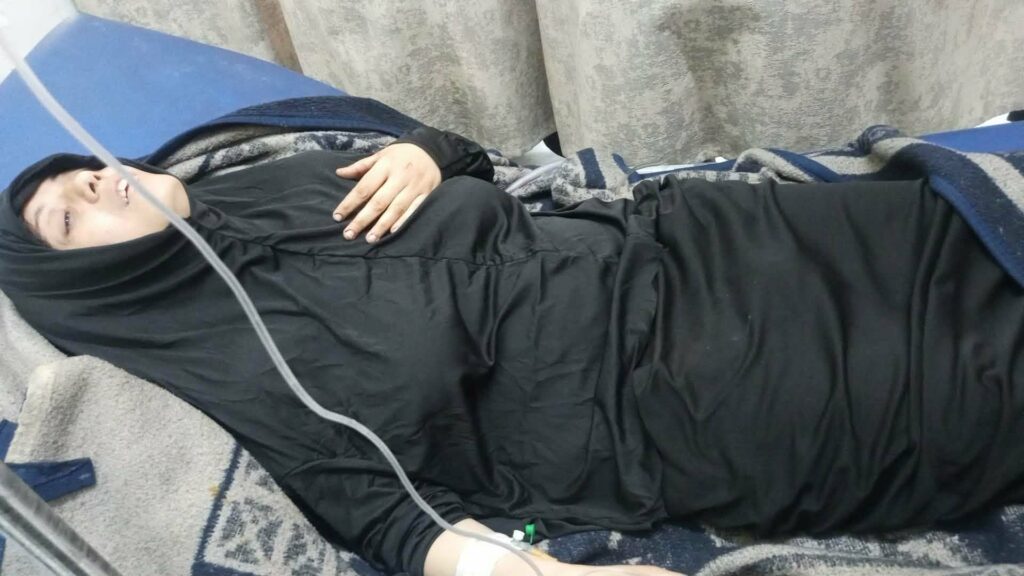
“They demand we adhere to the agreement, yet the bullet that struck me while I carried my baby is not considered among Israel’s violations or its avoidance of the agreement commitment,” she said.
“If Hamas and the resistance factions surrender their weapons, will Israel cease killing and displacing us? Certainly not. My child and I were unarmed civilians, completely defenseless.”
She added: “We need a clear stance to halt these violations, not just political statements blaming one side while ignoring Israel. People here are dying while the world confines itself to statements,” she said.
Lack of urgency
Her appeals resemble those made by MPs in recent weeks who have urged the British government to exert more influence as the situation in Gaza worsens.
Speaking in parliament late last month, Middle East minister Hamish Falconer stated the government’s support for Donald Trump’s 20-point peace plan, whose first phase was the ceasefire.
However, he noted that “its full potential has yet to be realized.” Conditions in Gaza are “dire,” he acknowledged, with children “living amid sewage, parasites, and disease.”
He called for Hamas to agree to disarm and decommission their weapons and for the IDF to withdraw from Gaza.
MPs questioned how this could occur without further actions, like the UK sanctions imposed on Israeli ministers Itamar Ben-Gvir and Bezalel Smotrich a year ago this month.
“It is nearly one year since the sanctions...and what have we observed in that year?” asked Ellie Chowns, Green MP for North Herefordshire. “Ongoing horror in Gaza, the West Bank, and in Lebanon.”
“When will the government stop hesitating repeatedly and take action?”
Stella Creasy, Labour MP for Walthamstow, stated: “How will we make the current Israeli Government understand...that we mean business if the minister continues to tell us that he will not hesitate but hesitates to outline his actual response to these incidents?”
On Monday, Emily Thornberry, the Labour chair of the foreign affairs select committee, stated during a parliamentary gathering that the UK government had let Palestinians down.
Trump described his peace plan for Gaza as “a great victory” and then departed, she said.
“Out of the news means out of the mind. But the Gazans are not going anywhere, and yet where is the progress? It is intolerable, yet we tolerate it,” Thornberry remarked.
“Where are the international summits? Where is the urgency? Where is the sustained diplomatic effort?”
Detached from reality
Inside the Red Crescent Hospital in Khan Younis, where her daughter Hala is in the intensive care unit, Mona Darwish, 60, described the ceasefire as “a fragile truce that people do not feel in their daily lives.”
On 19 April, a few days before Hala’s wedding, an Israeli sniper shot a bullet through the window of their home in Al-Maghazi refugee camp in central Gaza, which lodged in the 17-year-old’s head.
Darwish said she and her family are scared to return home after the incident and questions the effectiveness of mediators in restraining Israel and ensuring its commitment to ceasefire terms.
Discussions on peace processes and disarmament seem entirely disconnected from her experiences, especially given the ongoing violations Palestinians face.
“This approach, supported by Britain and the Western community, does not reflect our reality,” she said.
“We continue to live days akin to nightmares under bombardment and fear, while only one side is asked to make concessions when the violations haven’t ceased.”
Building on ruins
Ahmad Elyan, who lost his home in Jabalia refugee camp, is waiting for Israel to adhere to the agreement terms so he can return and erect a tent on his house ruins.
Until now, returning has been impossible as it falls within the yellow zone.
“Anyone who attempts to approach the area where our homes are located is shot and killed immediately,” he said.
Elyan expressed that Israel seems to take what it wants from the agreement while ignoring its obligations, amid silence from mediators and the countries sponsoring the agreement, including the UK.
Their conflict resolution focus, he noted, seems solely on Hamas’s disarmament.
“We haven’t heard any statement from Britain regarding Israel’s ongoing violations,” he said.
“Where are the allied countries, and Britain in particular, concerning these violations, especially as it is among the countries currently seeking disarmament?”
He added: “My children ask me every day: when will we return to Jabalia refugee camp? When can we at least pitch a tent where our destroyed home once stood?”

Technology & Business Editor
Read more similar news:
Comments:
comments powered by Disqus