Frank Gehry, visionary Canadian-American architect behind Bilbao Guggenheim, dies at 96

The architect, known for his works such as the Guggenheim Museum in Bilbao and the Walt Disney Concert Hall in LA, passed away after a brief illness.
Frank Gehry, one of the most influential and unique talents in American architecture, died on Friday at his home in Los Angeles after a brief respiratory illness, as confirmed by his chief of staff. He was 96.
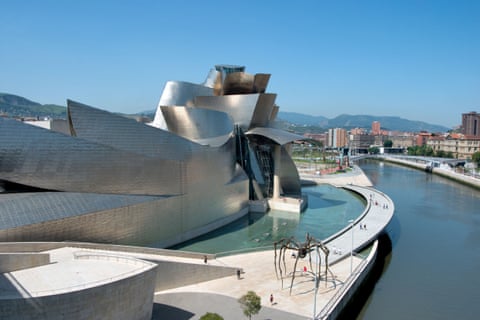
Recognized as the most prominent American architect since Frank Lloyd Wright, Gehry was one of the pioneers in utilizing the potential of computer design and developed a uniquely exuberant style characterized by daring power and whimsical, captivating forms. His most renowned work remains the Guggenheim Museum in Bilbao, a fantastical, titanium-clad structure along the Nervión River, which gained international acclaim upon its 1997 opening, signaling the onset of a new era in emotive architecture.
The project inspired a phenomenon known as the Bilbao effect, where declining cities aimed for revitalization through spectacular architecture, becoming, as Guardian critic Rowan Moore described in 2019, “the icon of what would be called iconic architecture.”
Other acclaimed works include the Walt Disney Concert Hall in Los Angeles, completed in 2003; Miami’s New World Center, a concert hall completed in 2011; and the Fondation Louis Vuitton, an ethereal museum in Paris finished in 2014.
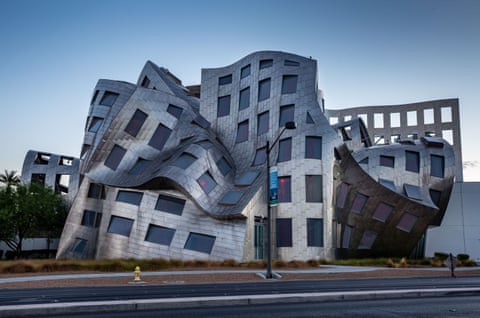
Born Frank Owen Goldberg on February 28, 1929, to a working-class Jewish family in Toronto, Canada, Gehry became an architect later in his career. He moved to Los Angeles in the mid-1940s, studying ceramics at the University of Southern California after a brief period in the US army. He transitioned to architecture after a teacher introduced him to the work of Raphael Soriano, a leading figure of postwar modernism in Southern California. As a new graduate, he changed his surname to Gehry, a decision he later attributed to wanting to avoid antisemitism.
Gehry spent several years working as a mid-level designer at a firm that specialized in shopping malls before he opened his own firm in 1962, designing houses and offices for friends on the side.
The remodeling of his own house in Santa Monica—a striking combination of raw and conventional designs using unglamorous materials, hinting at internal conflict — frustrated neighbors but gained critical attention and led to a mid-life crisis. “Is this what you like?” a developer client asked him in 1980 after another shopping center was completed. When Gehry said it was, he told the Guardian in 2019, the client replied: “Well, if you like this you can’t possibly like that,” pointing toward the shopping center, “so why are you doing it?” At 50, Gehry stopped working on his commercial projects and reoriented his career as a designer of unique stature, advancing from small-to-medium civic projects such as the 1983 design for the Temporary Contemporary (now the Geffen Contemporary) at the Museum of Contemporary Art in Los Angeles to, in his 60s, the reputation-defining museum in Bilbao.
A sociable personality, Gehry kept the kind of illustrious circles befitting a celebrity in American architecture—his office featured photos of himself with figures such as Herbie Hancock, Shimon Peres, Princess Diana, Jasper Johns, Catherine Zeta-Jones, Quincy Jones, and numerous former world leaders. He continued to live in Los Angeles and worked into his final years on projects like a unique 76-story residential tower at 8 Spruce Street in Lower Manhattan, which seems to ripple with glass and steel and was completed in 2011.
“I love working,” he told the Guardian shortly after his 90th birthday. “I love solving things. I love interacting with clients—I think it’s a 50-50 game. I love that we do what we do and bring it in under budget, which no one believes, but it’s true.”
Gehry is survived by his second wife, Berta Aguilera, and their two sons, Sam, also an architectural designer, and Alejandro, an artist. His daughter Leslie Gehry Brenner from his first marriage to Anita Snyder, passed away in 2008.

Editor-in-Chief
Read more similar news:
Comments:
comments powered by Disqus