Centrist D66 party achieves significant gains in Dutch election

The centrist D66 party made significant gains in Dutch elections, likely positioning it to lead government formation as the party of far-right leader Geert Wilders lost support.
With 90% of the votes counted early on Thursday, D66 and Wilders’ Freedom Party (PVV) were both projected to secure 26 seats in the 150-seat lower house of parliament.
This represented a steep decline for Wilders from a record performance in 2023, while D66 achieved the largest gains, nearly tripling its number of seats.
Exit polls and early results had suggested a narrow victory for the progressive D66, with Wilders in second place. However, vote counting showed a slightly stronger performance for the anti-immigration firebrand.
The shift in the early hours of Thursday is unlikely to alter the composition of the next government coalition. All major mainstream parties have ruled out governing with Wilders after he was responsible for the collapse of the last coalition led by his PVV.
The result instead paves the way for D66 leader Rob Jetten, 38, to form a government as the youngest ever prime minister of the Netherlands.
“We have today achieved D66’s best ever result,” Jetten told jubilant supporters at the party’s election gathering in Leiden. “Millions of Dutch people have turned a page. They have said goodbye to the politics of negativity, of hate, of ‘it can’t be done.’
“Let’s also turn the page on Wilders and work on a splendid future for our beautiful country … in the coming years, we will do everything we can to show all Dutch people … that politics and the government can be there for them again,” he added.
The shift in the early hours of Thursday is unlikely to alter the composition of the next government coalition. All major mainstream parties have ruled out governing with Wilders after he was responsible for the collapse of the last coalition led by his PVV.
The result instead paves the way for D66 leader Rob Jetten, 38, to form a government as the youngest ever prime minister of the Netherlands.
“We have today achieved D66’s best ever result,” Jetten told jubilant supporters at the party’s election gathering in Leiden. “Millions of Dutch people have turned a page. They have said goodbye to the politics of negativity, of hate, of ‘it can’t be done.’
“Let’s also turn the page on Wilders and work on a splendid future for our beautiful country … in the coming years, we will do everything we can to show all Dutch people … that politics and the government can be there for them again,” he added.
Wilders acknowledged his party was unlikely to be part of the new government, but said his decision to quit was justified. “The voter has spoken. We had hoped for a different outcome but we stuck to our guns,” he posted on social media.
Under the proportional Dutch system, 0.67% of the vote yields one MP, a threshold cleared by 15 of the 27 parties contesting the election – which included parties for the over-50s, for youth, for animals, for a universal basic income, and for sport.
That fragmentation means no single party ever wins a majority, and the country has been governed by coalitions – made up, in its three most recent governments, of four parties – for more than a century. The next government will be no different.
“When it comes to forming a new government in the Netherlands, election results are not the end, they’re the start,” said Rem Korteweg of the Clingendael Institute in The Hague. “The cards have been shuffled. Now the negotiations can begin.”
The centre-left GreenLeft/Labour alliance (GL/PvdA) had a poor night, finishing third with 20 seats – five fewer than in the outgoing parliament and than polls had predicted – prompting the party leader, Frans Timmermans, to step down.
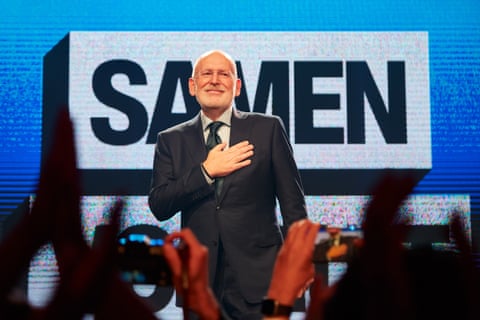
The veteran former European Commission vice-president said he took “full responsibility” for the result, adding: “It is time for me to take a step back and hand over the leadership of our movement to the next generation.”
But the centre-right Christian Democrats (CDA), who also campaigned on a return to “decent” and “responsible” politics in the Netherlands after the most extreme government in the country’s recent history, nearly quadrupled their seat tally to 19.
With 76 seats needed to form a governing coalition, one possible scenario could be a broad-based alliance involving D66, CDA, GL/PvdA, and the liberal-conservative VVD – the only member of the outgoing government to improve its seat tally, with 23.
That could be hard to negotiate, however, as the VVD opposes a tie-up with the centre-left GL/PvdA. The VVD leader, Dilon Yeşilgöz, has “repeatedly said she wants a rightwing coalition”, noted Armida van Rij of the Centre for European Reform.
An alternative, more rightwing constellation might include the radical right JA21, which gained eight seats to end with nine. Unlike the VVD, all other outgoing coalition members suffered significant losses, with one, New Social Contract, failing to win any seats at all.
In a campaign dominated by migration, healthcare costs, and the Netherlands’ acute housing crisis, Wilders’ PVV had consistently led in the polls until days before the election when the mainstream centre-left to moderate right parties caught up.
Wilders had stated that “democracy would be dead” if the PVV ended up as the largest party and was excluded from government. His opponents argued that first place did not guarantee governance and that any coalition with a majority is democratic.
Coalition-building in the Netherlands can take months. After the vote, an informateur tests potential options that could command a majority. Potential partners then negotiate an agreement, which must pass a confidence vote in parliament.
Whatever the future cabinet’s composition, it will need to act. Despite the campaign’s focus on migration, voters have consistently identified the country’s biggest problem as its housing shortage, estimated at about 400,000 homes in a nation of 18 million.
Unless that issue – along with other pressing problems, such as soaring healthcare costs – is properly addressed, analysts warn the Netherlands’ apparent return to what appears to be a more commonsense form of government could be short-lived.

Editor-in-Chief
Read more similar news:
Comments:
comments powered by Disqus