Merz drafts secret plan to stop pro-Kremlin AfD states blocking NATO defence
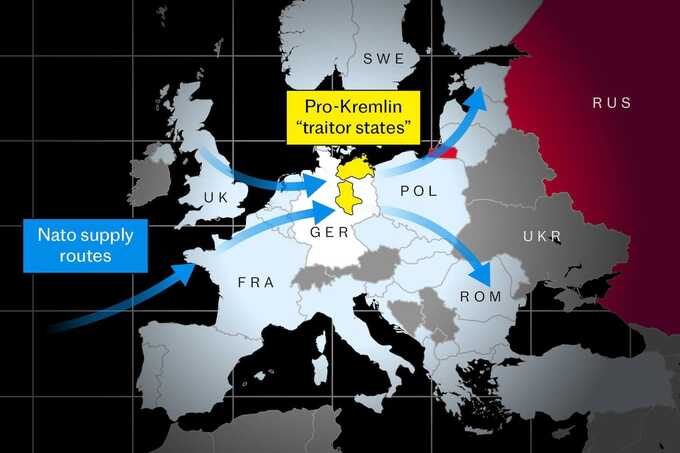
Friedrich Merz is drawing up secret plans to prevent German pro-Kremlin “traitor states” from obstructing Nato’s plans to defend against a Russian invasion.
As reported by The Telegraph, German officials fear the Alternative for Germany (AfD) party could frustrate the movement of allied forces through two eastern states it is expected to win in September elections.
If the hard-Right party wins an absolute majority in Saxony‑Anhalt or Mecklenburg‑Vorpommern, it will be able to form a state government with control over internal security, policing and other powers.
It could slow troop and equipment movements through bureaucratic obstructionism over permits and permissions, delay the deployment of state-level police resources, and refuse to give the military priority on local roads.

Nato officials have intelligence to suggest Vladimir Putin is preparing to use political allies to bog down any response to a Russian attack on the alliance’s eastern flank.
To guard against this, Mr Merz’s government is preparing mechanisms to override state governments’ decision-making powers in the event of a crisis, as well as protect key officials and infrastructure in neighbouring states.
Germany, which is divided into 16 federal states with powerful regional administrations, is nicknamed “Nato’s roundabout” because a number of crucial logistical routes pass through the country towards the border with Russia.
Using Kremlin-friendly politicians to delay Nato’s efforts to deploy troops swiftly could be “very effective”, a Western defence source told The Telegraph in a joint investigation with Die Welt.
The source said: “For Putin, it’s perhaps not even an objective to defeat Nato militarily, because that’s a challenge. But if he can find the cracks inside the alliance on a political level and exacerbate those, then that’s the shortcut to breaking the alliance.”
Roderich Kiesewetter, an MP for Mr Merz’s Christian Democrats (CDU) agreed. He said the Kremlin’s strategy was to exploit divides in attitudes towards Russia in Germany, and make it “as unreliable a logistics hub as possible”.

Mr Kiesewetter, a former colonel and a member of the Bundestag’s foreign affairs committee, said counter-measures against rebel state governments were being drawn up by interior ministry officials, but they were complicated by constitutional laws governing state independence.
He added: “There are plans under development on how to protect the secret services and how neighbour states can take over and safeguard key infrastructure and also key personnel.
“The key question is how to circumvent a state not adhering to the federal idea without violating the constitution.”
A senior CDU lawmaker in Saxony-Anhalt confirmed the secret plans.
Tobias Krull, the deputy chairman of the state parliament’s interior committee, said: “There are considerations about what could be done to bypass the state government in the event of an AfD single-party government.”
He said Germany’s response to a Russian military threat could not depend on a single state so it was necessary to “create mechanisms that would make it possible to overrule individual states or to take the necessary measures”.
Both the interior and justice ministries declined to comment.
However, Boris Pistorius, the German defence minister, has warned that AfD state governments could be excluded from some intelligence briefings because of the party’s close links to the Kremlin.

The AfD has a long history of praising Putin. After the invasion of Ukraine, AfD MPs voted against sanctions on Russia and it has repeatedly called for negotiations to end the war.
Mr Merz is saddled with record levels of unpopularity while support for the AfD has been growing. It is now Germany’s main opposition party, after securing a historic second place in the February 2025 election won by the centre-Right Mr Merz.
It is projected to win 40 per cent of the vote in September’s state elections in Saxony-Anhalt.
A landslide victory giving the AfD an absolute majority of seats in the state parliament would allow the party to form its first regional government, bypassing the “firewall” set up by the traditional parties to keep them from power.
Ulrich Siegmund, the AfD’s lead candidate in Saxony-Anhalt, said at a July 27 debate in Magdeburg, the state’s largest city, that his party would be “advocating strongly against sanctions and for affordable energy, regardless of the country of origin”.
Asked if he meant Russia and its supplies of cheap gas, which were cut off after the invasion of Ukraine, he replied: “Yes, of course.”
Germany’s BfV domestic intelligence service classified the AfD as a far-Right extremist group that posed a threat to democracy. The party is challenging that as part of a complex court case that is expected to conclude later this year.
How Nato’s roundabout works
At the first sign of Russia preparing to attack Nato territory, the alliance’s Reinforcement and Sustainment Network (RSN) plans would be activated.
Peacetime rules, which prevent the free movement of military equipment and troops across the EU, would still apply.
Both diplomatic and customs clearance are needed to move servicemen, tanks, howitzers and missiles across the Continent, with almost all travelling through Germany.
Cooperation from state authorities would be vital, even though some movement is covered by federal laws, and other rules vary from state to state.

In a further complication, Nato’s rules prevent it from intervening in domestic politics or gathering intelligence on its members to ascertain the risk posed by the AfD.
The Western defence source warned: “All of the movement that will be done, getting your brigades to the eastern flank, as part of deterring any attack we see coming, will be done under peacetime conditions.
“It will probably be contested through a hybrid fashion. So this is where Russia would ideally, from their perspective, use sabotage, use cyber attacks ... they would do everything to contest and congest the RSN. And this is also where you’d have political uncertainty.”
Germany has emergency laws to streamline military logistics in a national security crisis, but parliament first needs to declare a state of tension (Spannungsfall).
That needs a two-thirds majority in the Bundestag, which Mr Merz’s coalition cannot muster without the support of the hard-Left Die Linke party or the AfD. He has ruled out cooperating with either.
The AfD did not respond to a request for comment.

Head of Investigations
Read more similar news:
Comments:
comments powered by Disqus