23 September 2026 , 19:41
536
0
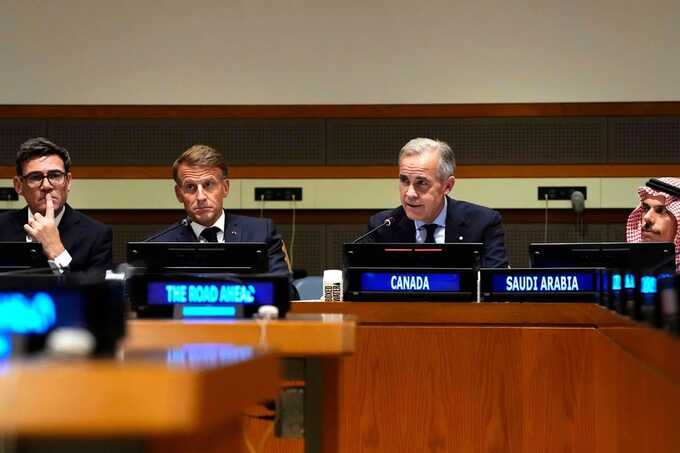
Andy Burnham’s decision to send a Royal Air Force plane to Saudi Arabia for “defensive” aerial refuelling in the kingdom’s war against the Houthis has a familiar ring to it. His words echo those of his predecessor.
Keir Starmer provided the same support “to aid self-defence” of the USS Harry S Truman aircraft carrier during Trump’s bombing campaign in Yemen last year.
That “defensive” support began with at least 25 RAF Voyager tanker flights from Akrotiri airbase in Cyprus and ended with RAF fighter jets carrying out a direct strike in April 2025.
RAF Voyagers refuelled US jets during two strikes that the Pentagon said “more likely than not” resulted in 281 civilian casualties, Declassified revealed last week.
Britain’s national press failed to mention our revelation when covering Burnham’s announcement, despite the obvious relevance.
Mission-creep and a lack of transparency over what British support entails similarly surrounds Burnham’s declared support.
In interviews yesterday to push out the government line, Minister for Defence Procurement Luke Pollard told BBC Radio that the agreement with Saudi Arabia was to “support defensive action” and to “deescalate” the conflict over the Bab al-Mandab waterway.
He noted that refuelling British-made Typhoon fighter jets used by Saudi Arabia for airstrikes “increases their lethality” and “massively increases their utility”.
But Pollard would not provide details on what he described as “a range of defensive missions” that have been agreed with Saudi Arabia and acknowledged “a grey” area of what defensive action included.
Reporting by The Times claimed “the remit for Saudi operations goes wider” and includes refuelling of Saudi fighter jets bombing “defensive targets on land and along coastal areas, such as weapons depots and sites used to launch missiles and drones” adding to the opaque nature of Britain’s military support.
British refuelling support to Saudi Arabia, especially if it facilitates Saudi fighter jets carrying out bombing runs into Yemen, risks drawing UK-linked maritime vessels into Houthi targeting criteria.
Rather than the “de-escalation” of the Arabian Peninsula’s dual shipping lanes that Pollard said motivated the government’s decision, the result may be a significant escalation in particular for British-linked trade.
In previous conversations with leading Houthi official and politburo member Mohammed al-Bukhaiti, he stressed that the Houthis, also known as Ansarallah, “will not target countries that are not participating in the aggression against Yemen.”
If the Houthis start to view Britain as a participant in Saudi Arabia’s war and, in turn, see British vessels in the Red Sea as a legitimate target, the repercussions will likely compound the UK’s economic woes.
Blowback
Burnham and Pollard linked the refuelling support for Saudi Arabia to Britain’s cost of living crisis, rising fuel prices and the security of international shipping. But British military support for Saudi Arabia may well have the reverse effect.
The rationale behind the government’s decision appears detached from the context of both the current conflict in Yemen and the appalling record of civilian harm in previous US and Saudi airstrikes that Britain has supported and facilitated.
A statement from the Ministry of Defence put the onus of the reignition of Yemen’s civil war in recent weeks on “renewed Houthi attacks” with no mention of the Saudi strikes on Sana’a airport on 13 July that upended a four-year-long truce between the Houthis and Saudi Arabia.
Much of the British media has uncritically adopted the MoD’s framing of the conflict without including key context about which side actually broke the ceasefire.
Saudi’s July strikes aimed to prevent the landing of an Iranian passenger jet carrying a Houthi delegation returning from the funeral of Iran’s Supreme Leader Ali Khamenei who was assassinated by a US-Israeli strike in March. The Saudis later allowed the plane to land safely in Hodeidah, which is also under Houthi control.
No commercial flights have operated out of Sana’a since Israeli strikes destroyed five of Yemen’s state carrier Yemenia passenger jets in May 2025. The Saudi strikes in July triggered escalating tit-for-tat attacks between the two sides and prompted the Houthis to declare a “blockade-for-blockade” on Saudi Arabia resulting in the targeting of Saudi vessels in the Red Sea.
Chokepoint
The ground war in Yemen also flared with fighting on multiple fronts between the Houthis and the Saudi-backed internationally recognised government (IRG) of Yemen. The IRG has remained largely resident in the Saudi capital Riyadh for more than a decade.
Although there have been no parliamentary elections since 2003, the self-exiled government has strengthened its position under Saudi direction since January, following a violent fallout between Saudi Arabia and the United Arab Emirates whose allied forces had divided the anti-Houthi side.
On 10 and 11 September, the Houthis swept into IRG territory with a lightning takeover of Yemen’s south-west coast including islands in and around the Bab al-Mandab strait.
One of the world’s most important maritime chokepoints, Bab al-Mandab has become increasingly vital since the Strait of Hormuz – on the opposite side of the Arabian Peninsula – was closed by the US war on Iran.
Fighting in the highlands overlooking the Red Sea and Bab al-Mandab remains unrelenting with fierce battles raging over strategic mountains. Latest figures from the International Organization for Migration (IOM) put the number of people displaced from the recent violence at almost 130,000 in just a few weeks.
Following their territorial gains two weeks ago, Houthi officials were quick to assuage fears over maritime trade through the Bab al-Mandab and southern Red Sea.
“There is no closure of the Bab al-Mandab Strait,” Houthi spokesman Mohammed Abdusalam stated, adding that the naval blockade was limited to only targeting “the Saudi side.”
Houthi attacks hit over 125 ships and sank four vessels killing nine merchant mariners from 2023 to the end of 2024 during the Houthi targeting of Israeli-linked vessels in response to the war in Gaza. International shipping transiting between Asia and Europe was forced to re-route south around South Africa’s Cape of Good Hope.
Saudi Arabia had been using the southern Red Sea to bypass the closed Strait of Hormuz and export oil to Asia through its east-west pipeline from the Yanbu oil terminal on the west coast. Houthi attacks on Saudi vessels and on Yanbu ended the export of around 4 million barrels of oil per day via the alternative route.
Brent crude oil prices surged last week to over $108 per barrel on the loss of 4% of global oil exports from Yanbu. A price that has since dropped back down below the $100-a-barrel marker. But petrol and diesel prices in the UK are currently at their highest rate since the US-Israeli war on Iran began at the end of February.
While Burnham is understandably worried about rising energy prices as Britain heads into winter, there is no evidence that further bombing of the Houthis will help, given that the group has already withstood years of aerial bombardment.
Potential Houthi repercussions for British support of Saudi bombing may make things worse by increasing the threat to UK-linked vessels in the Bab al-Mandab through which around 25% of global container trade usually passes.
Impunity
Three successive Conservative prime ministers supported Saudi Arabia’s first air war against the Houthis from 2015 to 2022.
The war resulted in more than 19,000 civilian casualties in up to 75,217 individual strikes over the seven years of bombing, according to airstrikes monitor Yemen Data Project (YDP). Saudi Arabia successfully lobbied to remove UN experts from investigating the conflict.
In October 2021, in an unprecedented move by member states, the UN Human Rights Council (UNHRC) voted down a resolution for a two-year renewal of the Group of Eminent Experts (GEE) on Yemen.
The GEE was created in 2017 to investigate and monitor violations of human rights, international humanitarian law (IHL) and war crimes by all belligerents. It was the first time in UNHRC history for a resolution to be voted down. Saudi Arabia reportedly influenced the vote by lobbying member states using “incentives and threats”.
The GEE mandate ended on 31 October 2021, halting the only international mechanism for accountability for IHL violations in the conflict.
In the three months following the UNHRC vote, civilian casualties in Saudi’s air war more than trebled every month, taking the monthly average of civilian casualties in bombings after October 2021 to 141, compared to less than six per month in the 12 months preceding the dissolution of the GEE, according to YDP records.
Adding to Saudi Arabia’s documented track record of civilian harm and accountability prevention is an absence of any record keeping or process for assessing civilian casualties by the British Ministry of Defence.
Yet Pollard asserted in one of his BBC interviews on Tuesday that all British actions would “be compliant with international humanitarian law”.
One of the beneficiaries of Saudi’s renewed conflict in Yemen is likely to be British arms manufacturer BAE Systems who made at least £2.3 billion every year from contracts with the Saudi military during the 2015–2022 air campaign.
That is according to BAE data highlighted by the Campaign Against the Arms Trade in a recent report proposing reparations for Yemen funded by a windfall tax on British arms companies that enabled Saudi’s devastating bombing campaign.

World Affairs Correspondent