10 July 2026 , 18:21
904
0
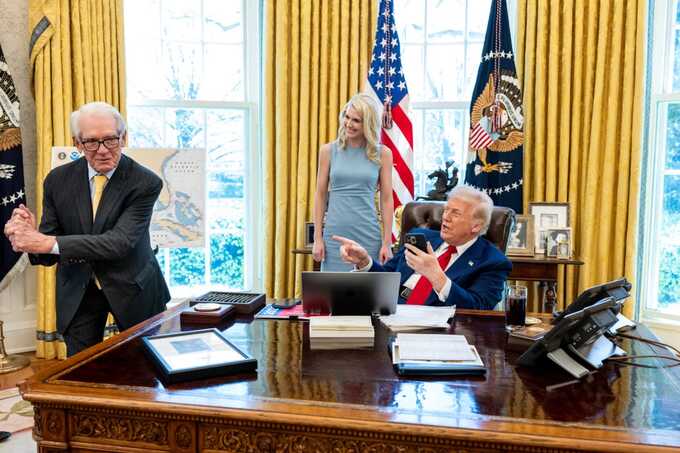
In August, a New York appeals court delivered some good news to President Trump—and sent his Charles Schwab account into overdrive.
As reported by The Wall Street Journal, a panel of judges threw out a roughly $500 million penalty against the Trumps stemming from New York Attorney General Letitia James’s fraud case against the family’s businesses.
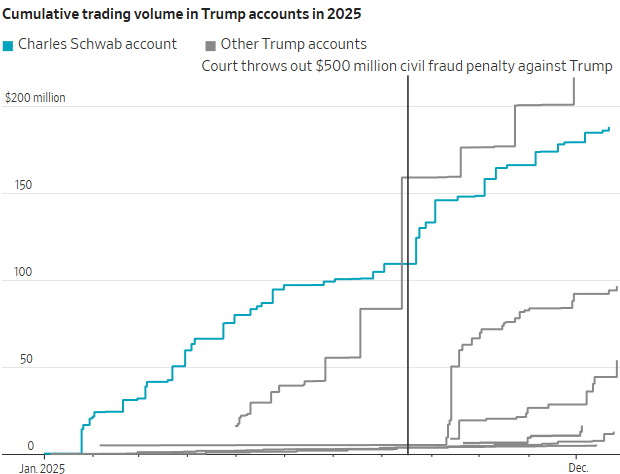
The president’s trust had set aside money in a Schwab account to pay the fine, but the ruling freed up that cash for investments, people familiar with the situation said. Within days, the Schwab account was snapping up and selling dozens of stocks as an automated trading strategy put the cash to work.
Trump’s massive increase in stock trading, detailed in recent financial disclosures, has drawn scrutiny from government ethics watchdogs. After reporting dozens or hundreds of trades in filings through the first 15 months of his term, he began disclosing thousands more in recent weeks. His latest report revealed an avalanche of more than 21,000 trades over the course of last year.
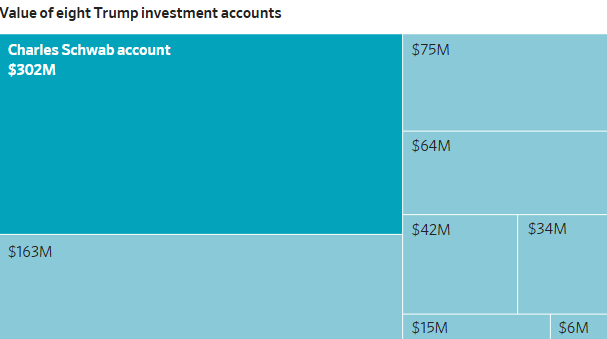
Schwab, which has emerged as one of the Trumps’ go-to financial firms, is one of the major money managers at the center of that trading activity. Of the eight investment accounts detailed in Trump’s annual financial report, one managed by Schwab—identified only as “account no. 7”—held the most money, as measured by the minimum values assigned to each holding, and had among the highest volume of trades on or after the August court ruling, according to people familiar with the matter.
UBS and JPMorgan Chase are two of the other financial firms handling investment accounts for the first family, some of the people said.
Trump has said his sons are managing all of his investments while he’s in office. “My kids run it,” he said on CNBC earlier this month. “I’ve made a tremendous amount of money, more than I would have ever thought I would have made, and I let people invest it I don’t even speak to.”
Much of the president’s wealth is held in a revocable trust. Trump is the sole beneficiary, though Donald Trump Jr. serves as the trustee, with sole voting power.
“All of the president’s assets are held in fully discretionary accounts managed by independent third-party financial institutions,” a White House spokeswoman said in a statement. “There are no conflicts of interest.”
Since the president’s return to the White House in early 2025, the Trumps have turned to automated trading strategies. A Trump Organization spokesman said the family is taking that approach to alleviate concerns about potential conflicts of interest.
One such strategy, direct indexing, involves buying individual securities that track the performance of an index—such as the S&P 500 or the Schwab 1000—while also generating losses that can be used to reduce capital-gains taxes. These automated strategies routinely buy and sell large quantities of stocks over the course of the year to hew to an index, and any influx of cash into the account will very quickly be redeployed.
Schwab is a dominant player in the brokerage industry and a pioneer in low-cost trading. Unlike banking giants such as JPMorgan and Capital One, the firm didn’t face accusations from the Trump family that it had “debanked” them, or closed their accounts, in response to the Jan. 6, 2021, riot at the U.S. Capitol.
Schwab founder Charles “Chuck” Schwab, who has occasionally appeared at the president’s side, has advocated for government-backed retirement plans, including a mandated savings program requiring employers to contribute to workers’ accounts, people familiar with the matter said. The idea, which the president mentioned Monday during remarks from the Oval Office, draws from Australia’s superannuation system.
Schwab wound up attached to the New York case when the Trumps lost in a lower court and put $175 million into an account for collateral on a bond intended to pay the fraud penalty. The reversal of that award triggered the new wave of stock trading. The appeals court kept in place the finding of fraud liability, and the case is now before the state’s highest court.
In addition to managing some of the Trumps’ investments, Schwab last year provided the Trump trust with a pledged-asset credit line of more than $50 million, according to the president’s financial disclosure report. Schwab’s pledged-asset lines allow customers to borrow against their stock and bond holdings, but the loans can’t be used to buy more securities.
There are key differences between revocable trusts—which are standard in estate planning—and the so-called blind trusts sometimes established by public officials, according to Melissa Rodriguez, a partner at law firm Day Pitney. With a blind trust, an appointed independent trustee has complete control, while the beneficiary isn’t permitted to offer any input or even know what’s being bought or sold.
“The goal is that they genuinely can’t be influenced by their own investments because they don’t know what they are,” Rodriguez said.
Revocable trusts allow the person who opens it to retain control during their lifetime and amend it, revoke it or move assets in and out of it, she said.

Eric Trump has said the trades disclosed in the president’s filings were directed by the financial firms that manage the trust’s accounts. “These institutions have sole and exclusive authority over all investment decisions, including asset allocation, trading, rebalancing, and portfolio management,” Eric Trump wrote in an X post in May.
The eight accounts disclosed in Trump’s annual report held at least $858 million in 2025, up from at least $237 million a year earlier. The report also revealed that Trump had brought in $2.2 billion in income in the first year of his second term, reflecting big gains from his crypto ventures.
Losses on stock investments such as those generated by the direct-indexing strategy the Trumps have employed, can offset capital gains anywhere in an investment portfolio, including those generated by crypto assets and business sales, according to Matt Chancey, founder of Tax Alpha Companies. The Trumps netted $1.4 billion from crypto in 2025, financial disclosures showed.
Direct-indexing programs typically trade frequently when the market turns more volatile, said Joe Smith, investment chief at Parti Pris Investment Partners. “You see trading activity as the markets get choppy or go down,” Smith said. “For the year we’ve had, direct-indexing advisers found good opportunities.”
The president’s own policies triggered one such opportunity in early April, when his announcement to impose tariffs on imports from nearly every U.S. trading partner sent the stock market into a tailspin. On April 3 and April 4, Trump’s investment accounts bought and sold hundreds of stocks. On April 8, the accounts went on a buying binge. Roughly 80% of the trades in the week ending April 8 were in the Schwab account.
The market quickly regained its footing from that selloff, thanks in large part to Trump’s April 9 decision to postpone his tariffs for 90 days, and in late June the S&P 500 had closed at a record high.

Head of Investigations