12 July 2026 , 16:15
800
0
At a secret location in southern Germany, the manager of a drone factory owned by Helsing SE — Europe’s most valuable artificial-intelligence defense start-up — hands me a lethal killing machine to cradle in my arms. Weighing just 26 pounds, the black, hard-foam attack drone is so light and looks so simple that it is easy to forget its role in a surging multibillion-dollar industry, the Russia-Ukraine War — and maybe even in Europe’s future security.
As reported by The New York Times, for decades, Western governments have ordered supplies like tanks, fighter jets and submarines from contractors such as Lockheed Martin or Northrop Grumman. Those items take years to deliver and are dizzyingly expensive; an F-35 jet can run to over $100 million.
That sort of multiyear government contract still accounts for a lot of military spending. But the current trend is clear: defense technology is becoming cheaper and nimbler, with breakthroughs developed by privately funded companies rather than governments.
“There’s a transformation in defense economics,” said Alexander Blanchard, senior researcher in A.I. governance at the Stockholm International Peace Research Institute.
Of the Pentagon’s $1.5 trillion budget request for next year, about $55 billion is earmarked for the creation of a new unmanned, A.I.-powered arsenal. On a more modest scale, the E.U. is piloting a €115 million program to fund A.I. defense companies. These budgets are expected to grow, and defense technology has become a booming area for venture capital.

Helsing, like other far smaller defense start-ups, has already flipped the script on sluggish governments, by harnessing the type of disruptive innovation more common in Silicon Valley, tapping billions in venture capital and hiring top tech talent. The company, some of whose top ranks migrated from Palantir, Tesla, Apple and Meta, set out to mass-produce war machines costing as little as €17,500. Powered by A.I., they require minimal military personnel and barely a week’s training. And the drones have been battle-tested under fire in Ukraine.
Few companies illustrate the profound shift in the way militaries spend as clearly as does Helsing, the five-year-old Munich-based start-up. This month the firm allowed DealBook to be the first U.S. journalists inside its drone factory.
A stealth factory


Situated in a serene, suburban industrial complex, the factory operates under watertight security. DealBook agreed not to disclose its location, and other tenants in the complex are kept unaware of its existence. Helsing’s name appears nowhere: The company fears the factory could be a prime target for sabotage or attack, given that thousands of the drones assembled here have been deployed against Russian forces in Ukraine.
The factory is able to be dismantled and relocated within a day, in case of a threat. The 100 or so factory workers, many of whom were recently laid off by flagging German carmakers, undergo extensive security vetting and sign nondisclosure agreements. Painted on one wall is a motivational slogan reading, “protecting our democracies.”
When Helsing’s three founders started the company in 2021, with seed funding from the Spotify founder Daniel Ek’s venture capital firm, they had one mission: Stave off Russian threats, and fast.

“The urgency was clear, or at least clear to us,” said the company’s co-founder and co-chief executive Gundbert Scherf, who was previously an adviser to Germany’s defense ministry and a partner at McKinsey. “There was a need to do more in defense and give Europe a stronger footing.” Yet with Russia’s invasion of Ukraine still a year away, investors were unconvinced. “At the time, it was virtually impossible to raise money for defense in Europe,” Scherf said.
The onrush of investments

There has been a seismic change since then — and not solely because of the war in Ukraine. President Trump’s demands for Europe to increase its military spending and his repeated threats to take control of Greenland have helped push defense budgets much higher. A flurry of investments in defense tech start-ups has followed. DealBook hears investors have rushed to participate in Helsing’s latest funding round, which was initially estimated to be about $1.2 billion, valuing the company at about $18 billion, according to The Financial Times.
“The market opportunities are enormous, and there is no one company that is going to capture it,” said Raviraj Jain, a partner at Lightspeed, which he says has so far invested more than $100 million in Helsing.
For investors, Helsing’s key advantage comes from its role in the grueling combat in Ukraine, where Helsing has deployed thousands of drones since late 2024. Those missions provide Helsing a trove of data, allowing it to update its software regularly; Ukrainian soldiers record many attacks on video, for mission-success analysis. “There is so much more at stake here,” Scherf said. “These technologies move very fast.”
Cat-and-mouse video games

The videos from Ukraine show a cat-and-mouse game. A so-called loitering munition or kamikaze drone, the HX-2 (the X is for its crossed wings) hovers over the battlefield, picking out minuscule Russian targets like battery systems and armored vehicles, camouflaged in forests. When Ukrainian soldiers, who operate the drone from many miles away, give the go-ahead, it swoops down and eviscerates the threat, often under fire.
Scherf said mission success rates in Ukraine were around 70 percent, “something we are very proud of.” The A.I. software allows the drones to continue functioning even if their communications systems and GPS are disabled by Russia’s well-honed electronic jammers. “I don’t know any other Western company that has got the autonomy Helsing has,” said Khaled Helloui, a partner at the London-based venture capital firm Plural, which he says has invested about $800 million in defense companies, including Helsing.
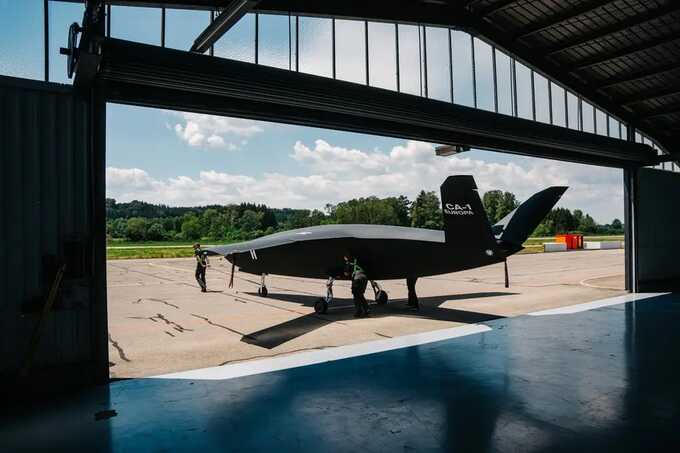
Helsing’s next innovation sits on a sunbaked airfield 90 minutes by car west of Munich, where aircraft engineers are building the company’s first unmanned fighter jet, named CA-1 Europa. Made with lightweight carbon fiber, the jet should be capable of striking deep inside an adversary like Russia by the time it is deployed in 2029.
The aim is simple: For a small fraction of the cost of one regular fighter jet, Helsing can, in theory, produce hundreds of Europas. It can send one ahead to jam the enemy’s electronic network, followed by several attack jets — all loaded with precision-guided weapons similar to those found on an F-35. “If you don’t have a pilot, you can conduct completely different, more dangerous missions,” said Stephanie Lingemann, Helsing’s vice president for its air programs. “You are no longer thinking about the human life you have to protect.”
That calculus is clear in the U.S. too. A Pentagon spokesman, Sean Parnell, told the U.S. Naval Institute this month that “drones and autonomous systems represent the most consequential battlefield innovation of this generation.”
A crowded market

For all Helsing’s whiz-bang A.I., it is possible that the proliferation of defense tech start-ups could confound investors, or even turn them off. “Defense tech, because of all the interest, has become a very noisy place,” Scherf said. “There are a lot of new players, and that makes it hard to read for investors, the public, and governments.”
But few believe the demand for unmanned warfare will subside any time soon. And in Helsing’s drone factory, the outline of the next potential conflict in Europe is already taking shape. In a large storage room, dozens of boxes are stacked several feet high, many containing drones awaiting shipment, not to Ukraine, but to a battle-ready German brigade stationed in Lithuania, near the Belarus border. Germany’s parliament this week approved a €220 million military contract for Helsing to develop a broad range of A.I. systems.
Ballooning military spending might be good for investors, but it could signal tough times for the world. “A lot of it hangs on the thinking that we are on course for a larger conflict in Europe,” Blanchard said. “You don’t grow your arms industry because you are expecting a generation of peace.”

Deputy Editor