04 August 2026 , 08:45
796
0
In a room decorated with colorful balloons and wall murals, a group of Kyrgyz children pose for the camera.
The boys, seated in front, wear traditional kalpak hats and clutch boxed building sets. Behind them, girls wearing yellow dresses and matching bows hold oversized plush dolls.
The children, celebrating the opening of their new kindergarten, are joined by an unusual guest: Standing behind them is a stern-looking man wearing a dark-blue suit and an inscrutable expression. This is Kamchybek Tashiev, at the time the head of Kyrgyzstan’s feared GKNB security service.
Under his leadership, the agency — the Kyrgyz successor to the Soviet KGB — had grown vastly in influence, becoming the country’s most privileged and influential state body. The new kindergarten, opened in 2024 for staff members’ children, was part of a wave of GKNB construction projects that now dot every region.

And the construction spree was only the most visible sign of the agency’s rise. New laws expanded the GKNB’s powers, giving it control over military units, strategic infrastructure, border protection, and even citizenship, while allowing broader use of force, weapons, and the use of false identities.
The security agency grew so powerful that Kyrgyzstan’s citizens saw their country as being ruled by a tandem, referring to Tashiev and the man who appointed him, President Sadyr Japarov, as ekidos — “two friends.”
That’s why Tashiev’s fall from power came as such a shock.
On February 10, while the 57-year-old security chief was in Germany for medical treatment, Japarov abruptly dismissed him. One after the other went his political allies, deputies, and relatives, all either resigning from their positions or being removed. Some of the GKNB’s broad new authorities were rolled back.
Japarov offered no detailed explanation, saying only that he had acted to prevent people invoking Tashiev’s name from sowing division. But his firing was followed by a criminal case, with Tashiev accused of attempting to violently seize power. In July he received a four-year prison term, though a judge amended his sentence to three years of supervised probation.
The drama is the latest milestone in Kyrgyzstan’s post-Soviet political journey. Once known as Central Asia’s “island of democracy,” this mountainous country of seven million has in recent years plummeted on every metric of freedom and political openness.
The GKNB under Tashiev was instrumental in making this happen. Though its agents have taken down organized criminal networks, they’ve also been relentless in pursuing independent businesses, the regime’s political opponents, journalists, and activists. Ordinary people who still dare to speak with reporters refuse to be quoted by name.

“The GKNB is everywhere. Every dog is with the GKNB,” says a woman with a business in Bishkek. “Everyone just whispers. It’s like telling jokes about Stalin in the kitchen.”
With Tashiev’s removal, the question for the people of Kyrgyzstan is whether this repressive apparatus will let up.
Experts view his dismissal, and the criminal case against him, as President Japarov’s way of neutralizing a potential rival for the office. The man Japarov chose to replace him, Zhumgalbek Shabdanbekov, is described by experts as a career security official and presidential loyalist — but not a political heavyweight.
There are no plans for any political liberalization, says Temur Umarov, a Central Asia specialist at the Carnegie Russia Eurasia Center in Berlin.
“Japarov is following the track that Tashiev built for him,” Umarov told OCCRP. “He won’t leave it. On the contrary, he will go further and longer. I think his plan is to build that typical Central Asian authoritarianism, which he will possibly pass on to his son.”
The GKNB, Tashiev, and the Japarov administration did not respond to reporters’ questions. Tashiev maintains his innocence and has appealed his conviction.
From Cellmates to Statesmen
Kyrgyzstan’s former ruling duo have a long history together. In 2006, Tashiev was one of the founders of Ata-Jurt (“Fatherland”), a nationalist political party that draws its support from ethnic Kyrgyz people in the south of the country. He and Japarov, also a top Ata-Jurt figure, were convicted and briefly imprisoned in 2013 for attempting to violently seize power.
For a time, it seemed their ambitions were thwarted. While Tashiev unsuccessfully ran for president, Japarov fled the country for several years, only to be convicted of hostage-taking and again imprisoned on his return.
Everything changed in 2020. After an election widely decried as fraudulent, widespread protests toppled the incumbent government. But hopes for a more democratic outcome were soon dashed: Japarov was sprung from prison by supporters and elevated to the presidency through behind-the-scenes maneuvers analysts have attributed to organized crime-linked networks. Within weeks, he named Tashiev, his old party comrade, to the nation’s top law enforcement position.
Together, the two men built a coalition designed to overcome one of Kyrgyzstan’s enduring political fault lines: the divide between the more Russified and industrialized north and the more densely populated south, with its stronger Uzbek and Tajik influences.

Japarov, a northerner, became the public face of the government, while Tashiev, from the south, entrenched himself inside the security services. The arrangement gave both men room to eliminate political competition.
The result was that Tashiev became far more than a security chief — particularly after Japarov also named him deputy head of the cabinet of ministers a year after his GKNB appointment. Though formally Japarov’s subordinate, he was widely seen as the decisive figure on law enforcement, control over parts of the economy, and the campaign against the criminal underworld.
Construction Boom
His rise soon began to leave a physical imprint on the country.
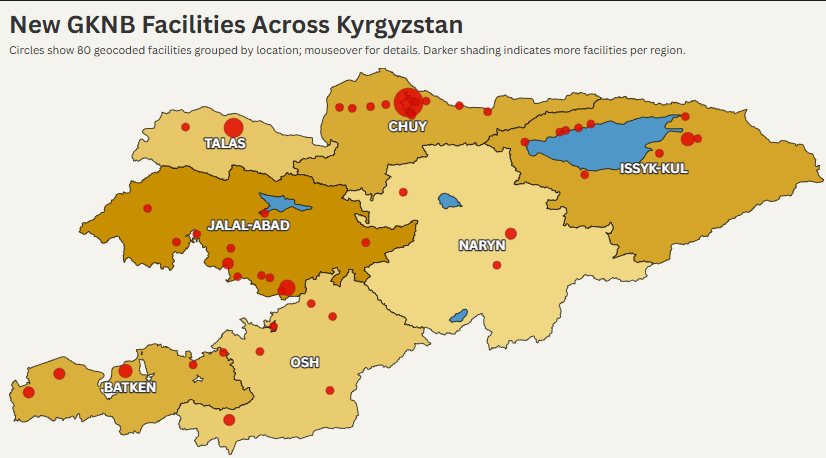
Reporters have catalogued dozens of new GKNB facilities (some still under construction) that now dot Kyrgyzstan’s every region, including a cybersecurity center, medical clinics, health resorts, and dozens of apartment buildings.
A new training academy meant that, for the first time, officers could be trained at home instead of being sent to Russia. And the new GKNB headquarters, opened last May in the country’s capital, Bishkek, is “ten times” the size of the previous, Tashiev announced. Its arrival, he said, marked “a new era in the country’s development.”


The first of Tashiev’s many ceremonial visits to a GKNB construction site took place in June 2021, about eight months after Japarov appointed him the agency’s head.
Donning a hard-hat and work gloves, he laid a time capsule in the foundation of a new administrative building in Manas, the rapidly-growing capital city of his native region. The bill for the 100-million-som ($1.2 million) project would be footed by unnamed “sponsors,” it was announced.
It was the beginning of a building spree. The following month, again in Manas, Tashiev presided over the groundbreaking of a 205-unit apartment building for GKNB staff and other security employees. “Neither the government budget nor any state companies have spent any money on this building,” he said, again pointing to unnamed “partners” as the sources of financing. A few weeks later he was back in the region again, cutting a ribbon in a small town just 8 kilometers down the road.

President Japarov, too, has made multiple such appearances. At the opening of the new GKNB headquarters in Bishkek last year, he gave the latest total figures: Ninety-four GKNB facilities, including 73 administrative buildings, seven kindergartens, and 14 residential buildings, had been built since 2021.
Reporters independently counted at least 88 new GKNB facilities built or started since Tashiev and Japarov’s rise to power. But public tenders were announced for only four of them, and none at all since mid-2021.
Just fifteen of these projects are listed in a public register maintained by the Ministry of Construction, Housing and Utilities, which shows their contractors, approximate locations, and in a few cases, their estimated costs. Reporters were unable to find out how the remaining projects were financed, who the contractors were, or any other official information.
In response to requests for comment and clarification, the Ministry wrote that it cannot provide any information about the scale, financing, or contractors behind the GKNB’s construction drive, because it does not collect the information in that form and considers the GKNB to be the relevant record-holder. It noted that its online list is not comprehensive, and said it would endeavour to correct duplicate entries flagged by reporters.
The GKNB itself did not respond to a request for comment on this or any other topics. And this lack of transparency extends beyond the security agency. Changes to Kyrgyzstan’s law on public procurement, instituted in early 2022, allowed state companies to bypass public tender procedures. And as of this May, tenders have been abolished entirely in many areas, the government now able to grant contracts to companies directly by “state assignment.”
Diminished oversight is a major concern in a country where officials are frequently accused of profiting from their positions. In a previous investigation, reporters found nearly a dozen state construction projects, valued at over $137 million, linked to the family of President Japarov and to the head of his Presidential Directorate. Among these is a vast new Presidential Palace, an airport expansion, and tourist infrastructure in a national park.

Codifying Control
The new GKNB facilities sprouting across Kyrgyzstan were only the most visible signs of the agency’s new reach. They were accompanied by legislative changes that sharply expanded its authority.
In November 2020, just a month after Japarov and Tashiev came to power, Kyrgyzstan’s once-separate border service was folded into the GKNB. But the most significant changes came in 2022, with the adoption of a much-discussed package of new security laws.
Their proponents argued that, given Kyrgyzstan’s new constitution, the country’s legal framework in this area was due for an update. Some security functions, such as counter-espionage, had never before been codified; doing so would establish public oversight for the first time.
But the new laws left the GKNB with vast new powers. Language in the main security law lists “military units … education and healthcare organizations, scientific research institutions, and socio-cultural objects” as being subordinated to the agency. Military counterintelligence units, which are also part of the GKNB, are described as being “independent from the command of the armed forces.”
The law also granted the agency the authority to deal with the issuance or revocation of Kyrgyz citizenship — a matter that has already drawn attention after outspoken investigative reporter Bolot Temirov was stripped of his citizenship in 2022.
It also loosened a number of restrictions on how GKNB agents operate in the field: They were now allowed to mask their identities by presenting themselves as employees of other agencies; they were no longer required to show their IDs to citizens or explain any restrictions on rights and freedoms; they were allowed to use weapons without a license; and they could wear masks to hide their faces.
“The excessive secrecy and excessive special powers could be justified in the presence of parliamentary oversight,” said Nurbek Toktakunov, a lawyer who has worked with independent Kyrgyz news organizations, including OCCRP partner Kloop. “But in its absence, I am forced to draw an analogy between the GKNB and the RSHA [Reich Security Main Office] of Nazi Germany. This agency carried out the police functions of the state, activity in intelligence and counterintelligence, and could also form militarized army formations.”

Tashiev’s Personal Rule
Beyond the GKNB’s legal powers, Tashiev — who concurrently held the post of deputy chairman of the Cabinet of Ministers — regularly commented on topics that had little to do with security.
Local journalists collected a number of examples when he publicly opined on matters as wide-ranging as vaccine distribution, economic prognoses, droughts and irrigation, and food prices. He demanded that government officials stop using fireworks, holding New Years parties, and giving New Years’ speeches, and also called for a ban on MMA fights.
In some cases, Tashiev’s words almost seemed to have the force of law. After Russia’s full-scale invasion of Ukraine in 2022 led to a rise in fuel prices, he “recommended” that Kyrgyzstan’s gas stations adopt an upper limit for diesel fuel prices. This statement, made at a meeting with several fuel traders, was published in an official GKNB press release. It noted that the traders had agreed to “corresponding measures.”
The GKNB leader also had a habit of threatening officials who displeased him. “Get ready,” was his message last August to the head of a district he was about to visit. “Clean everything, paint everything, get the streets, the drainage canals, and schools in order. If even one person speaks out against you, there will be a scandal.”
The following month, he told a cautionary tale about two feuding officials in the Jalal-Abad region. “First I called them in and told them to work together. They ignored me and kept fighting,” he said to reporters during a visit. “For a second time I warned them: ‘Don’t anger me.’ But they still didn’t get it. The third time I brought them both in and gave them a beating. I said: ‘If you don’t get it next time, I’ll arrest you both.’ Since then they’ve worked together just fine.”

On at least one occasion, Tashiev’s anger at a legislator led to his expulsion from parliament. Last March, MP Sultanbai Aizhigitov spoke out against a just-signed border agreement between Kyrgyzstan and Tajikistan, of which Tashiyev was an architect and chief negotiator.
Speaking in parliament a few weeks later, Tashiev said he had learned that Aizhigitov had lied about his criminal record when running for office. “Don’t be surprised if tomorrow the Central Election Committee takes away his mandate,” he said. Some nine days later, that is exactly what happened.
Aizhigitov was then interrogated by the GKNB in connection with an alleged abuse of his position. He and his wife were both brutally beaten during their detention, he later alleged. Both were subsequently charged with abuse of office over her employment as his parliamentary assistant, and Aizhigitov was convicted in September 2025.
Journalists from OCCRP partner Kloop documented several other cases where members of parliament who opposed an earlier Kyrgyz agreement with Uzbekistan faced expulsion and criminal charges under alleged GKNB pressure.
Arrests, Intimidation, and Repression
Tashiev’s intolerance of dissent extended to ordinary citizens. The years of his and Japarov’s rule were marked by sharp declines in Kyrgyzstan’s level of freedom of speech and the press. Among the victims are some of OCCRP’s closest partners in the country.
The authorities led an especially insidious campaign against Bolot Temirov, the outspoken founder of investigative video channel Temirov LIVE. Over the fall and winter of 2021, the GKNB conducted systematic surveillance and harassment of him and his team — just as they were preparing an exposé alleging corruption involving members of Tashiev’s family.
As OCCRP later revealed, this effort included installing a hidden camera and microphone in Temirov’s apartment and orchestrating a scheme in which a GKNB agent romantically pursued one of Temirov’s female employees, secretly recorded a sexual encounter, and used the intimate footage to blackmail her for information about Temirov’s work.
Two days after Temirov LIVE’s Tashiev exposé was published in January 2022, police raided the outlet’s office and arrested Temirov for alleged drug possession. He then faced additional prosecutions human rights experts widely view as politically motivated, ultimately being stripped of his citizenship and deported. Though he is still working from abroad, the authorities have continued targeting his team. His wife and the outlet’s director, Makhabat Tazhibek kyzy, received a six-year prison sentence, though that conviction was since overturned and the case sent to retrial.

The award-winning investigative outlet Kloop, a longtime OCCRP partner, has been effectively dismantled in the country. Kloop’s website was blocked in September 2023 following a GKNB complaint regarding a story about alleged torture by its agents. The outlet was then ordered to shut down based largely on expert testimony claiming that its reporting was "upsetting" the population.
Last May, the GKNB took eight Kloop employees and former employees in for questioning. Two former cameramen were detained and, along with two accountants, later charged with issuing “public calls for mass unrest.” All four were convicted, with the cameramen receiving prison terms but later being released on probation. Kloop’s remaining staff continue their work from abroad.
The GKNB Takes On Crime and Corruption
Almost immediately after Tashiev assumed leadership of the GKNB, the agency moved against two of Kyrgyzstan’s most powerful criminal figures.
In October 2020, its operatives detained Kamchy Kolbaev, a notorious underworld boss; he was released from detention after his family returned 50 million soms ($570,000) of “illegal income” to the state. The GKNB also detained Raimbek Matraimov, the former deputy head of customs, whose ties to a man accused of building a vast smuggling empire had been exposed in multiple OCCRP investigations.
The crackdown extended far beyond these two figures. An OCCRP review found dozens of GKNB press releases detailing detentions, wanted notices, and claimed “suppression” of criminal networks between 2020 and 2025. The drive was also linked to a controversial practice known as “kusturization” — from the Kyrgyz word for “to vomit” — in which suspects are forced to repay money or surrender assets to the state in exchange for leniency. By February 2024, the Ministry of Finance reported receiving over 20 billion soms ($200 million) from anti-corruption efforts, with Tashiev later claiming the total value reached 100 billion soms ($1 billion) when including seized real estate and other assets.
In July 2023, Tashiev issued a stark warning to criminal leaders at a Cabinet of Ministers meeting. “The president has set us the task of eradicating organized crime groups in Kyrgyzstan," he said. "Leaders of organized crime groups, if you cannot live peacefully in Kyrgyzstan, leave the country.”
Three months later came the dramatic culmination of the campaign: Kolbaev’s death during a GKNB operation to detain him. According to the security service, Kolbaev was being investigated for ordering the murder of a rival gang leader. The GKNB claimed Kolbaev put up armed resistance, forcing officers to open fire. His death triggered the arrest of 40 members of his criminal organization and the seizure of assets worth a billion dollars. Tashiev defended the operation, stating he had given the order to “liquidate” Kolbaev “for the sake of the state.” Kyrgyzstan had become “the first country in Central Asia” to eliminate its criminal underworld, he said. He later denied ordering Kolbayev’s death, saying he had meant that officers were authorized to use lethal force when Kolbayev allegedly resisted arrest.
Raids on Business
In parallel with its repression against dissidents and journalists, the GKNB conducted a mass campaign of asset seizure from businesses in the name of anti-corruption.
This resulted in the nationalization of a vast portfolio of properties. Among them are gold and mercury deposits worth tens of millions of dollars, а pub and brewery in Bishkek that was popular with expats, a hunting club with hundreds of square kilometers of territory, and a couple of lakeside holiday resorts.
At a press conference in November 2024, the head of the presidential administration announced that the state had taken possession of 1,180 apartments. “As you know yourselves,” he told assembled reporters, “unlawfully obtained land is being returned to the government on the order of GKNB head Kamchybek Tashiev.”
Many of these actions were justified as a crackdown on the financial empire of crime boss Kamchy Kolbayev, who was killed in October 2023 (see box above). A significant number were also seized because the state now deems their original privatizations, which often took place decades ago, to have been illegal.

Other times, instead of seizing assets, the state detained prominent business figures and released them after they made “voluntary” financial contributions.In at least some cases, businessmen have publicly alleged extortion.
Prominent Targets
The GKNB’s appropriation campaign in the business world extended even to the wealthy and prominent: Among its targets were a former presidential candidate and the former head of the Bishkek city council.
‘Into a Left Pocket’
Imamidin Tashov, a prominent businessman and a onetime minor presidential candidate, was detained in October 2023 after authorities alleged that one of his companies had engaged in illegal construction.
Tashov was released on house arrest after transferring properties worth 52 million som ($590,000) to the Bishkek city government. But in January 2024, a video circulated on social media in which he claimed GKNB officers had kidnapped him, held him for eight days, and demanded an additional 100 million som ($1.1 million) “into a left pocket.”
The GKNB publicly denied the claim and immediately announced that Tashov was being sought for allegedly plotting to overthrow the government. He was rearrested that April and eventually received a nine-year prison sentence, reduced to eight years on appeal.
While in custody Tashov claims to have been tortured, went on hunger strike, and repeatedly attempted to harm himself, including cutting his own neck in court. His lawyer was also arrested and said his case materials were seized during a search. The GKNB denies any mistreatment and claims Tashov’s injuries were an attempt to seek publicity.
‘A Politics of Robbery’
One prominent category of businesses that fell under the GKNB’s appropriation campaign are Kyrgyzstan’s open-air markets, an important part of the country’s economy. In 2024, at least 10 markets around the country were “returned to the state ownership” by the agency.
Nurzhamal Baibolova, the former head of the Bishkek city council, had a share in two of the city’s markets. But in February 2024, the GKNB launched a criminal case alleging that the decrees granting her ownership of the land were illegal. A court decision that year cancelled her land titles, arguing that part of the territory was originally a "green space" meant for public use.
In an interview with reporters, she said that her business had been “completely transparent,” with rent paid by bank transfer and taxes automatically withheld. Yet, she said, “they were looking for how to catch us.”
Baibolova, who now lives abroad, has been public about her story, denouncing the government in a Facebook post as pursuing a “politics of violence and robbery.”
One business owner, speaking with OCCRP on condition of anonymity, described a stifling atmosphere.
“It’s like in Russia ... They just bought a book called ‘How to become a dictator’ and now it’s happening,” she said. “As a business owner, I can’t express my opinion anywhere. ... [GKNB officers] come to our establishment, they cause complete mayhem, and we can’t kick them out because we know that on the next day someone will come for us.”
‘The only word that comes to mind is fear.’
It’s not just businesspeople. Journalists working in Kyrgyzstan have noticed that almost no one in the country is still willing to speak openly to reporters on any sensitive matters.
One data analyst from Bishkek says she no longer even uses her regular phone. “Only Telegram,” she wrote. “I’ve developed this habit because of the likelihood of a phone tap.”
Using the messenger, she described a pervasive anxiety. “The only word that comes to mind is fear,” she wrote. “It seems like they could come for you, your friends, your loved ones at any moment, even if you’ve done nothing wrong. … You don’t know what to expect today or tomorrow, or whether tomorrow will even come.”
The GKNB itself has recognized that it terrifies people. In a press release last year, the agency acknowledged that phone scammers have started to introduce themselves as GKNB operatives to pressure people into sending money. The victims often comply, the official press release reads, because “almost everyone is afraid of employees of the national security agencies and fears possible prosecution.”
Given the GKNB’s ruthlessly effective suppression of dissidents and Japarov’s political opponents, why was Tashiev removed?
Umarov, the Carnegie expert, says that, given the upcoming presidential election, scheduled for January 2027, his ambitions may have simply become intolerable to the president.
“From Japarov’s point of view, it seems that the situation started to look quite dangerous,” he told OCCRP. “When you are an autocrat, or preparing to become one, from your point of view it’s better to overreact and eliminate any possible dangerous scenarios at the root, instead of waiting and wondering whether it will blow up.”
At the same time, Tashiev appears to have gotten off lightly. He escaped any real prison sentence and was observed by Kyrgyz outlet 24.kg attending a football match on the day following his conviction.
More than one political analyst has described Japarov’s handling of the affair as a backroom deal or managed political solution designed to neuter Tashiev while avoiding any unrest or open conflict.
Indeed, Tashiev himself recently pledged his public support for Japarov, describing the president in a Facebook post as his friend and reaffirming his earlier promises not to run for the office. “We must stand firm in friendship, loyalty, and responsibility to the state in any situation!” he wrote.
Meanwhile, the GKNB has lost little of its new authority. Aside from the agency’s merger with the Border Service, which was reversed this February, the other expansions to its power have all remained in force or even strengthened further. Just last month, Japarov signed a new bill that will give the agency broader authority over telecom data and mobile devices.
“Even though Tashiev was the main personification of the repressive instruments,” Umarov says, “these instruments will remain even in his absence."

Head of Investigations