24 June 2026 , 12:10
966
0
On February 25 2015, Andy Burnham rang me up out of the blue. In those days, I was the political editor at the Manchester Evening News, covering Greater Manchester’s escalating attempts to wrestle power away from London. The latest iteration would see local leaders take more control over their health services, which since the 1940s had been run top-down by the central government.
As reported by FT, Burnham was then the shadow health secretary, as well as a Greater Manchester MP — and he fully intended to be in charge of the NHS within the next few months. He was so incensed at the devolution plan that my shorthand struggled to keep up with his concerns — it would lead to complex reorganisation and punch holes in the NHS “like Swiss cheese”, he told me. If Labour were to win that summer’s general election, he said, “I wouldn’t be offering this deal”.
As it turned out, Labour lost the election. In the leadership contest that followed, Burnham lost too. But less than a year later the same issue came up again. This time, we were in the upstairs room of a boutique city centre hotel, where he was announcing his ambition to become Greater Manchester’s first mayor. Slightly jarringly, that pitch included big plans for the devolved health system he had been so upset about before. Social care, he was now telling me, would be renationalised under his 10-year leadership vision. The election of a Manchester mayor was “a big moment that could rebalance politics and the country quite fundamentally”. Labour, he said, in reference to himself, must field “its biggest names”.
With hindsight, those two interactions were the ideal introduction to the man who is now preparing to enter Downing Street. A decade after his successful run for mayor, Burnham is back in Westminster.
Within a week of Labour descending into despair over May’s catastrophic local election results, he had rolled the dice — triggering and then storming a by-election in the Greater Manchester constituency of Makerfield, explicitly to replace the deeply unpopular Sir Keir Starmer. By this time next month, Burnham could be running the country.
It is to his Manchester years that Westminster politicos and the corporate world will now turn for clues to his reinvention. It was a period I followed closely in my former job, and now in my current one as the FT’s Northern England correspondent. Time and again I watched Burnham transform himself with spectacular success. But on one thing he was constant. He never lost his eye for the story — or the prize; the first was always his route to the second. A decade ago, that prize was the chance to make his name in Manchester instead of languishing on the opposition benches. Now it is Downing Street.

“I’ve never met anyone more ambitious in my life,” remarks one Labour figure who has worked closely with him in Manchester. He wears it well, but then he never tried that hard to hide it. “This is the job in politics I truly want,” Burnham told me in 2018, of the mayoralty he had already held for a year. “Because, in a way I could never be in Westminster, this job brings out the real me.” Westminster, he added for good measure, “makes a fraud out of you”. In that case, I suggested, he would presumably never go back? “I’m not going to say never,” he replied.
And he never did. Each time Burnham was asked about a potential leadership bid, he’d flirt with the party. If they wanted him, he said, then he would be there. There were other things that didn’t change: his instinct for a narrative, his love of a just cause, his ability to connect with people and his desire to please them. His tendency to turn up late for most appointments. His wide-eyed sincerity, coupled with a streak of vanity: “This is the one,” sang The Stone Roses at the launch of his first manifesto.
Born in Liverpool and brought up halfway between his birthplace and Manchester, Burnham is undoubtedly a creature of the north. Nonetheless, in this parochial part of England, his Mancunian credentials were often questioned in the early days. He went hard on his love of the city’s legendary 1980s and ‘90s music scene, perhaps in response. One of only two occasions he called me to complain was after I wrote a light-hearted article querying whether a Scouser could really be our mayor, a question already being asked by our readers. It clearly bothered him. But he would go on to relentlessly sell both his own brand and the city’s, until the two merged together in the national consciousness.
It helped him greatly that Manchester’s leaders had already created an intellectual framework for him to fall back on, an economic project dating back to the 1980s, one that by the mid-2010s was bearing fruit. It was also useful to have someone else to blame when needed: almost always central government. How that will work once Burnham is the face of that government, and whether Mr Manchester can also appeal to Middle England, remains to be seen.
In Manchester, reinvention was often key to his success. In London, it will be pounced upon as a weakness, proof that he remains the flip-flopper his SW1 critics have long suspected. Indeed, some of his positions in Manchester have spun around so comprehensively over the past decade that they’ve ended up back where they started. As Burnham returns to Westminster, so has he. The mayor is about to reinvent himself again.
To understand Andy Burnham’s transformation from Westminster aspirant to northern insurrectionist, you have to understand the environment into which he landed in Manchester in 2017.
“They really didn’t want a mayor,” recalled George Osborne this month to a House of Lords select committee, of Greater Manchester’s council leaders back then. As Conservative chancellor from 2010-2016, it was Osborne who had insisted on creating the position in return for granting the area new powers of self-governance. The city would have more control over planning, more autonomy over housing and transport investment and the ability to bring its fragmented, chaotic bus network back under public control. But, added Osborne, “I thought you needed a person that people could identify with, know who they were, and hold them accountable. The price was they kind of had to suck their teeth and have an elected mayor.”

As a result, the fresh-faced Burnham arrived to a fair amount of antipathy among his new Labour colleagues. Since the dark days of industrial decline in the 1980s, Manchester town hall in particular had been working to pivot the economy towards professional services, gradually retaining graduates, expanding the transport network and building investor confidence. It was a long slog, from a dismal economic starting point replicated across much of northern England. But they believed they had proved their ability to make more decisions for themselves. So Burnham’s sharp criticism of their health plans had not been forgotten. Two weeks after he rang me up in 2015, he had confronted Greater Manchester leaders in the Lord Mayor’s grand Victorian dining room at Manchester town hall, where he laid down the law. “They got savaged,” recalls one official. “He was angry,” agrees someone who was in the room. “We were all a bit taken aback.”
Long before Burnham’s arrival, the same council leaders had already ensured in negotiations with Osborne that the new mayor’s powers would be limited by a confusing tangle of rules that required their agreement on most issues. Manchester council’s spiky leader, Sir Richard Leese, primus inter pares, took to calling Burnham a “glorified bus conductor” in private. It was a reference to the most-prized power the leaders had won in exchange for accepting a mayor: the ability to take back control of their buses.
The state of Greater Manchester’s bus network had been an open sore for decades. Ever since its deregulation by Margaret Thatcher 40 years earlier, service provision had been left to the market. Many poorer areas were suffering particularly substandard services. Manchester’s buses were disjointed, expensive and unreliable, unlike in London where they had remained under public control. Local leaders viewed it as a totemic example of unfairness. Now, they’d gained the power to dictate routes, timetables and fares through a publicly controlled franchise system.
Burnham’s decision to stand for mayor came at a pivotal moment. In 2016, politics was in danger of overtaking Greater Manchester’s technocratic economic approach. Growth in the city centre, most visible through an explosion of new skyscrapers, was kicking into gear just as Osborne’s austerity policies began to bite. Jeremy Corbyn had taken over the Labour Party and the Brexit vote had unleashed deep-seated frustrations in Manchester’s outlying former mill towns. Future Reform voters were beginning to question what was in the city centre boom for them; future Green voters fretted over inequality.
Burnham’s instincts were piqued. Just as he would in Makerfield a decade later, he ran as an outsider against a Labour project. His first reinvention was under way. “It’s consistent with everything I’ve ever said and ever done,” he insisted, of running for the mayoralty. “I think most people realise that this is where my heart lies.” Once he was in post, it was clear to me that his approach was different to what had gone before. Here, suddenly, was a showboater, a holder of press conferences, a disciple of communication grids already known to TV researchers in the capital. A politician forged in the messaging lore of New Labour’s Westminster.
“Greater Manchester had been a successful project,” recalls one person working in the system at the time, “but it had not been overtly communicative or political. It had been quiet meetings with people who had been part of the club . . . There was never a narrative tying it together, or a voice that spoke externally in a public way.”

Burnham’s signature manifesto pledge in his first campaign was a seductively simple one. He would end rough sleeping by 2020, he said. It was pure Burnham. A clear, popular promise, with a hint of his tendency to respond emotionally and leave the detail for later. There was nevertheless a genuine concern at the time that the city leadership was not taking the crisis seriously. Manchester had not seen that scale of rough sleeping in decades. The town hall was intransigent and defensive, but Burnham took the opposite stance. Through soft power alone, he reoriented the system to focus on it.
The second time my reporting riled Burnham enough to prompt a phone call was after a critical article in the early days of his rough-sleeping project, when the charity sector was reporting problems. “This isn’t about me,” he said, or with words to that effect. “I just feel awful for the people in the system who have been working so hard on this.” And they had. By the time Covid-19 hit in 2020, rough sleeping had nearly halved across Greater Manchester. But meeting his promise was always going to be a tall order; many of the policy drivers lay not in Manchester, but London. As Burnham’s first term wore on, his language shifted from “ending” rough sleeping by 2020 to “trying” to end it. In his subsequent mayoral terms, he moved on to focus more on other things. Last November, rough sleeping figures were back at 2016 levels.
In those early months, it often felt as though Burnham hadn’t done his homework. There had been some discussions with the system about the extent of the mayoralty’s powers, but “he wasn’t particularly interested in that”, says one person familiar with those conversations. “He wanted to win the election. If you look back at that manifesto now, a lot of it was beyond his powers.” He never did nationalise social care.
The city region’s £300mn Housing Investment Fund, a pot of recyclable cash negotiated with the Treasury prior to Burnham’s arrival, had, like rough sleeping, become a political talking point. The fund was intended to pump-prime city centre development at a time when the market was still uncertain about this post-industrial city. Nevertheless, the optics of loaning huge sums to the developers of luxury skyscrapers were not ideal when sleeping bags were piling up in city centre doorways.
Burnham’s eye for a cause was caught. “If devolution is to mean anything, then surely it should be left to us to determine our own housing priorities?” he told Inside Housing in 2016, of a pot that had in fact been designed exactly according to the wishes of local leaders. “I think so, and that is why I will renegotiate the aims of this fund so that we can fully focus it on the long-term goal of an affordable home for all.” He also promised to use it as a mechanism to buy up slum housing from absentee landlords.
Neither of those things happened. His manifesto promised, too, to rewrite the local planning blueprint the city’s leaders had drawn up using their new powers. Noticing a backlash from campaigners, Burnham promised no net loss of greenbelt in the new version. That didn’t happen either. Several local leaders, eager to boost the economies of the outlying mill towns, refused to budge. The eventual plan did encroach on greenbelt areas, for which Burnham blamed government housebuilding targets. At this month’s by-election campaign in Makerfield, where voters were worried about plans for new housing on greenbelt near the M6, Burnham returned to his stance against building on the greenbelt. “He has flipped on a sixpence,” notes one official.
The politics and economics of those housing pledges have long seemed a source of internal conflict for Burnham, caught as he has been between two narratives about Greater Manchester’s resurgent city centre and its struggling post-industrial towns. You can see it in his initial campaign video for the Makerfield by-election, the first half of which is filmed in the constituency, emphasising its left-behind status, before an abrupt tonal shift to Manchester’s glittering skyline.
Of all Burnham’s reinventions, his conversion to public control of buses has been the most artful. In fact, his decision to regulate them has lately become central to his Number 10 pitch for greater public control, full stop. Without it, he told the BBC during the Makerfield campaign, “vested interests win”.
In the early years, though, Burnham had not been convinced. The political potency of buses, and the financial and legal risks that taking them over would entail, had to be impressed upon him by local Labour colleagues. Once on board, though, Burnham never looked back. He took to the subject with such an evangelical zeal that it became his trademark. “He’s a master at that,” notes one person who worked with him closely. “Once he got behind buses, he was 110 per cent.”
In the hands of someone else, the technocratic process of franchising bus services might have been dry fodder. But Burnham spun it into a story that wove together the cost of living, grievances about London and local identity. “If it’s good enough for London, it’s good enough for us,” he said in 2019. It was a winning pitch, first to voters in the following mayoral election, then to Makerfield and finally to the Labour Party as a prime ministerial blueprint for a fairer Britain.
“I’d say it undermines the argument that Andy doesn’t do detail,” says one politician who worked closely with him at the time, noting that Burnham successfully faced down legal challenges from operators as he tried to navigate the complex new legislation that allowed for franchising. “It was a very difficult undertaking, a lot of pressure and he saw it through. He could have ducked out.”
Burnham has also done a remarkable job of reinventing his story on policing. He argued during the Makerfield campaign that Greater Manchester Police (GMP) is the most improved police force in the country — a narrative that was barely queried. That the force needed that level of transformation in the first place was a point he did not choose to dwell upon. But the failure of GMP at the end of Burnham’s first term remains the low point of his time as mayor.

Just over a fortnight after Burnham took office, 22 people were killed and more than a thousand injured in a suicide bombing at a concert in Manchester Arena. The atrocity shook the city. Years later, it would transpire that GMP had failed catastrophically, but at the time, the mayoralty focused more closely on failures within the fire service. Burnham avoided public criticism of GMP. His experience of the bombing convinced him that “the chief constable was doing a good job”, says one person in the system at the time.
Yet there were warning signs. GMP had already been warned by the policing inspectorate of a “systemic failure” to record crime properly, a year earlier. Not long after Burnham became mayor, the force scrapped its serious sexual offences unit, dispersing its specialist detectives around the force instead. The idea came from GMP’s “omnicompetency” strategy, predicated on all officers being capable of all tasks, an approach that would later be debunked. Despite alarm from charities and detectives, the mayor’s office initially said nothing.
Over the following two years, morale in the police plummeted. Cops fled for neighbouring forces but GMP seemed subject to little public political scrutiny. In early 2019, the policing inspectorate warned that it had still not addressed an existing major concern about its treatment of vulnerable victims. The force’s reaction was telling. “In particular,” it responded, “we do not agree that our performance has declined since the last report.” Five weeks later, Burnham renewed Chief Constable Ian Hopkins’ contract, and his policing deputy called Hopkins “outstanding”.
Around the same time, police officers started whistleblowing about the force’s new £27mn police computer system. Cops do not, routinely, contact the press en masse. That so many took the risk of describing its dangers was a huge red flag, but the force doubled down and Burnham continued to back his chief, who insisted officers were stressed due to the impact of austerity. Yet MPs were raising concerns directly with the mayor’s office; social services directors were also alarmed. One person who was in the system at the time notes that if Burnham had been in charge of the largest police force, the Metropolitan Police, rather than GMP, the second largest, he would have been slaughtered in the national media. In the end, it would be more than a year, and only once the policing inspectorate had looked into its treatment of vulnerable victims, before the scale of GMP’s failures was laid bare. It had failed to record 80,000 crimes in a year. Its treatment of vulnerable people, which the inspectorate had already warned about in 2017, 2018, 2019 and March 2020, had deteriorated “significantly”. It placed the force in special measures.
The findings came as no surprise to me, or to many police officers. Within weeks, Hopkins was gone, with Burnham blaming the chief for failing to disclose the force’s failures. Yet “everyone knew”, said one official at the time, about “the culture and crap decisions”. “It should have been tackled when Andy first got the job.” Initially, Burnham tried to spin the force’s performance as a “mixed picture”.
Many people I’ve asked about Burnham’s early light touch towards the police return to his aversion to conflict. He didn’t want to go up against the chief, says one person in the Greater Manchester system at the time. “I think he didn’t want to go there,” even as “people around him had increasing concerns about what was really going on.”
Under other circumstances the failureof his police force could have been an electoral liability for Burnham. But 2020 featured an even more seismic moment for his mayoralty, one that would reinvent him in the eyes of voters in Manchester, and the country as a whole, forever.
The Covid pandemic hit Greater Manchester particularly hard. Its post-industrial communities suffered from embedded inequalities that made residents more vulnerable to the virus. Its substantial cohort of frontline workers and tradespeople, less able to work from home, also drove Covid’s spread. Soon after Boris Johnson and his ministers lifted the first national lockdown in early summer 2020, Greater Manchester’s high infection rates began flashing up on their dashboards.
Flailing, they began to talk vaguely of “local lockdowns”. By early autumn, they were cycling through a head-spinning series of measures, each more confusing than the last. At one point, Bolton had three different sets of rules in six days. Internally, Burnham was also struggling to maintain consensus among a group of leaders with different views on how to manage the situation. My own slightly manic diary from the time, written in a haze of worry about my mother and outrage at the government’s behaviour, reflects those tensions.
“Am stultified by endless circular, unwinnable local arguments about how Covid lockdowns should play out in GM,” I wrote in late September 2020. But as the days went by, the entries began to reflect something else: an escalating fury at the high-handed way ministers were behaving.
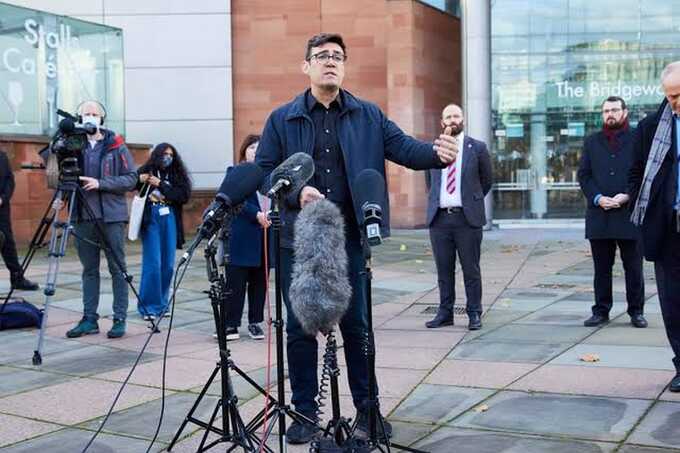
The next month, by the time they threatened a new, tougher Greater Manchester-wide lockdown without full furlough for its workers, the stage was set for a showdown. People had had enough. Burnham first called one press conference and then a second. “Go on Andy,” shouted a passer-by, as outside Manchester’s Bridgewater Hall Burnham railed against Johnson for ignoring “neglected”, low-paid, hard-working northerners.

The episode crystallised all Burnham’s strengths: the storytelling, the fight for the underdog, and knowing where the opportunity lay. “He is very good,” notes someone who knows him well, of his political instincts, “at spotting when a door is ajar.”
One official closely involved at the time says the pandemic showed Burnham could do detail and respond to a crisis thoughtfully, as well as instinctively. “One observation I’d make about Andy throughout that period,” they say, “is that while the statistics were very, very important, he never lost sight of the importance of human beings. That’s a very rare quality in a decision maker.”
He never did get any extra money out of the government. In the end, it didn’t matter. It was a moment of catharsis. A-boards advertised free pints for Burnham. A new avatar was created, later reused for his campaign in Makerfield. Vogue described what looked to me like a fairly ordinary coat as “an Orwellian Proletariat jacket in a deep navy hue, akin to garments worn by Winston in 1984”. Burnham’s most spectacular reinvention, into the “King of the North”, was complete. I’ve barely seen him in a suit since.
The day after Burnham’s storming victoryin Makerfield, I asked someone involved in his campaign how he had won. As much as anything, they said, he “likes people and people like him”.
Not long before that campaign, I saw him swamped by a crowd of middle-aged fanboys in a city centre bar, desperate to buy him a pint and canvass his opinions on football and craft ale. That popularity is real around here, as the result in Makerfield showed. If Burnham meets a person with a problem, says someone who has seen him at work, “he’ll do something about it. He’ll give out his number . . . How that works at Westminster scale, I don’t know, but it is genuine.”
That kind of emotional responsiveness is ultimately what drove both Burnham’s successes and failures in Manchester. Unlike Johnson, who knew his political persona was a construct, it often seemed to me that even when Burnham’s showboating sounded incoherent, there was often a sincerity in the moment. “It is fair, absolutely,” says one person who has worked closely with him here, of this theory. “It’s built on that personal connection with individuals. It’s almost that the last person he spoke to, if he’s sympathetic or agrees with them, there’s genuine sincerity and he decides to act on it.”
Others are a little less complimentary. “I used to always see him at the end of the day,” another person who worked with him as mayor says, “because if you saw him in the morning, he’d have moved on by the end of the afternoon.”
Either way, it is part of who he is. So when Burnham’s inconsistencies are ridiculed, he takes offence. “He hates that joke,” notes one MP, of a well-worn gag about his factional suppleness: A Blairite, a Brownite and a Corbynite walk into a bar. “What will you be having, Mr Burnham?” asks the bartender.

Alongside his instinct to avoid conflict, Burnham’s receptiveness helped him to hold Greater Manchester’s byzantine system together for a decade. When he talks about the lessons he has learnt here on the importance of collaboration, there is truth to it. “We didn’t end up in warfare,” recalls one person in the system. “It was edgy at times, but Andy’s power just grew once he understood.” He goes out, they add, with relations “stronger than ever”.
Unlike Starmer and his aides, Burnham and his right-hand man, Kevin Lee, never once, in the entire time I covered him, briefed against their own colleagues. Perhaps it was because Burnham’s fate was wrapped up in theirs, but he was savvy enough to resist the temptation. He was also, notably for readers in Whitehall, loved by his workforce. There are also other, less flattering comparisons to be made to Starmer. “As soon as stuff gets difficult,” notes one person familiar with the way Burnham and Lee worked in Manchester, “they disappear and go into a bunker, because that’s how they like it. It’s literally just the two of them.”
It also feels disconcerting that, after a decade of covering Burnham, I am unsure what he might do in government. As a mayor, he has had to make few unpopular decisions. “When there’s a clear right and wrong he can communicate extraordinarily,” says one politician who has seen him up close. “But when stuff is difficult and he doesn’t know where to be, he’s all over the place. He’s been busking for a decade.”
It’s hard to escape the fact that when he walked into Greater Manchester, Burnham inherited an existing project, one he has successfully presented to Labour loyalists as a rejection of neoliberalism and trickle-down economics. It was never that. But there are signs that he has genuinely bought into Manchester’s mantra that the country’s economic geography can and must be rebalanced. What that vision looks like from inside Number 10, what “re-industrialisation” really means in 2026, or where any of it fits into a governing philosophy, are open questions. More than one cautious northern optimist has mentioned Franklin D Roosevelt’s New Deal to me in recent days.
“The job he’s in, he’s very successful at it, because it plays to his strengths and his weaknesses are unscrutinised. And he’s safe,” said an official last week, while Burnham was still mayor. Does he realise that, I asked? “I don’t think he does,” they said. “What Andy’s got to work out now is can he do that as PM? And if he’s going to be like that as PM, who’s going to do the difficult stuff? He likes to be popular. Then the reality hits.”
A second person raised the same concern. “The worry is how he’s going to fare down there. He’s pretty thin-skinned. He likes to be loved. I’m not sure he’s very resilient.”
Greater Manchester will lose something. While Burnham’s record of delivering on his promises is not what he projects, he has injected a zeal into defining the city, not only to the rest of the country but to people here. For decades, local leaders had been quietly pulling in the same direction, but it was Burnham who sold their story to the masses.
Burnham’s strapline throughout his mayoralty, pilfered from the cult Manchester music scene film 24 Hour Party People, was “doing things differently”. It was by no means always accurate, but it played to the Mancunian tendency to self-mythologise — one Burnham shares. A lot now rides on him doing things differently on the national stage.
How far will he reinvent himself again? “It is our last chance to change,” he told jubilant supporters in Makerfield, the day after he swept to victory. Makerfield, he’d promised the night before, “will never be a stepping stone to me”. The words triggered a half-memory when I heard them on Thursday night. Curious, I returned to his remarks at a Labour mayoral hustings I chaired 10 years ago. The mayoralty was not a “political stepping stone”, Burnham had told Labour members gathered in Manchester Mechanics Institute. “This is Labour’s last chance to change.”
That change will now, at last, be in Burnham’s hands. He knew when the most important door of all, to No 10, was ajar. Which Andy Burnham walks through it will become clear soon enough.
Author: Andy Burnham.

Technology & Business Editor