31 July 2026 , 10:54
603
0
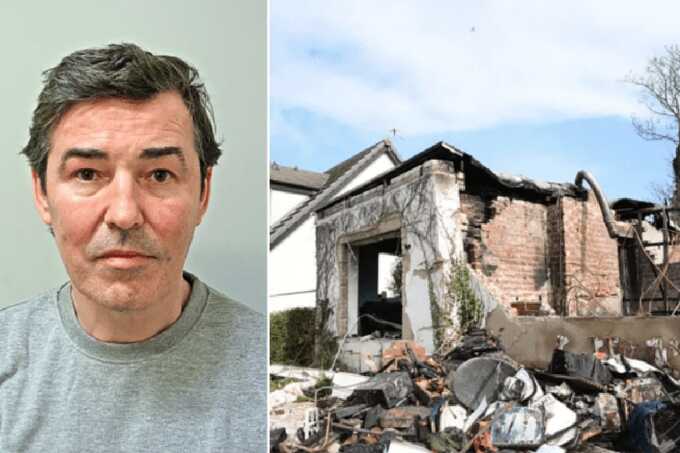
A man who blew up his childhood home in the mistaken belief he had been cut out of the family inheritance has been jailed.
Darren Davies, 55, poured petrol throughout the bedroom and attic of his £260,000 detached bungalow in Hambleton, Blackpool, on March 27.
He then set it alight with a candle and the resulting explosion engulfed it in flames, leaving glass and debris strewn across the road outside.
Davies emerged from the side of the house ‘miraculously uninjured’ and told a passer-by: ‘My family want the house. If I can’t have it, no-one can.’
He was jailed for four years yesterday, having pleaded guilty to arson being reckless as to whether life would be endangered.
Neighbours in the residential area were disturbed by a loud bang at about 9.50am as the property erupted into flames and plumes of thick black smoke appeared instantly, Preston Crown Court heard.
Witnesses also saw glass and debris ‘fly’ out in the blast, which severely damaged the bungalow as the roof collapsed into the rooms below.
Davies told neighbours, together with police and paramedics who quickly arrived on the scene, that he had wanted to kill himself.
Prosecutor Michael O’Brien said firefighters managed to bring the blaze under control before it could spread to other properties.
It was discovered that three gas cylinders had been placed in the kitchen, the front living room and one of the front bedrooms, the court was told.
Petrol was found in the loft and a candle had been lit.
Mr O’Brien said: ‘Due to the extent of the fire, it was not possible for the emergency services to determine the exact location at which the fire started.
‘It was concluded that the cause was the application of naked flame to combustible materials, with an ignitable liquid used to accelerate the development of the fire.
‘The force of the blast exposed people in the vicinity to a risk of life.’

His brother’s statement
In a victim personal statement, Craig Davies told the court that his parents had made wills which gave an equal share of the bungalow to himself and his brother.
He said he told his brother last year that he wanted to sell the property and ‘go our separate ways’ but said it ‘would not happen straightaway’.
Mr Davies said: ‘In early 2025, Darren developed the bizarre idea that there was a secret will signed by my dad in the last few months of his life leaving the house solely to myself.
‘This was a notion entirely of his making.
‘He continually accused me of being part of a plot against him.’
Craig Davies had earlier left home for work but received a WhatsApp message from a friend about 10 minutes after the blast which said his home had been ‘burnt to a crisp’.
Mr Davies, who was not in court, said a ‘deep feeling of despair came over me’ when he arrived at the scene.
He said: ‘The only thing that remained in fact was the extension that my dad had put in. That would have put a wry smile on his face.
‘Everything I owned in the house had been incinerated.
‘Darren has effectively erased everything that defined my life before March 27.’
Among treasured possessions lost in the fire were diaries he had kept from the age of 10, along with family photographs and his parents’ jewellery.

Mr Davies said he was ‘overwhelmed’ by the scale of the loss but also from the generosity of friends, neighbours and strangers.
He said: ‘Darren’s actions brought out the best of the community.’
He applied to the court for compensation from his brother for a sum of more than £170,000 including the half-share of the bungalow and £20,000 for the loss of his extensive CD collection.
Judge Philip Parry said the application was ‘too complex’ to determine immediately with outstanding issues relating to probate of the estate.
The court heard there are a total of four siblings, although only Darren and Craig were given a share of the bungalow.
The defendant was said to have a ‘long history’ of mental health difficulties including diagnoses of bipolar disorder, depression, anxiety and autism spectrum disorder.
A psychiatric report from the defence concluded he was mentally unwell at the time of setting the fire when he was overcome by an ‘autism crisis’.
Davies sent a letter to the judge in which he apologised to his brother and family, to the neighbours he ‘put at risk’, and the village of Hambleton.
Neil Ronan, defending, said: ‘It is merciful and lucky that I make this submission without anyone having been hurt – including him, as it was his plan to end his life.
‘For over a decade he was the primary carer for his ailing parents. He did regrettably become more alienated and spent more time in his room when he was not undertaking chores.’
The death of his parents was said to have been a ‘devastating blow’ for Davies who had worked ‘many years’ in the music industry in touring with bands before he was more recently employed in telesales.
Davies had historically failed to understand his mental health issues and found himself on a ‘slippery slope’, but had since gained insight.
Mr Ronan said the defendant had made ‘massive progress’ in custody since receiving psychiatric treatment and medication.
He said: ‘All is not lost for this man.’

Mr Ronan added his client was in no position to deal with questions of compensation.
‘When he is released, he is going to have rebuild his life from absolutely nothing,’ the barrister said.
Judge Parry told Davies it was ‘a sad and serious case’ but he took into account his guilty plea at the earliest opportunity and that his responsibility was ‘substantially reduced by your mental disorder’.
Davies must serve a maximum of half his sentence in custody with the remainder on licence.
Following sentence, Joanne Close of the Crown Prosecution Service said: ‘My thoughts are with Davies’s brother and the rest of the family as they continue to come to terms with the impact of this devastating incident.
‘Nothing can replace the memories and belongings lost in the home. His brother was left only with the personal items he had taken with him on his commute. Everything else he owned, and everything that had belonged to their parents, was destroyed.
‘The impact on his brother has been life-changing, and he has had to rely on the kindness of the community. Other family members have also suffered the loss of treasured family possessions and memories.’

Deputy Editor